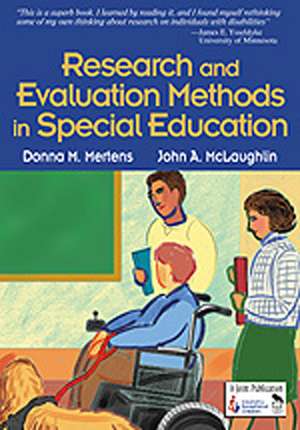
Research and Evaluation Methods in Special Education
Autor Donna M. Mertens, John A. McLaughlinen Limba Engleză Paperback – sep 2003
Subliniem, înainte de toate, importanța componentei aplicative a acestei lucrări: prin secțiunile dedicate de întrebări și activități de discuție de la finalul fiecărui capitol, Research and Evaluation Methods in Special Education transformă teoria în instrumente de lucru imediate. Într-o eră în care politicile guvernamentale pun un accent riguros pe cercetarea bazată pe dovezi științifice, volumul de față oferă claritatea necesară pentru a naviga prin complexitatea legislației IDEA (Individuals with Disabilities Education Act). Reținem că Donna M. Mertens nu se limitează la o simplă expunere a metodologiilor, ci analizează critic implicațiile etichetării elevilor ca fiind „la risc” sau cu dizabilități, oferind un cadru solid pentru dezvoltarea întrebărilor de cercetare. Considerăm că structura cărții este remarcabil de coerentă, pornind de la evaluarea programelor și trecând prin recenzia integrată a literaturii de specialitate, până la metode cantitative complexe și designuri de tip „single-case”. Această progresie permite cititorului să înțeleagă cum factorii contextuali unici din educația specială influențează interpretarea și raportarea datelor. Volumul extinde cadrul propus de The Essentials of Special Education Research de Professor Andrew M. Markelz prin adăugarea unei dimensiuni transformative și a unei analize mai profunde a populațiilor cu întârzieri în dezvoltare. În contextul operei sale, această lucrare face legătura între abordările teoretice din Program Evaluation Theory and Practice și viziunea sa despre echitate socială detaliată în Transformative Research and Evaluation. Este un ghid esențial care recalibrează modul în care cercetarea poate îmbunătăți direct serviciile educaționale pentru persoanele cu deficiențe funcționale.
Preț: 330.09 lei
Carte tipărită la comandă
Livrare economică 08-22 decembrie
Specificații
ISBN-10: 0761946535
Pagini: 298
Dimensiuni: 178 x 254 x 16 mm
Greutate: 0.53 kg
Ediția:New.
Editura: Corwin
Locul publicării:Thousand Oaks, United States
V-ar putea interesa
-
 The Lost ChildrenMary MaccrackenPreț: 59.05 lei
 -
 I Can't Do That!John LingPreț: 379.73 lei
 -
 The Learning Mentor's Resource BookKathy Hampson-8%Preț: 455.67 lei495.29 lei
 -
 Preț: 265.97 lei
 -
 Inclusion Strategies for Young ChildrenLorraine O. MoorePreț: 244.08 lei
 -
 Teaching Diverse LearnersAmy J MazurPreț: 308.04 lei
 -
 Teaching Play to Children with AutismLiz BeavanPreț: 473.22 lei
 -
 Ensuring Every Child MattersGianna KnowlesPreț: 456.86 lei
 -
 -19%Preț: 96.44 lei119.31 lei
 -
 -20%Preț: 95.65 lei119.42 lei
 -
 -20%Preț: 139.44 lei173.53 lei
 -
 -19%Preț: 125.35 lei155.59 lei
 -
 -19%Preț: 164.81 lei202.87 lei
 -
 Parenting ASD Teens: A Guide to Making it Up As You GoAndrew Schlegelmilch-19%Preț: 120.09 lei148.41 lei
 -
 -19%Preț: 136.34 lei167.30 lei
 -
 Martian in the PlaygroundClare SainsburyPreț: 325.59 lei
De ce să citești această carte
Această carte se adresează profesioniștilor, decidenților politici și studenților care doresc să fundamenteze intervențiile educaționale pe date riguroase. Cititorul câștigă capacitatea de a evalua critic studiile existente și de a proiecta cercetări care respectă standardele 'scientifically based research'. Este un instrument indispensabil pentru oricine dorește să transforme livrarea serviciilor în educația specială, asigurând o punte reală între cercetarea academică și practica la clasă.
Despre autor
Donna M. Mertens este profesor emerit la Universitatea Gallaudet, unde predă metode de cercetare și evaluare a programelor pentru studenți cu deficiențe de auz și auzitori. Expertiza sa este recunoscută la nivel internațional, fiind specializată în îmbunătățirea serviciilor de educație specială și promovarea incluziunii. Prin lucrările sale, Mertens a dezvoltat paradigma transformativă în cercetare, punând accent pe justiția socială și drepturile persoanelor cu dizabilități. Experiența sa vastă în evaluarea programelor educaționale și în lucrul direct cu populații diverse se reflectă în rigoarea și empatia cu care abordează metodologiile de cercetare.
Descriere scurtă
`This is a superb book. I learned by reading it, and I found myself rethinking some of my own thinking about research on individuals with disabilities' - James Ysseldyke, Professor, University of Minnesota
The purpose of this book is to enable the reader to use tools to design, conduct, and report research in a way that transforms, when appropriate, the delivery of special education. This book explores ways to adapt those research methods to the special education context by providing the reader with a framework for developing research questions and methods, as well as critically analyzing and conducting research focusing on the specific special education context. Unique contextual factors and populations in special education have implications for research conceptualization, design, implementation, interpretation, and reporting. Types of contextual issues specific to special education research that are addressed in this book are:
] The definition of who constitutes the special education population is not clear-cut. What are the implications of labeling someone "at risk" or disabled?
] How can appropriate identifications be made for such populations as developmentally delayed or learning disabled?
] What are the implications of conducting or critiquing research that addresses different types of functional impairments?
The audience for this book includes people who need information to support their decision-making. This includes those who set policy, administer and implement programmes, teach the students, and advocate for people with disabilities. For all these people, this book provides guidance in the conduct or critical analysis of research with special education populations. The populations that are included are primarily those that are eligible for funds under the federal government's classification system of special education students in the Individuals with Disabilities Education Act (IDEA) of 1997. Additionally, the text includes discussion of infants and toddlers with disabilities and persons with developmental delays and those at risk.
Recenzii
"This is a superb book. I learned by reading it, and I found myself rethinking some of my own thinking about research on individuals with disabilities."
"The authors have set for themselves a challenging task--to enable readers to design, conduct, report, and understand research in a way that transforms (when appropriate) the delivery of special education. What is even more amazing is it appears they have developed a guide that makes this task a reality."
Cuprins
Acknowledgments
About the Authors
1. Introduction
Questions and Activities for Application and Discussion
2. Program Evaluation
Questions and Activities for Application and Discussion
3. Literature Review
Purposes of the Literature Review
Resources to Support the Literature Review
Reporting the Literature Review Method
Aggregating Information for a Literature Review
The Integrated Literature Review
Questions to Critically Analyze the Literature Review
Questions and Activities for Application and Discussion
4. Quantitative Research Methods: Questions of Impact
Philosophical Assumptions Associated With Quantitative Research
Questions and Activities for Application and Discussion
5. Other Quantitative Approaches: Casual Comparative, Correlational, Single Case, and Survey Research
Causal Comparative and Correlational Research
Questions for Critically Analyzing Causal Comparative and Correlational Research
Questions for Critically Anaylzing Single-Case Designs
Survey Research
Questions for Critically Analyzing Survey Research
Questions and Activities for Application and Discussion
6. Qualitative Methods
Definition and Characteristics of Qualitative Methods
Importance of Qualitative Methods in Special Education Research
Philosophical Assumptions and Methodological Implications in Special Education Research
Qualitative Methods and Data Collection Strategies
Critically Analyzing Qualitative Research
Questions for Critically Analyzing Qualitative Research
Questions and Activities for Application and Discussion
7. Mixed Methods and Mixed Model Designs
Definitions and Characteristics
Questions and Activities for Application and Discussion
8. Identification and Selection of Research Participants
Population and Sample Definition
Designing and Selecting Samples
Generalizability, External Validity, and Transferability
Ethics and Confidentiality
Questions for Critically Analyzing Sample Design and Implementation
Questions and Activities for Application and Discussion
9. Information Collection
The Purpose of Information Collection
Technical Adequacy of Data Collection Instruments
Selecting and Using a Measurement Device
Questions for Critically Analyzing Information Collection Strategies and Instruments
Questions and Activities for Application and Discussion
10. Data Analysis, Interpretation, and Use
Quantitative Data Anaylsis
Challenges in Analysis and Interpretation
Responses to Analysis and Interpretation Challenges
Qualitative Data Analysis and Interpretation
Reporting Research
Beyond Reporting: Using Research Results
Questions for Critically Analyzing Data Analysis and Interpretation
Questions and Activities for Discussion and Application
Appendices
1. Federal Definitions for Individuals with Disabilities
2. Data Sources from Extant Data Bases
3. Definitions of Statistical Terms
4. Funding Resources
5. Proposal Outline
References
Index
Notă biografică
She conducts research and evaluation studies on such topics as improvement of special education services in international settings, planning for the inclusion of students with disabilities in neighborhood schools, enhancing the educational experiences of students with disabilities, preventing sexual abuse in residential schools for deaf students, improving access to the court systems for deaf and hard-of-hearing people, and improving the preparation of teachers of the deaf through appropriate use of instructional technology. Her research focuses on improving methods of inquiry by integrating the perspectives of those who have experienced oppression in our society. She draws on the writings of feminists, racial and ethnic minorities, and people with disabilities, as well as Indigenous peoples who have addressed the issues of power and oppression and their implications for research methodology.
Dr. Mertens has made numerous presentations at the meetings of the American Educational Research Association, American Evaluation Association, Australasian Evaluation Society, Association for College Educators of the Deaf and Hard of Hearing, International Sociological Association, Mixed Methods International Research Association, American Psychological Association, African Evaluation Association, Canadian Evaluation Society, Visitors Studies Association, and other organizations that explore these themes. She served as president and board member of the American Evaluation Association from 1997 to 2002 and as a member of the Board of Trustees for the International Organization for Cooperation in Evaluation, 2002-2003. She served as editor for the Journal of Mixed Methods Research 2009-2014.
Her publications include four edited volumes, Indigenous Pathways to Social Research (coedited with Fiona Cram and Bagele Chilisa, 2013), Handbook of Social Research Ethics (coedited with Pauline Ginsberg, 2009), Creative Ideas for Teaching Evaluation (1989), and Research and Inequality (coedited with Carole Truman and Beth Humphries, 2000), and several authored books, including Mixed Methods Design in Evaluation (2018), Program Evaluation: A Comprehensive Guide (2nd ed.) (with Amy Wilson, 2018), Transformative Research and Evaluation (2009), Research and Evaluation Methods in Special Education (coauthored with John McLaughlin, 2004), and Parents and Their Deaf Children (coauthored with Kay Meadow-Orlans and Marilyn Sass Lehrer, 2003). She also publishes many chapters and articles in edited volumes, encyclopedias, handbooks, and journals, such as Journal of Mixed Methods Research, Qualitative Social Work, Eye on Psi Chi, Educational Researcher, International Journal of Mixed Methods Research, New Directions for Program Evaluation, American Journal of Evaluation, American Annals of the Deaf, Studies in Educational Evaluation, and Educational Evaluation and Policy Analysis.