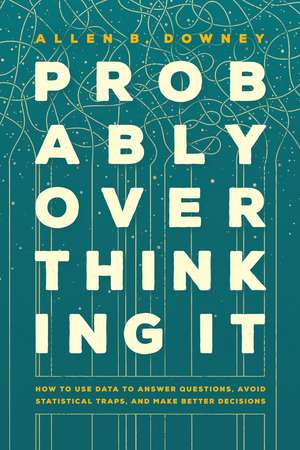
Probably Overthinking It: How to Use Data to Answer Questions, Avoid Statistical Traps, and Make Better Decisions
Autor Allen B. Downeyen Limba Engleză Paperback – 4 dec 2025
În capitolul dedicat paradoxurilor și pesimiștilor, remarcăm cum intuiția noastră dă greș în fața unor date aparent simple, o temă centrală a volumului Probably Overthinking It. Allen B. Downey propune o abordare vizuală a statisticii, înlocuind formulele matematice dense cu 126 de diagrame și 22 de tabele menite să clarifice mecanismele de decizie. Structura cărții ghidează cititorul de la interogații fundamentale despre normalitate și distribuții, trecând prin analiza cauzalității, până la fenomene complexe precum „coada lungă” a dezastrelor sau fereastra Overton.
Descoperim aici o metodologie care pune accentul pe date reale, de la modul în care sunt evaluate riscurile de cutremur până la interpretarea prognozelor medicale. Această lucrare acoperă aceeași arie tematică precum Is That a Fact? de Mark Battersby, însă se diferențiază printr-o abordare mult mai aplicată pe vizualizarea datelor și pe identificarea erorilor de gândire în rapoartele media contemporane. Față de The Art of Statistics de David Spiegelhalter, care oferă o privire de ansamblu asupra disciplinei, volumul lui Downey este un ghid corectiv, axat pe capcanele statistice specifice care duc la decizii politice sau personale eronate.
În contextul operei sale anterioare, dacă în Think Java sau Think Julia autorul se concentra pe rigoarea programării, în această lucrare el extinde conceptul de „gândire computațională” către sfera socială. Probably Overthinking It rafinează interesul pentru sistemele complexe explorat în Think Complexity, transformând analiza statistică dintr-un exercițiu academic într-un instrument esențial de navigare prin fluxul informațional zilnic.
Preț: 111.13 lei
Carte disponibilă
Livrare economică 05-19 noiembrie
Livrare express 21-27 octombrie pentru 59.52 lei
Specificații
ISBN-10: 0226845559
Pagini: 256
Ilustrații: 126 line drawings, 22 tables
Dimensiuni: 152 x 229 x 18 mm
Greutate: 0.39 kg
Ediția:First Edition
Editura: University of Chicago Press
Colecția University of Chicago Press
V-ar putea interesa
-
 How We Know What Isn't SoThomas Gilovich-11%Preț: 82.77 lei93.32 lei
 -
 How to Lie with StatisticsDarrell Huff-33%Preț: 61.38 lei91.39 lei
 -
 A Mathematician Reads the NewspaperJohn Allen PaulosPreț: 72.79 lei
 -
 Reckoning with RiskGerd Gigerenzer-19%Preț: 64.66 lei79.43 lei
 -
 The Drunkard's WalkLeonard MlodinowPreț: 92.91 lei
 -
 -28%Preț: 78.60 lei108.90 lei
 -
 On the EdgeNate SilverPreț: 107.37 lei
 -
 The Art of Statistics: Learning from DataDavid Spiegelhalter-30%Preț: 65.27 lei93.54 lei
 -
 When Everyone Knows That Everyone Knows...Steven PinkerPreț: 136.05 lei
 -
 Risk SavvyGerd Gigerenzer-31%Preț: 64.49 lei93.24 lei
 -
 A Field Guide to Lies and StatisticsDaniel Levitin-19%Preț: 64.25 lei79.07 lei
 -
 Naked StatisticsCharles WheelanPreț: 99.87 lei
 -
 Statistical: Ten Easy Ways to Avoid Being Misled By NumbersAnthony Reuben-27%Preț: 47.08 lei64.09 lei
 -
 -27%Preț: 57.66 lei78.70 lei
 -
 -25%Preț: 59.05 lei78.95 lei
 -
 -22%Preț: 270.20 lei347.99 lei
 -
 Statistics Done WrongAlex Reinhart-20%Preț: 136.47 lei170.35 lei
 -
 -19%Preț: 57.56 lei71.06 lei
 -
 The Tiger That Isn't: Seeing Through a World of NumbersAndrew Dilnot-20%Preț: 68.54 lei85.44 lei
 -
 Digressions in Elementary ProbabilityEdward Beltrami-18%Preț: 727.33 lei886.98 lei
De ce să citești această carte
Această carte este esențială pentru oricine dorește să înțeleagă numerele din spatele știrilor fără a fi expert în matematică. Veți câștiga capacitatea de a identifica rapid erorile de logică în sondaje sau rapoarte medicale. Este recomandată în special jurnaliștilor, factorilor de decizie și cititorilor curioși care vor să evite capcanele cognitive precum paradoxul lui Simpson, folosind vizualizarea datelor ca principal instrument de analiză.
Despre autor
Allen B. Downey este profesor de informatică la Olin College of Engineering și un educator recunoscut pentru abordările sale pragmatice în predarea științelor exacte. Cu o formare solidă la MIT și un doctorat obținut la U.C. Berkeley, Downey a predat anterior la instituții prestigioase precum Wellesley College și Colby College. Expertiza sa îmbină informatica, statistica și analiza sistemelor complexe, fiind autorul celebrei serii de manuale „Think”, care promovează învățarea prin practică și claritate conceptuală. Această experiență didactică se reflectă în capacitatea sa de a demistifica subiecte tehnice pentru un public larg.
Descriere scurtă
Statistics are everywhere: in news reports, at the doctor’s office, and in every sort of forecast, from the stock market to the weather. Blogger, teacher, and computer scientist Allen B. Downey knows well that people have an innate ability both to understand statistics and to be fooled by them. As he makes clear in this accessible introduction to statistical thinking, the stakes are big. Simple misunderstandings have led to incorrect medical prognoses, underestimated the likelihood of large earthquakes, hindered social justice efforts, and resulted in dubious policy decisions. There are right and wrong ways to look at numbers, and Downey will help you see which are which.
Probably Overthinking It uses real data to delve into real examples with real consequences, drawing on cases from health campaigns, political movements, chess rankings, and more. He lays out common pitfalls—like the base rate fallacy, length-biased sampling, and Simpson’s paradox—and shines a light on what we learn when we interpret data correctly, and what goes wrong when we don’t. Using data visualizations instead of equations, he builds understanding from the basics to help you recognize errors, whether in your own thinking or in media reports. Even if you have never studied statistics—or if you have and forgot everything you learned—this book will offer new insight into the methods and measurements that help us understand the world.
Notă biografică
Extras
Sometimes interpreting data is easy. For example, one of the reasons we know that smoking causes lung cancer is that when only 20% of the population smoked, 80% of people with lung cancer were smokers. If you are a doctor who treats patients with lung cancer, it does not take long to notice numbers like that.
But interpreting data is not always that easy. For example, in 1971 a researcher at the University of California, Berkeley, published a paper about the relationship between smoking during pregnancy, the weight of babies at birth, and mortality in the first month of life. He found that babies of mothers who smoke are lighter at birth and more likely to be classified as “low birthweight.” Also, low- birthweight babies are more likely to die within a month of birth, by a factor of 22. These results were not surprising.
However, when he looked specifically at the low- birthweight babies, he found that the mortality rate for children of smokers is lower, by a factor of two. That was surprising. He also found that among low-birthweight babies, children of smokers are less likely to have birth defects, also by a factor of 2. These results make maternal smoking seem beneficial for low- birthweight babies, somehow protecting them from birth defects and mortality. The paper was influential. In a 2014 retrospective in the International Journal of Epidemiology, one commentator suggests it was responsible for “holding up anti- smoking measures among pregnant women for perhaps a decade” in the United States. Another suggests it “postponed by several years any campaign to change mothers’ smoking habits” in the United Kingdom.
But it was a mistake. In fact, maternal smoking is bad for babies, low birthweight or not. The reason for the apparent benefit is a statistical error I will explain in chapter 7. Among epidemiologists, this example is known as the low-birthweight paradox. A related phenomenon is called the obesity paradox. Other examples in this book include Berkson’s paradox and Simpson’s paradox. As you might infer from the prevalence of “paradoxes,” using data to answer questions can be tricky. But it is not hopeless. Once you have seen a few examples, you will start to recognize them, and you will be less likely to be fooled. And I have collected a lot of examples.
So we can use data to answer questions and resolve debates. We can also use it to make better decisions, but it is not always easy. One of the challenges is that our intuition for probability is sometimes dangerously misleading. For example, in October 2021, a guest on a well- known podcast reported with alarm that “in the [United Kingdom] 70- plus percent of the people who die now from COVID are fully vaccinated.” He was correct; that number was from a report published by Public Health England, based on reliable national statistics. But his implication— that the vaccine is useless or actually harmful— is wrong.
Cuprins
1. Are You Normal? Hint: No
2. Relay Races and Revolving Doors
3. Defy Tradition, Save the World
4. Extremes, Outliers, and GOATs
5. Better Than New
6. Jumping to Conclusions
7. Causation, Collision, and Confusion
8. The Long Tail of Disaster
9. Fairness and Fallacy
10. Penguins, Pessimists, and Paradoxes
11. Changing Hearts and Minds
12. Chasing the Overton Window
Epilogue
Acknowledgments
Bibliography
Index
Recenzii
“By delving into the realms of probability and causality in an accessible, even enjoyable way, Downey provokes important questions. Readers of this book will not become data scientists overnight, but they will be able to begin asking questions like a statistician, taking a skeptical probe to the many oversimplified presentations of data available today.”