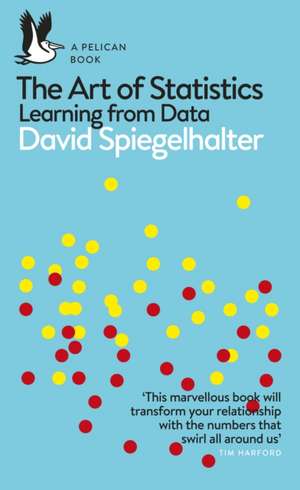
The Art of Statistics: Learning from Data
Autor David Spiegelhalteren Limba Engleză Paperback – 3 feb 2020
După parcurgerea acestui volum, cititorul va fi capabil să decripteze mecanismele din spatele titlurilor de presă alarmiste și să evalueze critic validitatea oricărui set de date prezentat ca adevăr absolut. Recomandăm The Art of Statistics nu ca pe un manual arid de matematică, ci ca pe un ghid esențial de supraviețuire intelectuală într-o lume saturată de informație. David Spiegelhalter reușește să transforme statistica dintr-o disciplină percepută adesea ca plictisitoare într-un instrument narativ fascinant. Merită menționat că autorul nu pornește de la formule, ci de la întrebări concrete: cum putem ști dacă spitalele mai aglomerate au rate de supraviețuire mai mici sau dacă screening-ul pentru cancer este cu adevărat benefic? Cititorul care a aplicat ideile din Naked Statistics de Charles Wheelan va găsi aici o aprofundare necesară, care trece dincolo de divertisment spre o metodologie riguroasă de interpretare a realității. În timp ce Wheelan mizează pe intuiție, Spiegelhalter ne învață rigoarea necesară pentru a nu fi păcăliți de coincidențe. Reținem că această lucrare reprezintă punctul culminant al carierei autorului, integrându-se perfect lângă The Art of Uncertainty. Dacă în lucrările anterioare, precum The Norm Chronicles, Spiegelhalter explora profilul omului mediu, aici el extinde perspectiva asupra întregii societăți prin lentila big data. Este o lectură care antrenează mintea să vadă modele acolo unde alții văd doar haos, oferind claritatea necesară în orice domeniu, de la medicină la politici publice.
Preț: 64.88 lei
Preț vechi: 93.38 lei
-31%
Carte disponibilă
Livrare economică 30 octombrie-10 noiembrie
Livrare express 14-20 octombrie pentru 50.65 lei
Specificații
ISBN-10: 0241258766
Pagini: 448
Dimensiuni: 112 x 180 x 28 mm
Greutate: 0.26 kg
Editura: Penguin Books
Colecția Pelican
Locul publicării:London, United Kingdom
V-ar putea interesa
-
 How to Lie with StatisticsDarrell Huff-33%Preț: 61.38 lei91.39 lei
 -
 Thinking, Fast and SlowDaniel Kahneman-27%Preț: 90.45 lei123.57 leiRecomandat
 -
 Statistics without TearsDerek Rowntree-32%Preț: 61.58 lei90.63 lei
 -
 -14%Preț: 99.18 lei114.69 lei
 -
 Machine LearningKevin P. Murphy-21%Preț: 714.20 lei902.37 lei
 -
 Deep LearningIan Goodfellow-20%Preț: 619.58 lei774.48 lei
 -
 Youth Strength TrainingAvery FaigenbaumPreț: 200.92 lei
 -
 English Literature in ContextPaul PoplawskiPreț: 257.44 lei
 -
 -10%Preț: 205.31 lei228.38 lei
 -
 Rational Emotive Behavior TherapyAlbert EllisPreț: 303.36 lei
 -
 Forget the Urgent!Matias BirrellPreț: 55.64 lei
 -
 Preț: 145.27 lei
 -
 Forest EcosystemsLee Zieger-15%Preț: 475.60 lei559.53 lei
 -
 The 4-Hour Work WeekTimothy Ferriss-23%Preț: 95.08 lei123.17 lei
 -
 TourismPeter Robinson-23%Preț: 678.09 lei880.64 lei
 -
 Python Machine LearningSebastian Raschka-20%Preț: 344.57 lei430.71 lei
 -
 Philosophies of Hospitality and TourismProkopis A. ChristouPreț: 345.78 lei
 -
 The Complete Guide to Joint-MakingJohn BullarPreț: 151.91 lei
 -
 The Advanced Business English GuideChristopher HillPreț: 104.30 lei
 -
 Web TechnologiesShruti KohliPreț: 227.94 lei
 -
 Parallel Programming with C# and .Net Core:Rishabh Verma Neha Shrivastava-20%Preț: 156.20 lei195.25 lei
De ce să citești această carte
Recomandăm această carte oricărui profesionist care lucrează cu date, dar și cetățeanului care dorește să nu mai fie manipulat de statistici scoase din context. Veți câștiga o metodă clară de a distinge între corelație și cauzalitate, învățând să puneți întrebările corecte în fața oricărui grafic. Este un instrument de alfabetizare numerică esențial pentru jurnaliști, medici și decidenți politici.
Despre autor
David Spiegelhalter este unul dintre cei mai respectați statisticieni britanici, fiind profesor emerit la Universitatea Cambridge. Expertiza sa în comunicarea riscului și a dovezilor statistice l-a transformat într-o figură publică de referință, fiind adesea consultat de instituții media precum BBC pentru a clarifica date complexe. În lucrări precum Covid By Numbers și The Art of Uncertainty, el a demonstrat o capacitate rară de a face știința accesibilă fără a-i sacrifica rigoarea. Pentru contribuțiile sale remarcabile în domeniu, a fost înnobilat, purtând titlul de Sir David Spiegelhalter.
Notă biografică
Recenzii
There is something in here for everyone ... A call to arms for greater societal data literacy ... Spiegelhalter's work serves as a reminder that there are passionate, self-aware statisticians who can argue eloquently that their discipline is needed now more than ever.
Shines a light on how we can use the ever-growing deluge of data to improve our understanding of the world . . . The Art of Statistics will serve students well. And it will be a boon for journalists eager to use statistics responsibly - along with anyone who wants to approach research and its reportage with healthy scepticism.
What David Spiegelhalter does here is provide a very thorough introductory grounding in statistics without making use of mathematical formulae. And it's remarkable. Spiegelhalter is warm and encouraging - it's a genuinely enjoyable read ... This book should be required reading for all politicians, journalists, medics and anyone who tries to influence people (or is influenced) by statistics. A tour de force.
The Art of Statistics is in the great educational tradition of its publishing imprint, Pelican Books: an attempt to get everyone up to speed with the practical uses of statistics, without pages of terrifying equations or Greek letters. In a series of spry, airy chapters, he succeeds fabulously ... Lucid and readable. In an age of scientific clickbait, 'big data' and personalised medicine, this is a book that nearly everyone would benefit from reading.
Important and comprehensive
This is an excellent book. Spiegelhalter is great at explaining difficult ideas . . . Yes, statistics can be difficult. But much less difficult if you read this book.
Like the fictional investigator Sherlock Holmes, Spiegelhalter takes readers on a trail to challenge methodology and stats thrown at us by the media and others. But where other authors have attempted this and failed, he is inventive and clever in picking the right examples that spark the reader's interest to become active on their own.
Do you trust headlines telling you . . . that bacon, ham and sausages carry the same cancer risk as cigarettes? No, nor do I. That is why we need a book like this that explains how such implausible nonsense arises in the first place. Written by a master of the subject . . . this book tells us to examine our assumptions. Bravo.
Descriere scurtă
'Required reading for all politicians, journalists, medics and anyone who tries to influence people (or is influenced) by statistics. A tour de force' Popular Science
Do busier hospitals have higher survival rates? How many trees are there on the planet? Why do old men have big ears? David Spiegelhalter reveals the answers to these and many other questions - questions that can only be addressed using statistical science.
Statistics has played a leading role in our scientific understanding of the world for centuries, yet we are all familiar with the way statistical claims can be sensationalised, particularly in the media. In the age of big data, as data science becomes established as a discipline, a basic grasp of statistical literacy is more important than ever.
In The Art of Statistics, David Spiegelhalter guides the reader through the essential principles we need in order to derive knowledge from data. Drawing on real world problems to introduce conceptual issues, he shows us how statistics can help us determine the luckiest passenger on the Titanic, whether serial killer Harold Shipman could have been caught earlier, and if screening for ovarian cancer is beneficial.
'Shines a light on how we can use the ever-growing deluge of data to improve our understanding of the world' Nature