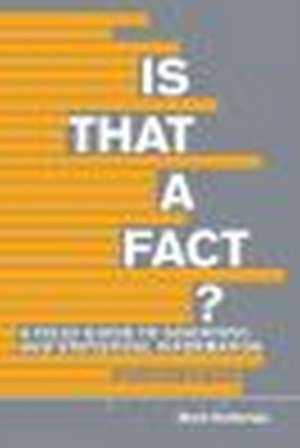
Is That a Fact? - Second Edition: A Field Guide to Statistical and Scientific Information
Autor Mark Battersbyen Limba Engleză Paperback – 4 mar 2016
Preț: 270.20 lei
Preț vechi: 347.99 lei
-22%
Puncte Express: 405
Carte disponibilă
Livrare economică 07-21 noiembrie
Livrare express 24-30 octombrie pentru 111.05 lei
Livrare prin curier în România Termenul estimat este afișat lângă disponibilitate.
Transport gratuit de la 400.00 lei Plată online sau ramburs, în funcție de opțiunile comenzii.
Retur gratuit în 14 zile Comandă securizată și suport în română.
Specificații
ISBN-13: 9781554812448
ISBN-10: 1554812445
Pagini: 304
Dimensiuni: 152 x 229 x 14 mm
Greutate: 0.36 kg
Ediția:2
Editura: BROADVIEW PR
Colecția Broadview Press
Locul publicării:Peterborough, Canada
ISBN-10: 1554812445
Pagini: 304
Dimensiuni: 152 x 229 x 14 mm
Greutate: 0.36 kg
Ediția:2
Editura: BROADVIEW PR
Colecția Broadview Press
Locul publicării:Peterborough, Canada
V-ar putea interesa
-
 -27%Preț: 659.15 lei902.94 lei
 -
 Net-Generation Student Motivation to Attend Community CollegeShalom Michael Akili-30%Preț: 376.37 lei534.82 lei
 -
 Preț: 218.14 lei
 -
 The Essentials of StatisticsJoseph Healey-22%Preț: 544.21 lei696.36 lei
 -
 Performing Action: Artistry in Human Behavior and Social ResearchJoseph R. GusfieldPreț: 247.16 lei
 -
 A Good Book, in TheoryAlan SearsPreț: 290.22 lei
 -
 -8%Preț: 362.57 lei394.09 lei
 -
 Critical Qualitative Inquiry: Foundations and FuturesGaile S Cannella-18%Preț: 1156.39 lei1410.23 lei
 -
 Critical Qualitative Inquiry: Foundations and FuturesGaile S CannellaPreț: 379.59 lei
 -
 For EthnographyPaul Atkinson-23%Preț: 596.55 lei774.74 lei
 -
 Preț: 307.90 lei
 -
 Child and NationKatharine Throssell-15%Preț: 513.26 lei603.84 lei
 -
 Preț: 420.81 lei
 -
 Preț: 283.97 lei
 -
 Preț: 412.14 lei
Recenzii
How much should we trust the polls on the latest electoral campaign? When a physician tells us that a diagnosis of cancer is 90% certain or a nutritionist tells us what is healthy to eat, what should we believe? Questions such as these are greatly important, yet many of us have only a vague sense of how to answer them. In Is That a Fact?, Mark Battersby aims not only to explain how to identify misleading statistics and research, but also to give readers the understanding necessary to evaluate and use statistical information in their own decision making. This second edition is revised and updated throughout and includes a new chapter on weighing risk in personal and public decision making.
Praise for Is That A Fact:
“Is That a Fact? is conceived as an updating for the Internet Age of Darrell Huff’s immensely popular 1954 classic, How to Lie with Statistics, with a somewhat broader focus…. Huff’s book has sold more than a million copies. Is That a Fact? deserves a similarly large readership.” — David Hitchcock, McMaster University, in Informal Logic
“Using timely and important examples, Professor Battersby provides a careful and well-documented discussion of statistics, and does this without sacrificing liveliness or readability. Is That a Fact? is a fascinating book about statistics to give to all your friends.” — Trudy Govier, University of Lethbridge
“A delightful discussion that beautifully clarifies what is all too often confusing or just plain confused. The book will help ordinary citizens to better understand and evaluate all sorts of scientific claims as they occur in the popular press and public policy debates. Hats off to Mark Battersby!” — Harvey Siegel, University of Miami
“Mark Battersby’s Is That a Fact? is not a statistics book, but rather a book that will help thoughtful people to better notice the actual grounds (or lack thereof) of claims they are called upon or inclined to believe. This second edition adds new material (such as that on internet polling) and new and better graphics.” — David Weber, Portland State University
“One of the intellectual currents of our time has been a revolution in the study of reasoning and argument. Philosophers and other academics have broadened their horizons and turned their attention to the study and analysis of the reasoning, arguments, and attempts at persuasion that inundate our lives. Mark Battersby has been an integral part of the movement in this direction. In Is That a Fact? he provides an engaging and thoroughly readable introduction to critical thinking on statistical and scientific claims. It can usefully inform the thinking of everyone who has to contend with such claims in their professional or personal lives.” — Leo Groarke, President of Trent University
Praise for Is That A Fact:
“Is That a Fact? is conceived as an updating for the Internet Age of Darrell Huff’s immensely popular 1954 classic, How to Lie with Statistics, with a somewhat broader focus…. Huff’s book has sold more than a million copies. Is That a Fact? deserves a similarly large readership.” — David Hitchcock, McMaster University, in Informal Logic
“Using timely and important examples, Professor Battersby provides a careful and well-documented discussion of statistics, and does this without sacrificing liveliness or readability. Is That a Fact? is a fascinating book about statistics to give to all your friends.” — Trudy Govier, University of Lethbridge
“A delightful discussion that beautifully clarifies what is all too often confusing or just plain confused. The book will help ordinary citizens to better understand and evaluate all sorts of scientific claims as they occur in the popular press and public policy debates. Hats off to Mark Battersby!” — Harvey Siegel, University of Miami
“Mark Battersby’s Is That a Fact? is not a statistics book, but rather a book that will help thoughtful people to better notice the actual grounds (or lack thereof) of claims they are called upon or inclined to believe. This second edition adds new material (such as that on internet polling) and new and better graphics.” — David Weber, Portland State University
“One of the intellectual currents of our time has been a revolution in the study of reasoning and argument. Philosophers and other academics have broadened their horizons and turned their attention to the study and analysis of the reasoning, arguments, and attempts at persuasion that inundate our lives. Mark Battersby has been an integral part of the movement in this direction. In Is That a Fact? he provides an engaging and thoroughly readable introduction to critical thinking on statistical and scientific claims. It can usefully inform the thinking of everyone who has to contend with such claims in their professional or personal lives.” — Leo Groarke, President of Trent University
Cuprins
Acknowledgements
Introduction
CHAPTER 1: How to Li(v)e with Statistics: Why We Need to Think about Statistical and Scientific Information
CHAPTER 2: Introduction to Critical Thinking
CHAPTER 3: Polling: The Basics
CHAPTER 4: Sampling Woes and Other Biases
CHAPTER 5: The Facts Ma’am, Nothing but the Facts: Getting Good Data
CHAPTER 6: Making Sense of Data: What Does It All Mean?
CHAPTER 7: The Power of Graphs
CHAPTER 8: Correlations: What Goes with What?
CHAPTER 9: Finding the Cause: Evaluating Causal Claims
CHAPTER 10: Evaluating Scientific Claims: Looking at the Context
CHAPTER 11: Using What You’ve Learned: Finding and Evaluating Scientific Information
CHAPTER 12: Probability and Judgement
CHAPTER 13: Studies Show, But So What?
CHAPTER 14: Decision Making Examples: Individual Risk and Uncertainty and Public Policy
Glossary
Index
Introduction
CHAPTER 1: How to Li(v)e with Statistics: Why We Need to Think about Statistical and Scientific Information
CHAPTER 2: Introduction to Critical Thinking
CHAPTER 3: Polling: The Basics
CHAPTER 4: Sampling Woes and Other Biases
CHAPTER 5: The Facts Ma’am, Nothing but the Facts: Getting Good Data
CHAPTER 6: Making Sense of Data: What Does It All Mean?
CHAPTER 7: The Power of Graphs
CHAPTER 8: Correlations: What Goes with What?
CHAPTER 9: Finding the Cause: Evaluating Causal Claims
CHAPTER 10: Evaluating Scientific Claims: Looking at the Context
CHAPTER 11: Using What You’ve Learned: Finding and Evaluating Scientific Information
CHAPTER 12: Probability and Judgement
CHAPTER 13: Studies Show, But So What?
CHAPTER 14: Decision Making Examples: Individual Risk and Uncertainty and Public Policy
Glossary
Index