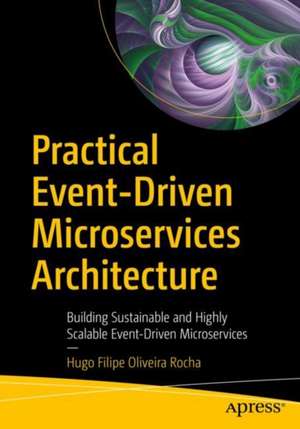
Practical Event-Driven Microservices Architecture
Autor Hugo Filipe Oliveira Rochaen Limba Engleză Paperback – 11 noi 2021
Actualizarea perspectivei asupra sistemelor distribuite devine critică în contextul actual, unde trecerea de la un monolit la o arhitectură bazată pe evenimente este adesea comparată de autorul Hugo Filipe Oliveira Rocha cu straturile unei cepe: gestionabilă la suprafață, dar extrem de complexă și provocatoare pe măsură ce avansăm în profunzime. Practical Event-Driven Microservices Architecture nu se rezumă la teorie, ci reprezintă un ghid prescriptiv fundamentat pe gestionarea unor platforme cu milioane de utilizatori. Putem afirma că volumul se distinge prin pragmatismul cu care abordează „punctele de durere” ale sistemelor decuplate. Ca și Adam Bellemare în Building Event–Driven Microservices, autorul distilează experiență reală în principii acționabile, punând un accent deosebit pe importanța schemei de evenimente încă de la începutul proiectului pentru a preveni rescrieri costisitoare. Structura logică a cărții facilitează o progresie naturală: primele capitole stabilesc fundamentele și strategiile de migrare, capitolele de mijloc (4-7) detaliază tiparele structurale, consistența eventuală și reziliența, în timp ce secțiunile finale abordează interfața cu utilizatorul și, crucial, asigurarea calității (QA) în medii distribuite. Reținem atenția acordată detaliilor tehnice fine, precum gestionarea mesajelor care ajung în afara ordinii cronologice sau soluționarea conflictelor de concurență. Merită menționat că, spre deosebire de alte lucrări care tratează microserviciile în mod generic, Hugo Filipe Oliveira Rocha oferă soluții specifice pentru medii cu throughput ridicat, unde fiabilitatea procesării evenimentelor este vitală pentru sustenabilitatea pe termen lung a întregului ecosistem digital.
Preț: 329.74 lei
Preț vechi: 412.18 lei
-20%
Carte disponibilă
Livrare economică 13-27 noiembrie
Livrare express 29 octombrie-04 noiembrie pentru 115.98 lei
Specificații
ISBN-10: 1484274679
Pagini: 472
Ilustrații: XX, 449 p. 143 illus.
Dimensiuni: 178 x 254 x 26 mm
Greutate: 0.88 kg
Ediția:First Edition
Editura: Apress
Locul publicării:Berkeley, CA, United States
V-ar putea interesa
-
 -20%Preț: 371.52 lei464.39 lei
 -
 Clean ArchitectureRobert C. Martin-20%Preț: 236.92 lei296.15 lei
 -
 -20%Preț: 305.24 lei381.55 lei
 -
 -20%Preț: 279.02 lei348.77 lei
 -
 On the Foundations of ComputingGiuseppe Primiero-17%Preț: 401.43 lei481.14 lei
 -
 Domain-Driven DesignEric J. Evans-20%Preț: 423.02 lei528.78 lei
 -
 Patterns of Enterprise Application ArchitectureMartin Fowler-20%Preț: 396.95 lei496.18 lei
 -
 Enterprise Integration PatternsGregor Hohpe-20%Preț: 398.67 lei498.33 lei
 -
 Computational Intelligence in Healthcare ApplicationsRajeev Agrawal-28%Preț: 839.26 lei1161.12 lei
 -
 Blockchain Chicken FarmXiaowei WangPreț: 93.56 lei
 -
 Qualitative Simulation Modeling and AnalysisPaul A. Fishwick-20%Preț: 623.39 lei779.23 lei
 -
 Possible Minds: Twenty-Five Ways of Looking at AIJohn Brockman-36%Preț: 83.27 lei129.23 lei
 -
 -53%Preț: 45.82 lei97.00 lei
 -
 FPGA SimulationRay Salemi-8%Preț: 487.69 lei530.09 lei
 -
 The Zynq BookLouise H. CrockettPreț: 297.25 lei
 -
 Algorithms Illuminated (Part 2)Tim Roughgarden-20%Preț: 89.06 lei111.32 lei
 -
 -20%Preț: 376.11 lei470.14 lei
 -
 Mueller, J: Machine Learning For DummiesJohn Paul Mueller-20%Preț: 176.20 lei220.25 lei
 -
 Database SystemsRamez Elmasri-20%Preț: 552.09 lei690.12 lei
 -
 Building MicroservicesSam Newman-20%Preț: 402.00 lei502.50 lei
 -
 Fundamentals of Software ArchitectureMark Richards-20%Preț: 361.37 lei451.71 lei
 -
 -20%Preț: 297.58 lei371.97 lei
 -
 Tmux 2Brian Hogan-20%Preț: 129.36 lei161.69 lei
 -
 The Revolutionary PhenotypeJean-François GariépyPreț: 122.50 lei
 -
 AdventureJamie LendinoPreț: 117.78 lei
 -
 Preț: 438.57 lei
 -
 Advances in Conceptual ModelingSilvana Castano-20%Preț: 341.85 lei427.31 lei
 -
 Peeling Design PatternsNarasimha KarumanchiPreț: 314.94 lei
De ce să citești această carte
Această carte este esențială pentru inginerii software și arhitecții care doresc să stăpânească complexitatea sistemelor distribuite. Cititorul câștigă o strategie deliberată pentru migrarea de la monolit și acces la sute de tipare verificate în producție pentru a asigura scalabilitatea. Este recomandarea noastră pentru oricine trebuie să gestioneze consistența datelor și fiabilitatea într-o arhitectură cu sute de microservicii care comunică asincron.
Despre autor
Hugo Filipe Oliveira Rocha este un expert în arhitectură software, specializat în sisteme distribuite și microservicii bazate pe evenimente. Cu o experiență vastă în lucrul cu platforme de mare anvergură, deservind milioane de utilizatori, Rocha s-a remarcat prin capacitatea de a transforma arhitecturi monolitice rigide în soluții scalabile și flexibile. Expertiza sa practică este reflectată în abordarea orientată spre rezolvarea problemelor reale de concurență și consistență, fiind un promotor al strategiilor de design sustenabile în cadrul comunității de dezvoltatori și arhitecți IT.
Descriere scurtă
This prescriptive guide takes you through the steps of moving a platform with millions of users from a monolith to a microservices event-driven architecture. You will learn about the challenges and complexities that arise in high-throughput environments that often contain upwards of hundreds of microservices. This book is designed to be your single best resource for learning how to apply event-driven architectures in real-world scenarios and offers hundreds of patterns to overcome the common and not so common challenges.
While event-driven architectures have been the standard for decoupled, pluggable, evolutionary architectures for years, they have onlyrecently been adopted by enterprises for the purpose of distributed microservices and there is little information about adopting them. Using them at scale can save valuable resources, but requires different considerations, including the added complexity of supporting several moving parts and getting the event schema right from the start in order to avoid large restructuring later on.
Author Hugo Rocha understands that these kinds of challenges, as well as many others, need to be considered from the beginning, and helps teach you the mindset needed to create a deliberate strategy upfront. This book offers learning approaches and patterns to get you up to speed in order to sustainably build and manage event-driven architectures.
What You Will Learn
- Understand the real-world challenges of event-driven architectures and the patterns to deal with those challenges and the trade-offs of each solution
- Leverage the advantages of event-driven architectures to build scalable solutions and address legacy applications
- Plan successful future implementations to avoid common pitfalls and apply proven patterns to deal with challenges in a real-world platform with millions of users
- Decide whether event-driven solutions are the right choice for the requirements at hand
- Discuss and understand advanced concepts about event-driven architectures