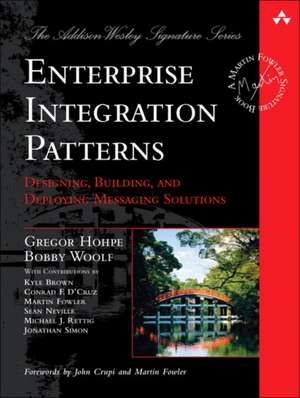
Enterprise Integration Patterns
Autor Gregor Hohpe, Bobby Woolfen Limba Engleză Hardback – 2004
Ne-a atras atenția, încă din primele capitole, modul în care Enterprise Integration Patterns transformă teoria abstractă în practică prin studiul de caz al unui sistem de tranzacționare de obligațiuni. Acest exercițiu complex demonstrează cum modelele de proiectare pot fi aplicate pentru a gestiona fluxuri de date masive în timp real, oferind o soluție concretă pentru problemele de latență și fiabilitate. Reținem faptul că autorii nu se limitează la descrieri textuale, ci introduc o notație vizuală standardizată, esențială pentru orice arhitect care dorește să comunice clar structura unui sistem distribuit. Cartea este organizată riguros, pornind de la conceptele fundamentale de mesagerie în capitolul 3, trecând prin construcția și rutarea mesajelor, până la strategii avansate de gestionare a punctelor terminale (endpoints). Cititorul care a aplicat deja ideile teoretice din Enterprise Systems Integration de Diogo R. Ferreira va găsi aici instrumentele practice necesare pentru implementare, beneficiind de un catalog de 65 de modele verificate în medii de producție. În timp ce alte lucrări, precum Just Spring Integration, se concentrează pe un singur framework Java, lucrarea lui Gregor Hohpe și Bobby Woolf oferă o perspectivă tehnologică agnostică, acoperind ecosisteme diverse precum JMS, MSMQ sau SOAP. În contextul operei lui Gregor Hohpe, acest volum reprezintă fundamentul tehnic pe care s-a construit ulterior viziunea sa strategică din The Software Architect Elevator. Dacă lucrarea mai recentă explorează rolul arhitectului în transformarea organizațională, volumul de față rămâne ancora tehnică indispensabilă pentru înțelegerea sistemelor asincrone. Recomandăm parcurgerea secțiunilor despre „Competing Consumers” și „Message Store” pentru a înțelege cum pot fi procesate mesajele concurent fără a compromite integritatea datelor, o provocare majoră în arhitecturile moderne de tip microservicii.
Preț: 398.67 lei
Preț vechi: 498.33 lei
-20%
Carte disponibilă
Livrare economică 03-17 noiembrie
Livrare express 20-24 octombrie pentru 71.22 lei
Specificații
ISBN-10: 0321200683
Pagini: 480
Dimensiuni: 186 x 238 x 42 mm
Greutate: 1.38 kg
Ediția:1
Editura: ADDISON-WESLEY
Colecția Pearson Professional
Locul publicării:Boston, United States
V-ar putea interesa
-
 -20%Preț: 365.08 lei456.35 lei
 -
 -20%Preț: 641.11 lei801.39 lei
 -
 Domain-Driven DesignEric J. Evans-20%Preț: 423.02 lei528.78 lei
 -
 Patterns of Enterprise Application ArchitectureMartin Fowler-20%Preț: 396.95 lei496.18 lei
 -
 Java Concurrency in PracticeBrian Goetz-20%Preț: 294.27 lei367.84 lei
 -
 -20%Preț: 339.53 lei424.41 lei
 -
 Implementing Domain-Driven DesignVaughn Vernon-20%Preț: 367.42 lei459.27 lei
 -
 Managing the Testing ProcessRex Black-20%Preț: 235.94 lei294.93 lei
 -
 Lessons Learned in Software Testing - A Context- Driven ApproachBret Pettichord-20%Preț: 258.03 lei322.54 lei
 -
 Head First EJBKathy Sierra-20%Preț: 263.18 lei328.97 lei
 -
 Java SOA CookbookEben Hewitt-20%Preț: 277.91 lei347.39 lei
 -
 Java Message ServiceMark Richards-20%Preț: 203.21 lei254.01 lei
 -
 Code Complete: A practical handbook of software constructionSteve McConnell-20%Preț: 285.38 lei356.73 lei
 -
 -20%Preț: 627.14 lei783.93 lei
 -
 Pro JPA 2Mike Keith-20%Preț: 399.39 lei499.23 lei
De ce să citești această carte
Recomandăm această carte arhitecților software și dezvoltatorilor care gestionează sisteme distribuite complexe. Cititorul câștigă un vocabular tehnic comun și o metodologie vizuală pentru a descrie soluțiile de integrare. Este o resursă esențială pentru a evita capcanele sistemelor asincrone, oferind soluții probate pentru rutare, transformare și monitorizarea sănătății sistemelor de mesagerie, indiferent de tehnologia utilizată.
Despre autor
Gregor Hohpe și Bobby Woolf sunt experți recunoscuți în arhitectura sistemelor de întreprindere, cu o experiență vastă în implementarea soluțiilor de mesagerie. Gregor Hohpe este cunoscut pentru capacitatea sa de a face legătura între deciziile tehnice de nivel scăzut și strategia de business, concept explorat pe larg în lucrarea sa The Software Architect Elevator. Bobby Woolf, co-autor al unor lucrări fundamentale despre design patterns, aduce rigoarea necesară documentării soluțiilor software reutilizabile. Împreună, aceștia au definit standardul de facto în industria IT pentru integrarea aplicațiilor prin mesagerie asincronă.
Textul de pe ultima copertă
Would you like to use a consistent visual notation for drawing integration solutions? "Look inside the front cover." Do you want to harness the power of asynchronous systems without getting caught in the pitfalls? "See "Thinking Asynchronously" in the Introduction." Do you want to know which style of application integration is best for your purposes? "See Chapter 2, Integration Styles." Do you want to learn techniques for processing messages concurrently? "See Chapter 10, Competing Consumers and Message Dispatcher." Do you want to learn how you can track asynchronous messages as they flow across distributed systems? "See Chapter 11, Message History and Message Store." Do you want to understand how a system designed using integration patterns can be implemented using Java Web services, .NET message queuing, and a TIBCO-based publish-subscribe architecture? "See Chapter 9, Interlude: Composed Messaging."
Utilizing years of practical experience, seasoned experts Gregor Hohpe and Bobby Woolf show how asynchronous messaging has proven to be the best strategy for enterprise integration success. However, building and deploying messaging solutions presents a number of problems for developers. " Enterprise Integration Patterns " provides an invaluable catalog of sixty-five patterns, with real-world solutions that demonstrate the formidable of messaging and help you to design effective messaging solutions for your enterprise.
The authors also include examples covering a variety of different integration technologies, such as JMS, MSMQ, TIBCO ActiveEnterprise, Microsoft BizTalk, SOAP, and XSL. A case study describing a bond trading system illustrates the patterns in practice, and the book offers a look at emerging standards, as well as insights into what the future of enterprise integration might hold.
This book provides a consistent vocabulary and visual notation framework to describe large-scale integration solutions across many technologies. It also explores in detail the advantages and limitations of asynchronous messaging architectures. The authors present practical advice on designing code that connects an application to a messaging system, and provide extensive information to help you determine when to send a message, how to route it to the proper destination, and how to monitor the health of a messaging system. If you want to know how to manage, monitor, and maintain a messaging system once it is in use, get this book.
0321200683B09122003
Notă biografică
Gregor Hohpe leads the enterprise integration practice at ThoughtWorks, Inc., a specialized provider of application development and integration services. Drawing from his extensive experience designing and implementing integration solutions for enterprise clients, Gregor has published a number of papers and articles presenting a no-hype view on enterprise integration, Web services, and Service-Oriented Architectures. He is a frequent speaker at technical conferences around the world.
Bobby Woolf is coauthor of The Design Patterns Smalltalk Companion (Addison-Wesley, 1998), and author of articles in IBM DeveloperWorks, Java Developer's Journal, and elsewhere. He has been a tutorial presenter at OOPSLA, JavaEdge, and Smalltalk Solutions, among other conferences.
0321200683AB09122003
Cuprins
- 1. Solving Integration Problems Using Patterns
- 2. Integration Styles
- 3. Messaging Systems
- 4. Messaging Channels
- 5. Message Construction
- 6. Interlude: Simple Messaging
- 7. Message Routing
- 8. Message Transformation
- 9. Interlude: Composed Messaging
- 10. Messaging Endpoints
- 11. System Management
- 12. Interlude: System Management Example
- 13. Integration Patterns in Practice
- 14. Concluding Remarks