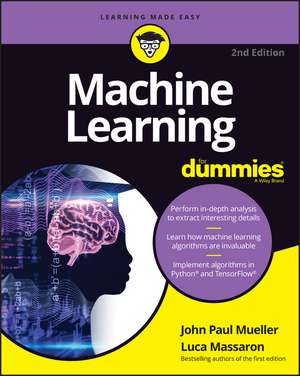
Mueller, J: Machine Learning For Dummies
Autor John Paul Mueller, Luca Massaronen Limba Engleză Paperback – 8 apr 2021
Merită menționat că Mueller, J: Machine Learning For Dummies este conceput ca un punct de intrare accesibil pentru cei care nu dețin experiență prealabilă în programare sau statistică avansată, presupunând doar o alfabetizare digitală de bază. Remarcăm o abordare progresivă, care demistifică complexitatea matematică din spatele algoritmilor, fără a sacrifica rigoarea tehnică necesară pentru a construi modele funcționale. Pe linia practică a volumului Introduction to Machine Learning with Python, dar cu focus pe ecosistemul Wiley care prioritizează accesibilitatea, această lucrare ghidează cititorul prin întregul flux de lucru al unui specialist în date.
Suntem de părere că structura cărții este unul dintre punctele sale forte. Autorii John Paul Mueller și Luca Massaron organizează materialul în cinci secțiuni logice: începând cu contextul istoric și terminând cu rezolvarea problemelor complexe de business. Capitolele dedicate uneltelor de lucru (Python 3.8, TensorFlow 2.x și Google Colab) sunt esențiale pentru configurarea corectă a mediului de dezvoltare, în timp ce secțiunile de matematică explică vizual concepte precum gradient descent. Spre deosebire de alte manuale care utilizează seturi de date învechite, ediția a doua folosește date actuale pentru a ilustra aplicații în rețele neuronale și Support Vector Machines (SVM). Ritmul este constant, axat pe aplicabilitate imediată în domenii precum publicitatea în timp real sau analiza predictivă, oferind o bază solidă pentru oricine dorește să înțeleagă motorul tehnologic al viitorului.
Preț: 176.20 lei
Preț vechi: 220.25 lei
-20%
Carte disponibilă
Livrare economică 17 noiembrie-01 decembrie
Specificații
ISBN-10: 1119724015
Pagini: 464
Dimensiuni: 188 x 234 x 27 mm
Greutate: 0.61 kg
Ediția:2. Auflage
Editura: Wiley
Locul publicării:Hoboken, United States
V-ar putea interesa
-
 Artificial Intelligence Fourth EditionStuart Russell-23%Preț: 1535.84 lei1994.60 lei
 -
 -18%Preț: 1359.01 lei1657.32 lei
 -
 Essentials of Wireless Mesh NetworkingSteve Methley-11%Preț: 484.20 lei544.04 lei
 -
 Multi-Agent CoordinationArup Kumar Sadhu-20%Preț: 767.44 lei959.31 lei
 -
 -20%Preț: 622.92 lei778.65 lei
 -
 IoT Projects with NVIDIA Jetson NanoAgus Kurniawan-20%Preț: 206.74 lei258.42 lei
 -
 Python PlaygroundMahesh Venkitachalam-40%Preț: 141.91 lei234.64 lei
 -
 Doing Math with PythonAmit Saha-37%Preț: 182.16 lei288.37 lei
 -
 Invent Your Own Computer Games with Python, 4EAl Sweigart-35%Preț: 193.07 lei299.29 lei
 -
 The Manga Guide to MicroprocessorsMichio Shibuya-35%Preț: 120.66 lei184.82 lei
 -
 -36%Preț: 192.66 lei300.29 lei
 -
 Mission Python: Code a Space Adventure Game!Sean McManusPreț: 223.39 lei
 -
 Preț: 169.54 lei
 -
 -37%Preț: 187.39 lei295.59 lei
 -
 -35%Preț: 204.53 lei316.03 lei
 -
 Python Flash Cards: Syntax, Concepts, and ExamplesEric Matthes-20%Preț: 139.62 lei174.53 lei
 -
 -36%Preț: 201.75 lei315.48 lei
 -
 Write Great Code, Volume 3: Engineering SoftwareRandall Hyde-30%Preț: 248.80 lei353.20 lei
 -
 -20%Preț: 273.98 lei342.48 lei
 -
 -34%Preț: 245.40 lei373.08 lei
 -
 Write Great Code, Volume 2, 2nd EditionRandall Hyde-27%Preț: 267.82 lei367.09 lei
 -
 -38%Preț: 168.52 lei273.39 lei
 -
 Deep Learning: A Visual ApproachAndrew Glassner-35%Preț: 504.69 lei777.34 lei
 -
 -36%Preț: 299.83 lei465.21 lei
 -
 Learning Robotics Using PythonLentin Joseph-20%Preț: 285.88 lei357.35 lei
 -
 -20%Preț: 297.64 lei372.04 lei
 -
 ROS Robotics ProjectsRamkumar Gandhinathan-20%Preț: 302.43 lei378.04 lei
De ce să citești această carte
Recomandăm această carte oricărui profesionist sau student care dorește să treacă de la statutul de observator la cel de practicant în domeniul inteligenței artificiale. Veți câștiga abilitatea de a construi și testa propriile modele de învățare automată folosind Python și TensorFlow. Este un instrument esențial pentru cei care vor să aplice ML în optimizarea afacerilor sau în securitate cibernetică, beneficiind de un parcurs de învățare structurat și validat de experți.
Despre autor
John Paul Mueller este un autor prolific și consultant tehnic cu o experiență vastă, având peste 100 de cărți publicate în domenii ce variază de la programare la securitate IT. Expertiza sa în simplificarea conceptelor complexe este completată de Luca Massaron, un cercetător de date și expert în Google Developer, specializat în analiză predictivă și învățare automată. Împreună, aceștia aduc un echilibru între claritatea didactică și rigoarea aplicată în industrie, fiind recunoscuți pentru capacitatea de a face tehnologiile de ultimă oră inteligibile pentru publicul larg.
Notă biografică
John Mueller has produced hundreds of books and articles on topics ranging from networking to home security and from database management to heads-down programming. Luca Massaron is a senior expert in data science who has been involved with quantitative methods since 2000. He is a Google Developer Expert (GDE) in machine learning.
Cuprins
Introduction 1 Part 1: Introducing How Machines Learn 5 Chapter 1: Getting the Real Story about AI 7 Chapter 2: Learning in the Age of Big Data 23 Chapter 3: Having a Glance at the Future 37 Part 2: Preparing Your Learning Tools 47 Chapter 4: Installing a Python Distribution 49 Chapter 5: Beyond Basic Coding in Python 67 Chapter 6: Working with Google Colab 87 Part 3: Getting Started with the Math Basics 115 Chapter 7: Demystifying the Math Behind Machine Learning 117 Chapter 8: Descending the Gradient 139 Chapter 9: Validating Machine Learning 153 Chapter 10: Starting with Simple Learners 175 Part 4: Learning from Smart and Big Data 197 Chapter 11: Preprocessing Data 199 Chapter 12: Leveraging Similarity 221 Chapter 13: Working with Linear Models the Easy Way 243 Chapter 14: Hitting Complexity with Neural Networks 271 Chapter 15: Going a Step Beyond Using Support Vector Machines 307 Chapter 16: Resorting to Ensembles of Learners 319 Part 5: Applying Learning to Real Problems 339 Chapter 17: Classifying Images 341 Chapter 18: Scoring Opinions and Sentiments 361 Chapter 19: Recommending Products and Movies 383 Part 6: The Part of Tens 405 Chapter 20: Ten Ways to Improve Your Machine Learning Models 407 Chapter 21: Ten Guidelines for Ethical Data Usage 415 Chapter 22: Ten Machine Learning Packages to Master 423 Index 431
Descriere
One of Mark Cuban's top reads for better understanding A.I. (inc.com, 2021) Your comprehensive entry-level guide to machine learning
While machine learning expertise doesn't quite mean you can create your own Turing Test-proof android--as in the movie Ex Machina--it is a form of artificial intelligence and one of the most exciting technological means of identifying opportunities and solving problems fast and on a large scale. Anyone who masters the principles of machine learning is mastering a big part of our tech future and opening up incredible new directions in careers that include fraud detection, optimizing search results, serving real-time ads, credit-scoring, building accurate and sophisticated pricing models--and way, way more.
Unlike most machine learning books, the fully updated 2nd Edition of Machine Learning For Dummies doesn't assume you have years of experience using programming languages such as Python (R source is also included in a downloadable form with comments and explanations), but lets you in on the ground floor, covering the entry-level materials that will get you up and running building models you need to perform practical tasks. It takes a look at the underlying--and fascinating--math principles that power machine learning but also shows that you don't need to be a math whiz to build fun new tools and apply them to your work and study.
- Understand the history of AI and machine learning
- Work with Python 3.8 and TensorFlow 2.x (and R as a download)
- Build and test your own models
- Use the latest datasets, rather than the worn out data found in other books
- Apply machine learning to real problems
Whether you want to learn for college or to enhance your business or career performance, this friendly beginner's guide is your best introduction to machine learning, allowing you to become quickly confident using this amazing and fast-developing technology that's impacting lives for the better all over the world.