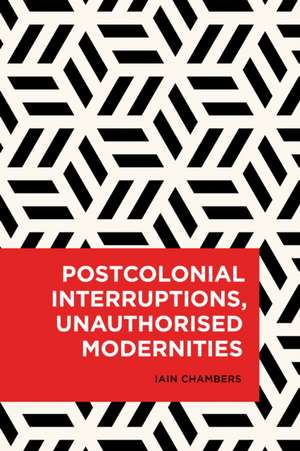
Postcolonial Interruptions, Unauthorised Modernities: Radical Cultural Studies
Autor Iain Chambersen Limba Engleză Paperback – mar 2017
Drawing upon the interdisciplinary lines of thought developed within cultural and postcolonial studies, the work develops a concept of heritage beyond the concerns and obsessions of the Anglo-American world. It offers a counter-hegemony construction of the figure of the migrant and 'other' as a disruptive force in the construction of the idea of the West. It proposes a rethinking of the geo-political economies of knowledge and power, lived and viewed from elsewhere. This accessibility written book should be of interest to anyone interested in the construction of modernity and the future of postcolonial studies.
| Toate formatele și edițiile | Preț | Express |
|---|---|---|
| Paperback (1) | 310.47 lei 6-8 săpt. | |
| Bloomsbury Publishing – mar 2017 | 310.47 lei 6-8 săpt. | |
| Hardback (1) | 775.48 lei 6-8 săpt. | |
| Bloomsbury Publishing – 8 mar 2017 | 775.48 lei 6-8 săpt. |


Preț: 310.47 lei
Preț vechi: 411.58 lei
-25%
Puncte Express: 466
Preț estimativ în valută:
54.89€ • 65.83$ • 47.71£
54.89€ • 65.83$ • 47.71£
Carte tipărită la comandă
Livrare economică 13-27 martie
Specificații
ISBN-13: 9781786603326
ISBN-10: 1786603322
Pagini: 208
Dimensiuni: 149 x 231 x 10 mm
Greutate: 0.2 kg
Editura: Bloomsbury Publishing
Colecția Rowman & Littlefield Publishers
Seria Radical Cultural Studies
Locul publicării:New York, United States
ISBN-10: 1786603322
Pagini: 208
Dimensiuni: 149 x 231 x 10 mm
Greutate: 0.2 kg
Editura: Bloomsbury Publishing
Colecția Rowman & Littlefield Publishers
Seria Radical Cultural Studies
Locul publicării:New York, United States
V-ar putea interesa
-
 The Theory of Political CultureStephen Welch-34%Preț: 782.39 lei1181.68 lei
 -
 Biohackers: The Politics of Open ScienceAlessandro DelfantiPreț: 242.75 lei
 -
 Demanding the ImpossibleSlavoj ZizekPreț: 121.96 lei
 -
 Power Play: The Bush Presidency and the ConstitutionJames P. Pfiffner-25%Preț: 139.66 lei185.46 lei
 -
 The Intelligent Woman's GuideBernard ShawPreț: 71.12 lei
 -
 Giving Is Good For YouJohn NicksonPreț: 139.52 lei
Cuprins
Acknowledgements/1. The Algebra of Power/2. A Tattered Map/3. Migrating Modernities/4. Lessons from the South/5. Scarred Landscapes/6. Folds in Time/References/Index
Recenzii
In this compelling book Iain Chambers shows migration from, and connections with, the South to be central to the story of Europe, but in paradoxical ways. This globality has been both systematically denied and cited in framing Europe as exception and exceptional, at odds with people and traditions from an imagined elsewhere. Chambers locates this duality at the heart of the European apparatus of power, suggesting that if not addressed as such, it will always obstruct a more extensive understanding of Europe as trans-cultural. An original, powerful and much needed book in these terrifying times.
This is an intellectual tour de force that gives us a fresh take on postcolonial interrogations and confrontations. Celebrating interruptions, gaps and dissonances, the book is an ode to broken archives and submerged histories, marked by cruelty and violence but also offering new imaginaries for the future. Beautifully written, with the recognizable poetic style that distinguishes Chambers' theoretical engagement, the book also takes on art, photography and cinema as a way of rethinking modernity, incorporating other bodies and voices.
Iain Chambers is concerned to link in an elegant and powerful manner knowledges appropriate to the Mediterranean region, together with the south of the world more generally, with the critical interrogation of received ideas about identification within existing political and cultural boundaries. He is one of the most important writers making the legacy of Stuart Hall and Antonio Gramsci relevant today. In this 'post truth' era, Chambers insists on questioning both "who is speaking" and "where they are speaking from". I have benefited immensely both from his work, as well as his specific interest in contemporary art practice, including my own, that I have been able to pursue in conversations in London, Naples and elsewhere.
Moving seamlessly across centuries, continents and genres, this collection of essays offers a persistent and urgent interrogation of our contemporary global colonial order. As with the works of art discussed, the essay form itself, composed through Chambers' flowing prose, functions as a form of 'heresy' - as part of an unauthorized, 'southern' archive that interrupts and fractures hegemonic modernity, re-assembling its ruins.
Erudite and decidedly planetary in orientation, Chambers not only poses a compelling epistemological and methodological challenge to the European social sciences. In an era of rapidly contracting borders and ever-shrinking space for dissenting narratives, his appeal to 'turn the outside in' is also an urgently needed call to imagine alternative futures, premised on our intersections and framed by our imbrications.
Iain Chambers' profound meditation on the figure of the migrant recasts contemporary migration, not as an exceptional "crisis," but as expressive of the generative structures and colonial origins of European modernity. Chambers' penetrating epistemological critique identifies the colonial imperatives that continue to condition and authorize academic disciplines. A timely and eloquent call to reassemble the "broken archive" of Western knowledge through an engagement with alternative rationalities and creative practices.
Iain Chambers shows the impossibility of making the world transparent, fully understandable and unilaterally controllable, that is, the morbid dream Western reason has cultivated during the last five centuries.
Chambers does a powerful job at exposing the ways in which what I call subliminal indebtedness is constantly disowned by the political denial enforced by Occidental colonialism. . Postcolonial Interruptions, Unauthorized Modernities has to be embraced as an opportunity for a deconstructing act of - individual and collective - introspection. To the extent that the book exhorts us to think of colonialism as an historical process that is actively (re)producing the cultural and political order that best suits its perpetuation . Lastly, one of the most laudable aspects of Postcolonial Interruptions, Unauthorized Modernities is its virtuosity. .
If one should summarise Chambers' study in one sentence, one could say that it
endeavours to postcolonially deconstruct the long five centuries of modern/colonial
epistemology, to use the vocabulary of the decolonial thinking, with the obstinate
interruptions of the critical waves of the southern seas and of the arts.
It is a rare experience entering the first page of an academic book and leaving its last
page with the feeling that you were reading a novel. Iain Chambers' volume, in fact, is a
journey suspended between the multiple fault-lines that separate, therefore connect, the
innumerable tensions, unexpected vertigos and whispering silences that shape and
deform the living tissue of critical thinking, cultural sociology and postcolonial theory.
As Chambers insists, this is not a scholarly paper or monograph, but essayistic prose that interrupts and fractures illusions of "discursive rationality" (p.13). Indeed, the book reads like an extended meditation on the making and (potential) unmaking of Euro-American dominated modernity. It maps pulse points of postcolonial studies, synthesises and pushes further different strands of postcolonial argument, and offers a rich resource of thought and method. It throws up questions and suggests avenues for investigation, rather than giving definite or final answers.
This is an intellectual tour de force that gives us a fresh take on postcolonial interrogations and confrontations. Celebrating interruptions, gaps and dissonances, the book is an ode to broken archives and submerged histories, marked by cruelty and violence but also offering new imaginaries for the future. Beautifully written, with the recognizable poetic style that distinguishes Chambers' theoretical engagement, the book also takes on art, photography and cinema as a way of rethinking modernity, incorporating other bodies and voices.
Iain Chambers is concerned to link in an elegant and powerful manner knowledges appropriate to the Mediterranean region, together with the south of the world more generally, with the critical interrogation of received ideas about identification within existing political and cultural boundaries. He is one of the most important writers making the legacy of Stuart Hall and Antonio Gramsci relevant today. In this 'post truth' era, Chambers insists on questioning both "who is speaking" and "where they are speaking from". I have benefited immensely both from his work, as well as his specific interest in contemporary art practice, including my own, that I have been able to pursue in conversations in London, Naples and elsewhere.
Moving seamlessly across centuries, continents and genres, this collection of essays offers a persistent and urgent interrogation of our contemporary global colonial order. As with the works of art discussed, the essay form itself, composed through Chambers' flowing prose, functions as a form of 'heresy' - as part of an unauthorized, 'southern' archive that interrupts and fractures hegemonic modernity, re-assembling its ruins.
Erudite and decidedly planetary in orientation, Chambers not only poses a compelling epistemological and methodological challenge to the European social sciences. In an era of rapidly contracting borders and ever-shrinking space for dissenting narratives, his appeal to 'turn the outside in' is also an urgently needed call to imagine alternative futures, premised on our intersections and framed by our imbrications.
Iain Chambers' profound meditation on the figure of the migrant recasts contemporary migration, not as an exceptional "crisis," but as expressive of the generative structures and colonial origins of European modernity. Chambers' penetrating epistemological critique identifies the colonial imperatives that continue to condition and authorize academic disciplines. A timely and eloquent call to reassemble the "broken archive" of Western knowledge through an engagement with alternative rationalities and creative practices.
Iain Chambers shows the impossibility of making the world transparent, fully understandable and unilaterally controllable, that is, the morbid dream Western reason has cultivated during the last five centuries.
Chambers does a powerful job at exposing the ways in which what I call subliminal indebtedness is constantly disowned by the political denial enforced by Occidental colonialism. . Postcolonial Interruptions, Unauthorized Modernities has to be embraced as an opportunity for a deconstructing act of - individual and collective - introspection. To the extent that the book exhorts us to think of colonialism as an historical process that is actively (re)producing the cultural and political order that best suits its perpetuation . Lastly, one of the most laudable aspects of Postcolonial Interruptions, Unauthorized Modernities is its virtuosity. .
If one should summarise Chambers' study in one sentence, one could say that it
endeavours to postcolonially deconstruct the long five centuries of modern/colonial
epistemology, to use the vocabulary of the decolonial thinking, with the obstinate
interruptions of the critical waves of the southern seas and of the arts.
It is a rare experience entering the first page of an academic book and leaving its last
page with the feeling that you were reading a novel. Iain Chambers' volume, in fact, is a
journey suspended between the multiple fault-lines that separate, therefore connect, the
innumerable tensions, unexpected vertigos and whispering silences that shape and
deform the living tissue of critical thinking, cultural sociology and postcolonial theory.
As Chambers insists, this is not a scholarly paper or monograph, but essayistic prose that interrupts and fractures illusions of "discursive rationality" (p.13). Indeed, the book reads like an extended meditation on the making and (potential) unmaking of Euro-American dominated modernity. It maps pulse points of postcolonial studies, synthesises and pushes further different strands of postcolonial argument, and offers a rich resource of thought and method. It throws up questions and suggests avenues for investigation, rather than giving definite or final answers.