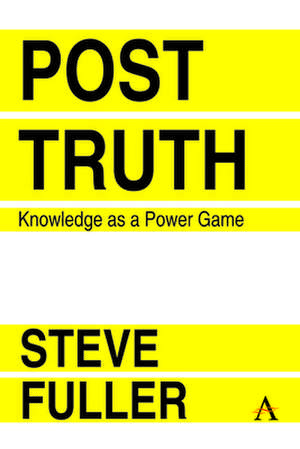
Post-Truth: Key Issues in Modern Sociology, cartea 1
Autor Steve Fulleren Limba Engleză Paperback – 25 mai 2018
Post-truth should be seen as largely a continuation of the last forty years of postmodernism, especially in its deconstructive guise. Both postmodernism and post-truth publicly display a strong anti-authoritarian, democratic streak. Yet it is also a legacy rooted in Plato, who acknowledged an eternal power struggle - done in the name of 'truth' - between those who uphold adherence to the past and those who uphold openness to the future. Later, Machiavelli, and still later Vilfredo Pareto, described these two positions as 'lions' and 'foxes', respectively. Moreover, there has always been concern that if the struggle between the lions and foxes is made public, the social fabric will disintegrate altogether, as happened to Athens in Plato's day. The ancient and medieval support for a 'double truth' doctrine (i.e. one for the elites and one for the masses), as carried over in modern conceptions of censorship, articulate these misgivings. In early twentieth century, Pareto based a general theory of society on this struggle. Pareto's legacy left the most lasting impression in the US through the Harvard biochemist Lawrence Henderson. Henderson convened a 'Pareto Circle' in the late 1930s, which influenced the young Thomas Kuhn, author of the most influential account of science in the second half of the twentieth century, 'The Structure of Scientific Revolutions'. What distinguishes science from politics is that in science the lions normally rule because they suppress contested features of their history until their own internal disagreements about how to interpret puzzling findings force a 'crisis' and finally 'revolution', during which the scientific foxes are briefly in control.
The book is concerned with the implications of a systematically post-truth perspective on academic knowledge production, which is largely seen as a vulnerable target. It turns out that military and industrial attitudes towards knowledge production have always embodied a post-truth perspective. The book also suggests an academic course of study for a post-truth world. The course would put less emphasis on content and more on skills, especially those involving the propagation and deconstruction of content, much of which is normally associated with marketing, public relations as well as aesthetic and literary criticism. In addition, the course would focus on arguments relating to the avoidance (lions) or acceptance (foxes) of risk. It would also examine the contrasting Orwellian practices involved in constructing canonical (lions) and revisionist (foxes) histories. The twentieth century interwar debate between Walter Lippmann (lion) and Edward Bernays (fox) over the meaning of a public philosophy in an era of mass media would be a centrepiece.
Din seria Key Issues in Modern Sociology
- 19%
 Preț: 678.09 lei
 - 23%
 Preț: 716.45 lei
 -
 Preț: 263.85 lei
 -
 Preț: 337.70 lei
 -
 Preț: 263.44 lei
 - 19%
 Preț: 685.27 lei
 -
 Preț: 307.47 lei
 - 19%
 Preț: 685.27 lei
 -
 Preț: 263.59 lei
 -
 Preț: 271.73 lei
 -
 Preț: 267.79 lei
 -
 Preț: 267.93 lei
 -
 Preț: 262.88 lei
 -
 Preț: 310.80 lei
 - 23%
 Preț: 719.31 lei
 -
 Preț: 254.22 lei
 - 9%
 Preț: 935.86 lei
 -
 Preț: 286.77 lei
 -
 Preț: 273.29 lei
 -
 Preț: 184.24 lei
 -
 Preț: 275.93 lei
 -
 Preț: 268.29 lei
 - 23%
 Preț: 1698.11 lei
 - 19%
 Preț: 701.15 lei
 -
 Preț: 262.44 lei
 - 19%
 Preț: 699.02 lei
 - 23%
 Preț: 1705.93 lei
 - 19%
 Preț: 697.32 lei
 - 19%
 Preț: 681.74 lei
Preț: 257.80 lei
Puncte Express: 387
Carte indisponibilă temporar
Livrare prin curier în România Termenul estimat este afișat lângă disponibilitate.
Transport gratuit de la 400.00 lei Plată online sau ramburs, în funcție de opțiunile comenzii.
Retur gratuit în 14 zile Comandă securizată și suport în română.
Specificații
ISBN-13: 9781783086948
ISBN-10: 1783086947
Pagini: 218
Dimensiuni: 152 x 229 x 14 mm
Greutate: 0.36 kg
Editura: Anthem Press
Colecția Key Issues in Modern Sociology
Seria Key Issues in Modern Sociology
ISBN-10: 1783086947
Pagini: 218
Dimensiuni: 152 x 229 x 14 mm
Greutate: 0.36 kg
Editura: Anthem Press
Colecția Key Issues in Modern Sociology
Seria Key Issues in Modern Sociology
V-ar putea interesa
-
 The Infinite BookJohn D. Barrow-19%Preț: 74.60 lei92.25 lei
 -
 The Varieties of Scientific ExperienceCarl SaganPreț: 141.35 lei
 -
 Studies in the Philosophy of the Scottish EnlightenmentM. A. Stewart-28%Preț: 360.88 lei501.92 lei
 -
 The Scenes of Inquiry: On the Reality of Questions in the SciencesNicholas Jardine-28%Preț: 424.97 lei593.79 lei
 -
 Philosophy of Science TodayPeter Clark-20%Preț: 288.93 lei362.54 lei
 -
 Broca's BrainCarl SaganPreț: 58.41 lei
 -
 Billions & BillionsCarl SaganPreț: 111.61 lei
 -
 Preț: 435.46 lei
 -
 Understanding Philosophy of ScienceJames LadymanPreț: 357.58 lei
 -
 Inference to the Best ExplanationPeter LiptonPreț: 380.36 lei
 -
 The Logic of Scientific DiscoveryKarl PopperPreț: 233.98 lei
 -
 Preț: 221.51 lei
 -
 Science and PoetryMary MidgleyPreț: 213.83 lei
 -
 Problems of EmpiricismPaul K. FeyerabendPreț: 246.29 lei
 -
 Realism, Rationalism and Scientific MethodPaul K. FeyerabendPreț: 216.75 lei
 -
 Science and Ultimate RealityJohn. D. Barrow-9%Preț: 780.25 lei857.42 lei
 -
 The Turning PointFritjof CapraPreț: 157.38 lei
 -
 A Sense of the MysteriousAlan LightmanPreț: 108.03 lei
 -
 A Realist Theory of ScienceRoy BhaskarPreț: 172.67 lei
Notă biografică
Steve Fuller is the Auguste Comte Professor of Social Epistemology in the Department of Sociology at the University of Warwick, UK. Originally trained in history and philosophy of science, Fuller pioneered the field of 'social epistemology' in a quarterly journal that he founded in 1987 as well as in more than twenty books. His most recent books are Knowledge: The Philosophical Quest in History (2015) and The Academic Caesar (2016).
Cuprins
Acknowledgements; Introduction: Science and Politics in a Post-Truth Era: Pareto's Hidden Hand; Chapter One: Brexit: Political Expertise Confronts the Will of the People; Chapter Two: What Philosophy Does and Does Not Teach Us about the Post-Truth Condition; Chapter Three: Sociology and Science and Technology Studies as Post-Truth Sciences; Chapter Four: The Post-Truth about Academia: Undiscovered Public Knowledge; Appendix: Prolegomena To A Deep History of 'Information Overload'; Chapter Five: Science Customisation: A Project for the Post-Truth Condition; Chapter Six: The Performance of Politics and Science on the Playing Field of Time; Chapter Seven: Forecasting: The Future as the Post-Truth Playground; The Argument in A Nutshell; Glossary; References; Index.
Acknowledgements; Introduction: Science and Politics in a Post-Truth Era: Pareto's Hidden Hand; Chapter One: Brexit: Political Expertise Confronts the Will of the People; Chapter Two: What Philosophy Does and Does Not Teach Us about the Post-Truth Condition; Chapter Three: Sociology and Science and Technology Studies as Post-Truth Sciences; Chapter Four: The Post-Truth about Academia: Undiscovered Public Knowledge; Appendix: Prolegomena To A Deep History of 'Information Overload'; Chapter Five: Science Customisation: A Project for the Post-Truth Condition; Chapter Six: The Performance of Politics and Science on the Playing Field of Time; Chapter Seven: Forecasting: The Future as the Post-Truth Playground; The Argument in A Nutshell; Glossary; References; Index.
Acknowledgements; Introduction: Science and Politics in a Post-Truth Era: Pareto's Hidden Hand; Chapter One: Brexit: Political Expertise Confronts the Will of the People; Chapter Two: What Philosophy Does and Does Not Teach Us about the Post-Truth Condition; Chapter Three: Sociology and Science and Technology Studies as Post-Truth Sciences; Chapter Four: The Post-Truth about Academia: Undiscovered Public Knowledge; Appendix: Prolegomena To A Deep History of 'Information Overload'; Chapter Five: Science Customisation: A Project for the Post-Truth Condition; Chapter Six: The Performance of Politics and Science on the Playing Field of Time; Chapter Seven: Forecasting: The Future as the Post-Truth Playground; The Argument in A Nutshell; Glossary; References; Index.