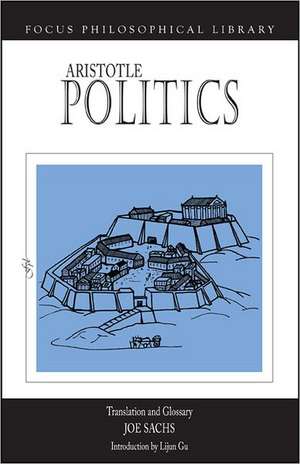
Politics
Autor Aristotle Joe Sachs Introducere de Dr. Lijun Gu Ph.Den Limba Engleză Paperback – 10 aug 2012
Veți descoperi în această lucrare fundamentală nu doar un tratat de științe politice, ci o explorare profundă a modului în care comunitățile umane se organizează pentru a atinge fericirea colectivă. Notăm cu interes felul în care Aristotle ancorează politica în etică, transformând guvernarea dintr-un simplu exercițiu de putere într-o extensie naturală a virtuții umane. Considerăm că forța acestui text rezidă în capacitatea sa de a clasifica regimurile politice pe baza unui criteriu moral: dacă acestea servesc binele comun sau doar interesele conducătorilor.
Structura volumului reflectă o progresie logică riguroasă, pornind de la unitatea de bază a societății — gospodăria — și culminând cu analiza complexă a statului ca asociație naturală. Ca și Athenian Constitution. Eudemian Ethics. Virtues and Vices, această operă analizează structurile de guvernare, dar se diferențiază prin accentul pus pe fundamentul filosofic și teleologic al statului, nu doar pe cronica sa istorică. În contextul operei sale, Politics întregește viziunea expusă în Nicomachean Ethics, demonstrând că omul este, prin natura sa, un animal politic care își poate atinge potențialul maxim doar în cadrul unei cetăți bine rânduite.
Ritmul lecturii este unul analitic, susținut de notele și introducerile semnate de T. A. Sinclair și T. J. Saunders, care clarifică terminologia tehnică și disputele editoriale privind ordinea originală a capitolelor. Este o lucrare esențială pentru a înțelege vocabularul intelectual al Occidentului, oferind perspective asupra sclaviei, economiei de familie și educației cetățenilor care rămân subiecte de dezbatere și în prezent.
Preț: 135.20 lei
Preț vechi: 163.25 lei
-17%
Carte disponibilă
Livrare economică 14-28 noiembrie
Specificații
ISBN-10: 1585103764
Pagini: 336
Ilustrații: none
Dimensiuni: 140 x 216 x 21 mm
Greutate: 0.39 kg
Ediția:First Edition
Editura: Hackett Publishing Company,Inc
Colecția Focus
Locul publicării:United States
V-ar putea interesa
-
 English Verb DrillsEd Swick-12%Preț: 121.64 lei138.26 lei
 -
 -12%Preț: 111.11 lei126.50 lei
 -
 The Epic of GilgameshAndrew George-17%Preț: 59.67 lei72.28 lei
 -
 RepublicPlato-14%Preț: 57.68 lei67.39 lei
 -
 JulianGore Vidal-25%Preț: 81.31 lei108.90 lei
 -
 Positive Psychology For DummiesAveril LeimonPreț: 174.13 lei
 -
 -17%Preț: 79.17 lei95.36 lei
 -
 Check Your Vocabulary for Military English: A Workbook for UsersBloomsbury Publishing-38%Preț: 38.28 lei61.94 lei
 -
 ChickenfeedMinette WaltersPreț: 77.42 lei
De ce să citești această carte
Pentru cititorul pasionat de istoria ideilor și de bazele democrației, această carte oferă claritate asupra modului în care s-au născut conceptele de stat și cetățenie. Veți câștiga o înțelegere profundă a sistemelor de guvernare, învățând să distingeți între regimurile orientate spre binele public și cele deviante. Este o resursă indispensabilă pentru studenții la științe politice și pentru oricine dorește să analizeze societatea modernă prin prisma gândirii clasice.
Despre autor
Aristotle (384–322 î.Hr.) a fost un filosof grec și polimat, elev al lui Platon și preceptor al lui Alexandru cel Mare. Fondator al Liceului din Atena și al școlii peripatetice, contribuțiile sale acoperă aproape toate domeniile cunoașterii, de la biologie și fizică până la logică și poetică. Deși doar o treime din scrierile sale au supraviețuit, acestea au format lexicul intelectual al Occidentului. În Politics, el sintetizează observațiile empirice asupra constituțiilor vremii sale, stabilind bazele științei politice moderne și influențând decisiv modul în care înțelegem astăzi guvernarea și etica socială.
Descriere
Focus Philosophical Library books are distinguished by their commitment to faithful, clear, and consistent presentations of texts and the rich world part and parcel of those texts.
Recenzii
—Lijun Gu, St. John's College
—Nathan Andersen, Eckerd College
—Antonio Marino López, Universidad Nacional Autónoma de México
—Corinne Painter, Washtenaw Community College
—Edward Halper, University of Georgia
“What strikes me most in this welcome new translation of Aristotle’s Politics is the sense of Aristotle as a man thinking carefully how to speak about political realities he studied and witnessed, rather than a treatise-builder expounding political doctrines.”
—Nathan Andersen, Eckerd College
“This fact alone sets Joe Sachs apart from all other recent translators of the Politics: he is the only one who is not a specialist in one area of Aristotelian philosophy and his holistic command of the corpus allows him to deliver the most nuanced and precise translations available in English.”
—Antonio Marino López, Universidad Nacional Autónoma de México
“Joe Sachs has an extraordinary ability to render ancient Greek into English sentences that are so clear and direct that they help readers to look past Aristotle’s technical terminology and reflect on the philosophical issues in the text.”
—Edward Halper, University of Georgia
“This translation is a must, both for scholars working on or otherwise interested in Aristotle’s Politics as well as for students and others who might be reading this text for the first time.”
—Corinne Painter, Washtenaw Community College
Joe Sachs taught for thirty years at St. John’s College in Annapolis, Maryland. His other translations for the Focus Philosophical Library include Aristotle’s Nicomachean Ethics and Poetics.
Lijun Gu has been a tutor at St. John’s College in Annapolis, Maryland, since 1996.
Cuprins
Translator’s Preface
Introduction by Lijun Gu
Aristotle’s Politics (Book titles added by translator)
Book I. The natural basis of the city
Book II. Previous opinions about the best city
Book III. Citizenship and political rule
Book IV. The spectrum of democratic and oligarchic forms of government
Book V. Factions and changes of government
Book VI. How democracies and oligarchies can be made more effective and enduring
Book VII. Characteristics of the best city
Book VIII. Education of citizens
Glossary
Summary of Contents
Index