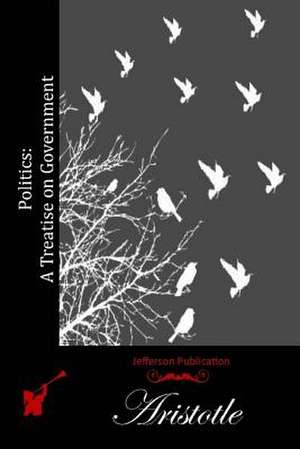
Politics
Autor Aristotleen Limba Engleză Paperback
Veți descoperi în această lucrare fundamentală nu doar un tratat de științe politice, ci o explorare profundă a modului în care comunitățile umane se organizează pentru a atinge fericirea colectivă. Notăm cu interes felul în care Aristotle ancorează politica în etică, transformând guvernarea dintr-un simplu exercițiu de putere într-o extensie naturală a virtuții umane. Considerăm că forța acestui text rezidă în capacitatea sa de a clasifica regimurile politice pe baza unui criteriu moral: dacă acestea servesc binele comun sau doar interesele conducătorilor.
Structura volumului reflectă o progresie logică riguroasă, pornind de la unitatea de bază a societății — gospodăria — și culminând cu analiza complexă a statului ca asociație naturală. Ca și Athenian Constitution. Eudemian Ethics. Virtues and Vices, această operă analizează structurile de guvernare, dar se diferențiază prin accentul pus pe fundamentul filosofic și teleologic al statului, nu doar pe cronica sa istorică. În contextul operei sale, Politics întregește viziunea expusă în Nicomachean Ethics, demonstrând că omul este, prin natura sa, un animal politic care își poate atinge potențialul maxim doar în cadrul unei cetăți bine rânduite.
Ritmul lecturii este unul analitic, susținut de notele și introducerile semnate de T. A. Sinclair și T. J. Saunders, care clarifică terminologia tehnică și disputele editoriale privind ordinea originală a capitolelor. Este o lucrare esențială pentru a înțelege vocabularul intelectual al Occidentului, oferind perspective asupra sclaviei, economiei de familie și educației cetățenilor care rămân subiecte de dezbatere și în prezent.
Preț: 54.82 lei
Carte disponibilă
Livrare economică 30 octombrie-13 noiembrie
Specificații
ISBN-10: 1512084085
Pagini: 152
Dimensiuni: 152 x 229 x 8 mm
Greutate: 0.21 kg
Editura: CreateSpace Independent Publishing Platform
V-ar putea interesa
-
 English Verb DrillsEd Swick-12%Preț: 121.64 lei138.26 lei
 -
 -12%Preț: 111.11 lei126.50 lei
 -
 The Epic of GilgameshAndrew George-18%Preț: 59.10 lei72.28 lei
 -
 RepublicPlato-15%Preț: 57.12 lei67.39 lei
 -
 JulianGore Vidal-26%Preț: 79.40 lei107.40 lei
 -
 Positive Psychology For DummiesAveril LeimonPreț: 171.08 lei
 -
 -18%Preț: 77.29 lei94.04 lei
 -
 Check Your Vocabulary for Military English: A Workbook for UsersBloomsbury Publishing-38%Preț: 38.28 lei61.94 lei
 -
 ChickenfeedMinette WaltersPreț: 77.42 lei
De ce să citești această carte
Pentru cititorul pasionat de istoria ideilor și de bazele democrației, această carte oferă claritate asupra modului în care s-au născut conceptele de stat și cetățenie. Veți câștiga o înțelegere profundă a sistemelor de guvernare, învățând să distingeți între regimurile orientate spre binele public și cele deviante. Este o resursă indispensabilă pentru studenții la științe politice și pentru oricine dorește să analizeze societatea modernă prin prisma gândirii clasice.
Despre autor
Aristotle (384–322 î.Hr.) a fost un filosof grec și polimat, elev al lui Platon și preceptor al lui Alexandru cel Mare. Fondator al Liceului din Atena și al școlii peripatetice, contribuțiile sale acoperă aproape toate domeniile cunoașterii, de la biologie și fizică până la logică și poetică. Deși doar o treime din scrierile sale au supraviețuit, acestea au format lexicul intelectual al Occidentului. În Politics, el sintetizează observațiile empirice asupra constituțiilor vremii sale, stabilind bazele științei politice moderne și influențând decisiv modul în care înțelegem astăzi guvernarea și etica socială.
Descriere scurtă
Descriere
The Politics is one of the most influential texts in the history of political thought, and it raises issues which still confront anyone who wants to think seriously about the ways in which human societies are organized and governed. The work of one of the world's greatest philosophers, it draws on Aristotle's own great knowledge of the political and constitutional affairs of the Greek cities. By examining the way societies are run - from households to city states - Aristotle establishes how successful constitutions can best be initiated and upheld. For this edition Sir Ernest Barker's fine translation, which has been widely used for nearly half a century, has been extensively revised to meet the needs of the modern reader. The accessible introduction and clear notes by R F Stalley examine the historical and philosophical background of the work and discuss its significance for modern political thought. ABOUT THE SERIES: For over 100 years Oxford World's Classics has made available the widest range of literature from around the globe. Each affordable volume reflects Oxford's commitment to scholarship, providing the most accurate text plus a wealth of other valuable features, including expert introductions by leading authorities, helpful notes to clarify the text, up-to-date bibliographies for further study, and much more.
Recenzii
—Lijun Gu, St. John's College
—Nathan Andersen, Eckerd College
—Antonio Marino López, Universidad Nacional Autónoma de México
—Corinne Painter, Washtenaw Community College
—Edward Halper, University of Georgia
“What strikes me most in this welcome new translation of Aristotle’s Politics is the sense of Aristotle as a man thinking carefully how to speak about political realities he studied and witnessed, rather than a treatise-builder expounding political doctrines.”
—Nathan Andersen, Eckerd College
“This fact alone sets Joe Sachs apart from all other recent translators of the Politics: he is the only one who is not a specialist in one area of Aristotelian philosophy and his holistic command of the corpus allows him to deliver the most nuanced and precise translations available in English.”
—Antonio Marino López, Universidad Nacional Autónoma de México
“Joe Sachs has an extraordinary ability to render ancient Greek into English sentences that are so clear and direct that they help readers to look past Aristotle’s technical terminology and reflect on the philosophical issues in the text.”
—Edward Halper, University of Georgia
“This translation is a must, both for scholars working on or otherwise interested in Aristotle’s Politics as well as for students and others who might be reading this text for the first time.”
—Corinne Painter, Washtenaw Community College
Joe Sachs taught for thirty years at St. John’s College in Annapolis, Maryland. His other translations for the Focus Philosophical Library include Aristotle’s Nicomachean Ethics and Poetics.
Lijun Gu has been a tutor at St. John’s College in Annapolis, Maryland, since 1996.
Notă biografică
Cuprins
Aristotle's Life and Works
Aristotle's Politics in the Past
Aristotle's Politics Today
Notes by the Reviser Reviser's Introduction, by T. J. Saunders
A Modern Report on the Politics
Teaching and Research in the Lyceum
The Contents and Structure of the Politics
Aristotle's Philosophical Assumption
Why Read the Politics?
The Revised Translation
Principles of Revision
Translation of Key Terms
Refractory Terms
Italicized Prefaces to Chapters
Numerical References
Footnotes
Bibliographies
Table of Contents and Index of Names
Acknowledgments
THE POLITICS
Book I
Preface to Book I
i. The State as an Association
ii. The State Exists by Nature
The Two "Pairs"
Formation of the Household
Formation of the Village
Formation of the State
The State and the Individual
iii. The Household and Its Slaves
iv. The Slave as a Tool
v. Slavery as Part of a Universal Natural Pattern
vi. The Relation between Legal and Natural Slavery
vii. The Nature of Rule over Slaves
viii. The Natural Method of Acquiring Goods
ix. Natural and Unnatural Methods of Acquiring Goods
x. The Proper Limits of Household-Management; The Unnaturalness of Money-lending
xi. Some Practical Considerations, Especially on the Creation of Monopoly
xii. Brief Analysis of the Authority of Husband and Father
xiii. Morality and Efficiency in the Household
Book II
i. Introduction to Ideal States: How Far Should Sharing Go?
ii. Extreme Unity in Plato's Republic
iii. Extreme Unity is Impracticable
iv. Further Objections to Community of Wives and Children
v. The Ownership of Property
vi. Criticisms of Plato's Laws
vii. The Constitution of Phaleas
viii. The Constitution of Hippodamus
ix. Criticism of the Spartan Constitution
The Helots
Spartan Women
Property
The Ephors
The Board of Elders
The Kings
Some Common Meals
Some Further Criticisms
x. Criticism of the Cretan Constitution
xi. Criticism of the Carthaginian Constitution
xii. Solon and Some Other Lawgivers
Book III
i. How Should We Define "Citizen"?
ii. A Pragmatic Definition of "Citizen"
iii. Continuity of Identity of the State
iv. How Far Should the Good Man and the Good Citizen Be Distinguished?
v. Ought Workers to Be Citizens?
vi. Correct and Deviated Constitutions Distinguished
vii. Classification of Correct and Deviated Constitutions
viii. An Economic Classification of Constitutions
ix. The Just Distribution of Political Power
x. Justice and Sovereignty
xi. The Wisdom of Collective Judgments
xii. Justice and Equality
xiii. The Sole Proper Claim to Political Power
xiv. Five Types of Kingship
xv. The Relation of Kingship and Law (1)
xvi. The Relation of Kingship and Law (2)
xvii. The Highest Form of Kingship
xviii. The Education of the Ideal King
Book IV
i. The Tasks of Political Theory
ii. Consitutions Placed in Order of Merit
iii. Why There are Several Constitutions
iv. The Parts of the State and the Classification of Democracies
Definitions of Democracy and Oligarchy
The Parts of the State, and Resulting Variety among Constitutions (1)
Plato on the Parts of the State
The Parts of the State, and Resulting Variety among Constitutions (2)
Varieties of Democracy
v. The Classification of Oligarchies
vi. Four Types of Democracy and Four of Oligarchy
vii. Varieties of Aristocracy
viii. Polity Distinguished from Aristocracy
ix. Polity as a Mixture of Oligarchy and Democracy
x. Three Forms of Tyranny
xi. The Merits of the Middle Constitution
xii. Why Democrats and Oligarchs Should Cultivate the Middle Ground
xiii. Right and Wrong Strategems to Ensure a Majority for the Constitution
xiv. The Deliberative Element in the Constitution
xv. The Executive Element in the Constitution
xvi. The Judicial Element in the Constitution
Book V
i. Equality, Justice, and Constitutional Change
ii. Sources of Constitutional Change (1)
iii. Sources of Constitutional Change (2)
iv. The Immediate Occasions of Constitutional Change
v. Why Democracies Are Overthrown
vi. Why Oligarchies Are Overthrown
vii. The Causes of Factions in Aristocracies
viii. How Constitutions May Be Preserved (1)
ix. How Constitutions May Be Preserved (2)
x. The Origins and Downfall of Monarchy
xi. Methods of Preserving Monarchies, with Particular Reference to Tyranny
xii. The Impermanence of Tyrannies; Plato on Constitutional Change
Book VI
i. How Do Constitutions Function Best?
ii. Principles and Practices of Democracies
iii. Ways of Achieving Equality
iv. The Best Democracy
v. How Democracies May be Preserved
vi. The Preservation of Oligarchies (1)
vii. The Preservation of Oligarchies (2)
viii. A Comprehensive Review of Officialdom
Book VII
i. The Relation between Virtue and Prosperity
ii. The Active Life and the Philosophic Life (1)
iii. The Active Life and the Philosophic Life (2)
iv. The Size of the Ideal State
v. The Territory of the Ideal State
vi. The Importance of the Sea
vii. The Influence of Climate
viii. Membership and Essential Functions of the State
ix. Citizenship and Age-Groups
x. The Food-Supply and the Division of the Territory
xi. The Siting and Defence of the City
xii. The Siting of Markets, Temples and Communal Refectories
xiii. Happiness as the Aim of the Constitution
xiv. Education for Citizenship
xv. The Proper Education for Cultured Leisure
xvi. Sex, Marriage and Eugenics
xvii. The Main Periods of Education; Censorship
Book VIII
i. Education as a Public Concern
ii. Controversy about the Aims of Education
iii. Leisure Distinguished from Play; Education in Music (1)
iv. The Limits of Physical Training
v. Education in Music (2)
vi. Gentlemen versus Players
vii. Melodies and Modes in Education
Select Bibliographies
Glossaries:
Greek-English
English-Greek
Index of Names