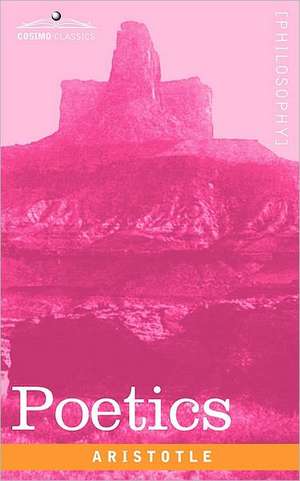
Poetics
Autor Aristotleen Limba Engleză Paperback – 30 oct 2008
În centrul acestui volum fundamental se află analiza tragediei, pe care Aristotle o consideră forma supremă de imitație a acțiunilor umane superioare. Observăm cum autorul descompune arta dramatică în elemente constitutive, acordând o importanță capitală intrigii (mythos). Pentru ca o narațiune să fie eficientă, succesiunea evenimentelor trebuie să respecte legile necesității și probabilității, eliminând arbitrarul în favoarea unei structuri logice riguroase.
Descoperim aici o abordare analitică a modului în care dispozitivele de complot, precum răsturnările de situație și momentele de recunoaștere, sunt utilizate pentru a manipula răspunsul emoțional al publicului, vizând generarea celebrei stări de catharsis prin milă și frică. Textul nu se limitează la structură, ci explorează și estetica limbajului, subliniind că stăpânirea metaforei este un semn al geniului natural. Ediția de față, publicată în seria Dover Thrift Editions, oferă o traducere revizuită și adnotată de Malcolm Heath, fiind organizată metodic pentru a ghida cititorul de la conceptul de mimesis la specificul epopeii și al comediei.
Cititorii familiarizați cu antologia Classical Literary Criticism de D. A. Russell vor aprecia aici focalizarea exclusivă pe textul aristotelic, oferind o claritate mai mare asupra mecanismelor interne ale dramei decât o face o selecție generală de texte antice. Față de Routledge Philosophy Guidebook to Aristotle and the Poetics, care este un comentariu critic, acest volum oferă acces direct la sursa primară, fiind esențial pentru înțelegerea rădăcinilor teoriei literare occidentale. Lucrarea completează sistemul filozofic al autorului, făcând trecerea de la logica și etica explorate în Nicomachean Ethics către estetică și psihologia recepției artei.
Preț: 71.34 lei
Carte tipărită la comandă
Livrare economică 30 noiembrie-14 decembrie
Specificații
ISBN-10: 1605203556
Pagini: 68
Dimensiuni: 127 x 203 x 4 mm
Greutate: 0.08 kg
Editura: COSIMO CLASSICS
Locul publicării:United States
V-ar putea interesa
-
 The Art of RhetoricAristotlePreț: 28.01 lei
 -
 StructuresJ. E. GordonPreț: 108.04 lei
 -
 The User IllusionTor NorretrandersPreț: 116.59 lei
 -
 EthicsBenedict SpinozaPreț: 86.21 lei
 -
 MeditationsMarcus Aurelius-20%Preț: 45.71 lei56.89 lei
 -
 On SuicideDavid Hume-21%Preț: 44.10 lei55.80 lei
 -
 -18%Preț: 102.28 lei124.13 lei
 -
 Beyond Good and Evil: Prelude to a Philosophy of the FutureFriedrich Nietzsche-19%Preț: 63.27 lei78.47 lei
 -
 Anecdotes of the CynicsRobert Dobbin-39%Preț: 17.44 lei28.47 lei
 -
 Why I Am so CleverFriedrich Nietzsche-39%Preț: 17.06 lei28.11 lei
 -
 The Little Book of HyggeMeik Wiking-16%Preț: 92.42 lei110.63 lei
 -
 On the Nature of the PsycheC. G. JungPreț: 140.64 lei
 -
 RhetoricAristotlePreț: 56.04 lei
 -
 Beyond the Pleasure PrincipleSigmund Freud-52%Preț: 20.24 lei42.38 lei
 -
 The Ego and the IdSigmund FreudPreț: 34.87 lei
 -
 -20%Preț: 73.96 lei92.24 lei
 -
 -35%Preț: 37.44 lei57.64 lei
 -
 The Moon is a Harsh MistressRobert A. Heinlein-25%Preț: 59.78 lei79.93 lei
 -
 The Pocket Thich Nhat HanhThich Nhat HanhPreț: 63.08 lei
 -
 Why We Do the Things We DoJoel Levy-12%Preț: 41.50 lei47.10 lei
 -
 Stephen Shore: American SurfacesStephen Shore-16%Preț: 353.11 lei420.47 lei
 -
 War and PeaceLeo TolstoyPreț: 44.02 lei
De ce să citești această carte
Această ediție este esențială pentru studenții la litere, dramaturgie sau filozofie, oferind fundamentul teoretic al oricărei structuri narative moderne. Cititorul câștigă o înțelegere profundă a modului în care se construiește o poveste de succes, învățând despre echilibrul dintre intrigă, caracter și limbaj. Este instrumentul perfect pentru a descifra mecanismele prin care literatura și teatrul reușesc să ne emoționeze de milenii.
Despre autor
Aristotle (384–322 î.Hr.) a fost unul dintre cei mai influenți filozofi ai Greciei Antice, elev al lui Platon și mentor al lui Alexandru cel Mare. Fondator al Liceului din Atena, el a pus bazele multor discipline academice, de la logică și biologie la etică și politică. Deși a scris numeroase tratate, doar o treime din opera sa a supraviețuit, reprezentând în mare parte note de curs care au modelat lexicul intelectual al Occidentului. În Poetics, el sintetizează observațiile sale despre estetică, stabilind canoanele criticii literare care rămân relevante și în prezent.
Descriere scurtă
Notă biografică
Descriere
'What is poetry, how many kinds of it are there, and what are their specific effects?'Aristotle's Poetics is the most influential book on poetry ever written. A founding text of European aesthetics and literary criticism, from it stems much of our modern understanding of the creation and impact of imaginative writing, including poetry, drama, and fiction. For Aristotle, the art of representation conveys universal truths which we can appreciate more easily than the lessons of history or philosophy. In his short treatise Aristotle discusses the origins of poetry and its early development, the nature of tragedy and plot, and offers practical advice to playwrights. This new translation by Anthony Kenny is accompanied by associated material from Plato and a range of responses from more modern literary practitioners: Sir Philip Sidney, P. B. Shelley, and Dorothy L. Sayers. The book includes a wide-ranging introduction and notes, making this the most accessible and attractive modern edition. ABOUT THE SERIES: For over 100 years Oxford World's Classics has made available the widest range of literature from around the globe. Each affordable volume reflects Oxford's commitment to scholarship, providing the most accurate text plus a wealth of other valuable features, including expert introductions by leading authorities, helpful notes to clarify the text, up-to-date bibliographies for further study, and much more.
Cuprins
1. Human culture, poetry and the Poetics
2. Imitation
3. Aristotle's history of poetry
4. The analysis of tragedy
5. Plot: the basics
6. Reversal and recognition
7. The best kinds of tragic plot
8. The pleasures of tragedy
9. The other parts of tragedy
10. Tragedy: miscellaneous aspects
11. Epic
12. Comedy
13. Further reading
14. Reference conventions
Notes to the Introduction
Synopsis of the Poetics
POETICS
Notes to the translation
Recenzii
—Jerry L. Thompson, Author, Truth and Photography
From the Introduction
Some of the most exhilarating things an educated person can think about come tumbling out of Aristotle’s inquiry into the questions of what a tragedy is, what it does, and how it does it. In the Poetics a human achievement of rare power and a thinker of rare depth met, and the world has never stopped talking about their encounter.
“I find the Introduction extremely convincing, lucid, learned, fair to past scholarship, and truly illuminating about the meaning of tragedy in general and about the very specific acceptions of hamartia, katharsis, ekplêxis, and thauma, in the context of an appropriate understanding of the Poetics. Another remarkable feature is the dexterity and ease with which it draws on all the relevant parts of the Aristotelian corpus to shed light on troublesome textual passages in the Poetics. Finally, the style of the Introduction is straightforward, free of unnecessary jargon, direct, and economical, the best interpretation of the Poetics I ever read.”
—Sabetai Unguru, Tel Aviv University
“The translations of Joe Sachs are a great gift to Greekless amateurs like me. He uses simple, unambiguous words joined into sentences that are often complex, as they must be to be accurate, but always clear (after sufficient attention has been paid). A stylist may find some awkwardness in the hyphenated compound words and the noun clauses he prefers to the polysyllabic Latinate words often found in English versions of Aristotle. But these blunt locutions — along with Sachs’ excellent notes — manage to convey both the richness of meaning and the clarity of thought of their Greek antecedents. The resulting translation may strike some as awkward in style, but it will strike the careful reader who cares about what is translated as elegant (in the way mathematicians use that word).”
Jerry L. Thompson, Author, Truth and Photography