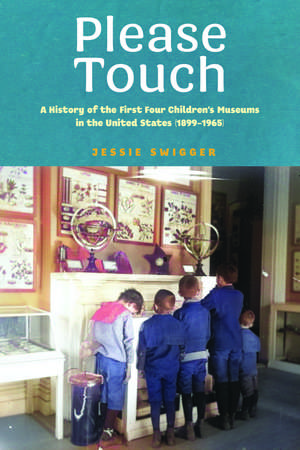
Please Touch: A History of the First Four Children's Museums in the United States (1899–1965): Public History in Historical Perspective
Autor Jessie Swiggeren Limba Engleză Hardback – 13 feb 2026
When it opened in 1899, the Brooklyn Children’s Museum greeted visitors with a new experience. Rather than carefully ensconcing artifacts and curios behind protective glass, the staff took the unusual step of moving the objects out of their cases and into the hands of the children, inviting them to “please touch.” Born out of the reformist spirit of the Progressive Era, the museum represented a new kind of institution, one whose primary purpose was not to collect, preserve, and display objects but rather to educate a specific audience. Over the next twenty-five years, three other children’s museums opened with a similar mission and approach: the Boston Children’s Museum (1913), the Detroit Children’s Museum (1917), and The Children’s Museum of Indianapolis (1925).
At a time when most museums were led by men, women played a critical role in overseeing this first wave of children’s museums. As the number of children’s museums grew, women rose to prominence in the museum profession at large, advocating for new ways for institutions to interact with and serve their audiences. By 1965, the children’s museum movement had succeeded in demonstrating rich rewards and had influenced all types of museums and continues to do so to this day.
Drawing on archival materials, newspaper accounts, and the writings of museum workers and professionals, Please Touch carefully chronicles the early histories of these four seminal children’s museums. Jessie Swigger provides thorough institutional histories of each and connects them to broader currents in education, such as the Progressive education movement, and to key events in early- to mid-twentieth-century US history, including immigration, the Great Depression, World Wars I and II, and the Cold War. She also demonstrates how these institutions were fundamentally shaped by women’s leadership, and how they challenged and expanded the definition of museums and pressed museum practices in new directions.
| Toate formatele și edițiile | Preț | Express |
|---|---|---|
| Paperback (1) | 209.79 lei Precomandă | |
| University of Massachusetts Press – 13 feb 2026 | 209.79 lei Precomandă | |
| Hardback (1) | 568.58 lei Precomandă | |
| University of Massachusetts Press – 13 feb 2026 | 568.58 lei Precomandă |
Din seria Public History in Historical Perspective
-
 Preț: 238.17 lei
 -
 Preț: 174.07 lei
 -
 Preț: 246.11 lei
 -
 Preț: 259.60 lei
 -
 Preț: 253.11 lei
 -
 Preț: 238.53 lei
 -
 Preț: 252.96 lei
 -
 Preț: 234.64 lei
 -
 Preț: 283.99 lei
 -
 Preț: 261.63 lei
 -
 Preț: 248.37 lei
 -
 Preț: 263.51 lei
 -
 Preț: 280.45 lei
 -
 Preț: 252.09 lei
 -
 Preț: 208.72 lei
 -
 Preț: 238.78 lei
 -
 Preț: 226.04 lei
 -
 Preț: 231.75 lei
 -
 Preț: 230.75 lei
 - 8%
 Preț: 550.23 lei
 -
 Preț: 211.01 lei
 - 15%
 Preț: 609.21 lei
 -
 Preț: 224.74 lei
 - 8%
 Preț: 549.92 lei
 -
 Preț: 224.38 lei
 - 8%
 Preț: 604.23 lei
 - 9%
 Preț: 618.46 lei
 - nou
 Preț: 209.79 lei
Preț: 568.58 lei
Preț vechi: 701.94 lei
-19% Precomandă
Puncte Express: 853
Preț estimativ în valută:
100.61€ • 117.98$ • 88.36£
100.61€ • 117.98$ • 88.36£
Carte nepublicată încă
Doresc să fiu notificat când acest titlu va fi disponibil:
Se trimite...
Preluare comenzi: 021 569.72.76
Specificații
ISBN-13: 9781625349101
ISBN-10: 1625349106
Pagini: 216
Ilustrații: 12 illus.
Dimensiuni: 152 x 229 x 23 mm
Greutate: 0.45 kg
Editura: University of Massachusetts Press
Colecția University of Massachusetts Press
Seria Public History in Historical Perspective
ISBN-10: 1625349106
Pagini: 216
Ilustrații: 12 illus.
Dimensiuni: 152 x 229 x 23 mm
Greutate: 0.45 kg
Editura: University of Massachusetts Press
Colecția University of Massachusetts Press
Seria Public History in Historical Perspective
Notă biografică
JESSIE SWIGGER is associate professor of history and director of public history at Western Carolina University. She is author of “History is Bunk”: Assembling the Past at Henry Ford’s Greenfield Village. Her work has appeared in the Journal of Museum Education, the Journal of the History of Childhood and Youth, and the Journal of the American Studies Association of Texas.
Recenzii
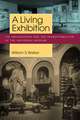
“In a clean, elegant, and fluid style, and grounded in excellent archival research, Please Touch demonstrates how these early children’s museums forged an innovative approach to audience engagement. An important addition to the field of museum studies.”—William S. Walker, author of A Living Exhibition: The Smithsonian and the Transformation of the Universal Museum
“A well-written and well-researched history of a previously not well-chronicled episode in the history of education and museums: namely, the children’s museum movement. Swigger skillfully synthesizes the secondary and primary literature in the history of Progressivism, education, and museum work to provide an account that will appeal to museum studies scholars and historians of education, as well as museum practitioners themselves.”—Karen Rader, coauthor of Life on Display: Revolutionizing U.S. Museums of Science and Natural History in the Twentieth Century
“A well-written and well-researched history of a previously not well-chronicled episode in the history of education and museums: namely, the children’s museum movement. Swigger skillfully synthesizes the secondary and primary literature in the history of Progressivism, education, and museum work to provide an account that will appeal to museum studies scholars and historians of education, as well as museum practitioners themselves.”—Karen Rader, coauthor of Life on Display: Revolutionizing U.S. Museums of Science and Natural History in the Twentieth Century
Cuprins
CONTENTS
List of Illustrations
Acknowledgments
Introduction. The Kernel of the Idea: Children in the Museum
Notes
Index
List of Illustrations
Acknowledgments
Introduction. The Kernel of the Idea: Children in the Museum
- “The Only One of Its Kind”: The Brooklyn Children's Museum
- “The New Freedom”: The Boston Children's Museum
- “Most Useful to Schools”: The Detroit Children's Museum
- A Museum Comes of Age: The Children's Museum of Indianapolis
Notes
Index