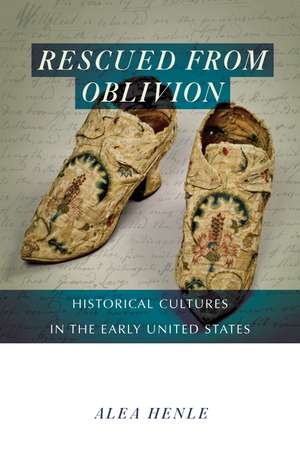
Rescued from Oblivion: Historical Cultures in the Early United States: Public History in Historical Perspective
Autor Alea Henleen Limba Engleză Paperback – 28 aug 2020
In 1791, a group of elite Bostonian men established the first historical society in the nation. Within sixty years, the number of local history organizations had increased exponentially, with states and territories from Maine to Louisiana and Georgia to Minnesota boasting collections of their own.
With in-depth research and an expansive scope, Rescued from Oblivion offers a vital account of the formation of historical culture and consciousness in the early United States, re-centering in the record groups long marginalized from the national memory. As Alea Henle demonstrates, these societies laid the groundwork for professional practices that are still embraced today: collection policies, distinctions between preservation of textual and nontextual artifacts, publication programs, historical rituals and commemorations, reconciliation of scholarly and popular approaches, and more. At the same time, officers of these early societies faced challenges to their historical authority from communities interested in preserving a broader range of materials and documenting more inclusive histories, including fellow members, popular historians, white women, and peoples of color.
With in-depth research and an expansive scope, Rescued from Oblivion offers a vital account of the formation of historical culture and consciousness in the early United States, re-centering in the record groups long marginalized from the national memory. As Alea Henle demonstrates, these societies laid the groundwork for professional practices that are still embraced today: collection policies, distinctions between preservation of textual and nontextual artifacts, publication programs, historical rituals and commemorations, reconciliation of scholarly and popular approaches, and more. At the same time, officers of these early societies faced challenges to their historical authority from communities interested in preserving a broader range of materials and documenting more inclusive histories, including fellow members, popular historians, white women, and peoples of color.
Din seria Public History in Historical Perspective
-
 Preț: 238.17 lei
 -
 Preț: 259.60 lei
 - 19%
 Preț: 564.17 lei
 -
 Preț: 261.38 lei
 -
 Preț: 252.70 lei
 -
 Preț: 283.99 lei
 -
 Preț: 261.63 lei
 -
 Preț: 248.37 lei
 -
 Preț: 174.07 lei
 -
 Preț: 264.04 lei
 -
 Preț: 252.09 lei
 -
 Preț: 234.63 lei
 -
 Preț: 208.72 lei
 -
 Preț: 239.95 lei
 - 8%
 Preț: 549.78 lei
 - 15%
 Preț: 608.75 lei
 -
 Preț: 210.86 lei
 - 8%
 Preț: 549.49 lei
 -
 Preț: 224.36 lei
 - 8%
 Preț: 603.74 lei
Preț: 224.56 lei
Puncte Express: 337
Preț estimativ în valută:
39.71€ • 47.09$ • 34.58£
39.71€ • 47.09$ • 34.58£
Carte indisponibilă temporar
Doresc să fiu notificat când acest titlu va fi disponibil:
Se trimite...
Specificații
ISBN-13: 9781625344991
ISBN-10: 1625344996
Pagini: 264
Ilustrații: 9 b&w photos 5 tables
Dimensiuni: 152 x 229 x 33 mm
Greutate: 0.4 kg
Ediția:First Edition
Editura: University of Massachusetts Press
Colecția University of Massachusetts Press
Seria Public History in Historical Perspective
ISBN-10: 1625344996
Pagini: 264
Ilustrații: 9 b&w photos 5 tables
Dimensiuni: 152 x 229 x 33 mm
Greutate: 0.4 kg
Ediția:First Edition
Editura: University of Massachusetts Press
Colecția University of Massachusetts Press
Seria Public History in Historical Perspective
Notă biografică
ALEA HENLE is associate librarian and head of the access and borrow department at Miami University Libraries.
Cuprins
Acknowledgments
Introduction
1. “The Lumber Yard of History”: The Organization, Progress, Successes, and Failures of Historical Societies
2. “So Divided and Subdivided”: Preserving Local Histories and Government Records
3. “Providing Materials for History”: Historical Collection Priorities
4. “Disjointed Fragments”: Materials as History versus Materials for History
5. “Less Repulsive to the General Reader”: Popular History and Historical Societies
6. “An Oblivious Society”: Inclusion, Exclusion, and Omission in Historical Collections
Conclusion
Appendix I. Historical and Related Societies Established in the United States, 1791–1850
Appendix II. Mediating the Connecticut Historical Society Visitor Logs
Notes
Index
Introduction
1. “The Lumber Yard of History”: The Organization, Progress, Successes, and Failures of Historical Societies
2. “So Divided and Subdivided”: Preserving Local Histories and Government Records
3. “Providing Materials for History”: Historical Collection Priorities
4. “Disjointed Fragments”: Materials as History versus Materials for History
5. “Less Repulsive to the General Reader”: Popular History and Historical Societies
6. “An Oblivious Society”: Inclusion, Exclusion, and Omission in Historical Collections
Conclusion
Appendix I. Historical and Related Societies Established in the United States, 1791–1850
Appendix II. Mediating the Connecticut Historical Society Visitor Logs
Notes
Index
Recenzii
“Rescued from Oblivion: Historical Cultures in the Early United States is a smart and clear-eyed assessment of how early historical societies shaped the way Americans thought about their past, for better or worse . . . It should serve as a valuable resource for anyone entering the public history profession.”—The Public Historian
“Henle’s attention to women’s history, race, and class makes Rescued from Oblivion the new touchstone study of historical societies in the early United States . . . That Henle’s book can be read in productive conversation with many new literary studies testifies to the interdisciplinary scope and significance of her work. Rescued from Oblivion does a service to studies of collecting, book history, and historical consciousness by providing a new foundational survey for future studies.”—Early American Literature
“Rescued from Oblivion is abundant with the kind of details that make for stimulating history, with interesting personalities, decisions with lasting consequences, and the restoration to the historical record of women and others who have previously been neglected.”—Robert B. Townsend, author of History's Babel: Scholarship, Professionalization, and the Historical Enterprise in the United States, 1880–1940
“In this richly layered study of archival history, Henle highlights not only the prejudices and priorities that members of early historical societies brought to their work but the various ways those prejudices and priorities were challenged by other historical actors.”—Elizabeth Yale, author of Sociable Knowledge: Natural History and the Nation in Early Modern Britain
“Henle’s attention to women’s history, race, and class makes Rescued from Oblivion the new touchstone study of historical societies in the early United States . . . That Henle’s book can be read in productive conversation with many new literary studies testifies to the interdisciplinary scope and significance of her work. Rescued from Oblivion does a service to studies of collecting, book history, and historical consciousness by providing a new foundational survey for future studies.”—Early American Literature
“Rescued from Oblivion is abundant with the kind of details that make for stimulating history, with interesting personalities, decisions with lasting consequences, and the restoration to the historical record of women and others who have previously been neglected.”—Robert B. Townsend, author of History's Babel: Scholarship, Professionalization, and the Historical Enterprise in the United States, 1880–1940
“In this richly layered study of archival history, Henle highlights not only the prejudices and priorities that members of early historical societies brought to their work but the various ways those prejudices and priorities were challenged by other historical actors.”—Elizabeth Yale, author of Sociable Knowledge: Natural History and the Nation in Early Modern Britain