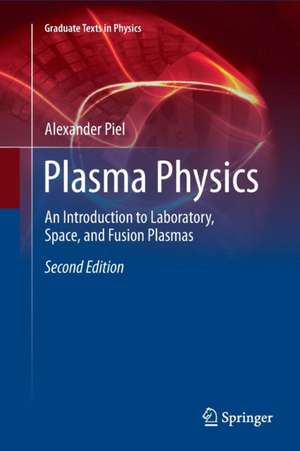
Plasma Physics
Autor Alexander Pielen Limba Engleză Paperback – 18 mai 2018
Written by an internationally renowned researcher in experimental plasma physics, the text keeps the mathematical apparatus simple and emphasizes the underlying concepts. The guidelines of plasma physics are illustrated by a host of practical examples, preferentially from plasma diagnostics. There, Langmuir probe methods, laser interferometry, ionospheric sounding, Faraday rotation, and diagnostics of dusty plasmas are discussed. Though primarily addressing students in plasma physics, the book is easily accessible for researchers in neighboring disciplines, such as space science, astrophysics, material science, applied physics, and electrical engineering.
This second edition has been thoroughly revised and contains substantially enlarged chapters on plasma diagnostics, dusty plasmas and plasma discharges. Probe techniques have been rearranged into basic theory and a host of practical examples for probe techniques in dc, rf, and space plasmas. New topics in dusty plasmas, such as plasma crystals, Yukawa balls, phase transitions and attractive forces have been adopted. The chapter on plasma discharges now contains a new section on conventional and high-power impulse magnetron sputtering. The recently discovered electrical asymmetry effect in capacitive rf-discharges is described.
The text is based on an introductory course to plasma physics and advanced courses in plasma diagnostics, dusty plasmas, and plasma waves, which the author has taught at Kiel University for three decades. The pedagogical approach combines detailed explanations, a large number of illustrative figures, short summaries of the basics at the end of each chapter, and a selection of problems with detailed solutions.
Preț: 517.94 lei
Preț vechi: 609.33 lei
-15%
Puncte Express: 777
Carte tipărită la comandă
Livrare economică 31 august-14 septembrie
Livrare prin curier în România Termenul estimat este afișat lângă disponibilitate.
Transport gratuit pentru acest produs Plată online sau ramburs, în funcție de opțiunile comenzii.
Retur gratuit în 14 zile Comandă securizată și suport în română.
Specificații
ISBN-13: 9783319875538
ISBN-10: 3319875531
Pagini: 484
Ilustrații: XX, 463 p. 268 illus., 39 illus. in color.
Dimensiuni: 155 x 235 x 27 mm
Greutate: 0.73 kg
Ediția:Softcover reprint of the original 2nd edition 2017
Editura: Springer
Locul publicării:Cham, Switzerland
ISBN-10: 3319875531
Pagini: 484
Ilustrații: XX, 463 p. 268 illus., 39 illus. in color.
Dimensiuni: 155 x 235 x 27 mm
Greutate: 0.73 kg
Ediția:Softcover reprint of the original 2nd edition 2017
Editura: Springer
Locul publicării:Cham, Switzerland
V-ar putea interesa
-
 Transport Phenomena in Partially Ionized PlasmaV.A. Rozhansky-18%Preț: 1808.90 lei2205.97 lei
 -
 Transport Processes in Multicomponent PlasmaV.M. Zhdanov-18%Preț: 1694.80 lei2066.83 lei
 -
 Dusty PlasmasBouchoule-9%Preț: 2708.71 lei2976.61 lei
 -
 Plasma Physics for AstrophysicsRussell M. Kulsrud-19%Preț: 684.67 lei845.28 lei
 -
 Instabilities in a Confined PlasmaA.B Mikhailovskii-18%Preț: 3185.20 lei3884.39 lei
 -
 Introduction to Dusty Plasma PhysicsP.K Shukla-18%Preț: 1692.18 lei2063.63 lei
 -
 Industrial Plasma Engineering - 2 Volume SetJ Reece Roth-9%Preț: 760.61 lei835.83 lei
 -
 Plasma WavesDonald Gary Swanson-9%Preț: 1136.52 lei1248.92 lei
 -
 Advances in Plasma Physics Research: Volume 6Francois Gerard-26%Preț: 399.21 lei536.57 lei
 -
 Plasma DiagnosticsA A Ovsyannikov-27%Preț: 730.76 lei1001.03 lei
 -
 Relativistic Electron MirrorsDaniel Kiefer-15%Preț: 616.45 lei725.24 lei
 -
 XUV Pump-Probe Experiments on Diatomic MoleculesKirsten Schnorr-15%Preț: 620.13 lei729.57 lei
 -
 Atomic Properties in Hot PlasmasJacques Bauche-15%Preț: 629.91 lei741.07 lei
 -
 Introduction to Plasma Physics and Controlled FusionFrancis Chen-15%Preț: 569.83 lei670.38 lei
 -
 Magnetically Activated and Guided Isotope SeparationThomas R. Mazur-15%Preț: 616.87 lei725.73 lei
 -
 Polarization BremsstrahlungAndrey V. Korol-29%Preț: 566.28 lei800.34 lei
 -
 -32%Preț: 544.58 lei796.68 lei
 -
 Active Control of Magneto-hydrodynamic Instabilities in Hot PlasmasValentin Igochine-15%Preț: 628.06 lei738.89 lei
Cuprins
Introduction.- Definition of the Plasma State.- Single Particle Motion in Electric and Magnetic Fields.- Stochastic Processes in a Plasma.-Fluid Models.- Plasma Waves.- Plasma Boundaries.- Instabilities.- Kinetic Description of Plasmas.- Dusty Plasmas.- Plasma Generation.- Glossary.- Appendices.- Solutions.
Notă biografică
Prof. Dr. Alexander Piel obtained his PhD in plasma physics from Ruhr-Universität Bochum in 1977 and habilitated in 1986. Since 1989 he is full professor of atomic and plasma physics at Kiel University. The author is a fellow of the American Physical Society and served as chair of the plasma physics division of Deutsche Physikalische Gesellschaft (German Physical Society). He has published more than 200 peer-reviewed articles in international journals and several book chapters.
Textul de pe ultima copertă
The enlarged new edition of this textbook provides a comprehensive introduction to the basic processes in plasmas and demonstrates that the same fundamental concepts describe cold gas-discharge plasmas, space plasmas, and hot fusion plasmas. Starting from particle drifts in magnetic fields, the principles of magnetic confinement fusion are explained and compared with laser fusion. Collective processes are discussed in terms of plasma waves and instabilities. The concepts of plasma description by magnetohydrodynamics, kinetic theory, and particle simulation are stepwise introduced. Space charge effects in sheath regions, double layers and plasma diodes are given the necessary attention. The novel fundamental mechanisms of dusty plasmas are explored and integrated into the framework of conventional plasmas. The book concludes with a concise description of modern plasma discharges.
Written by an internationally renowned researcher in experimental plasma physics, the text keeps the mathematical apparatus simple and emphasizes the underlying concepts. The guidelines of plasma physics are illustrated by a host of practical examples, preferentially from plasma diagnostics. There, Langmuir probe methods, laser interferometry, ionospheric sounding, Faraday rotation, and diagnostics of dusty plasmas are discussed. Though primarily addressing students in plasma physics, the book is easily accessible for researchers in neighboring disciplines, such as space science, astrophysics, material science, applied physics, and electrical engineering.
This second edition has been thoroughly revised and contains substantially enlarged chapters on plasma diagnostics, dusty plasmas and plasma discharges. Probe techniques have been rearranged into basic theory and a host of practical examples for probe techniques in dc, rf, and space plasmas. New topics in dusty plasmas, such as plasma crystals, Yukawa balls, phase transitions and attractive forces have been adopted. The chapter on plasma discharges now contains a new section on conventional and high-power impulse magnetron sputtering. The recently discovered electrical asymmetry effect in capacitive rf-discharges is described.
The text is based on an introductory course to plasma physics and advanced courses in plasma diagnostics, dusty plasmas, and plasma waves, which the author has taught at Kiel University for three decades. The pedagogical approach combines detailed explanations, a large number of illustrative figures, short summaries of the basics at the end of each chapter, and a selection of problems with detailed solutions.
Written by an internationally renowned researcher in experimental plasma physics, the text keeps the mathematical apparatus simple and emphasizes the underlying concepts. The guidelines of plasma physics are illustrated by a host of practical examples, preferentially from plasma diagnostics. There, Langmuir probe methods, laser interferometry, ionospheric sounding, Faraday rotation, and diagnostics of dusty plasmas are discussed. Though primarily addressing students in plasma physics, the book is easily accessible for researchers in neighboring disciplines, such as space science, astrophysics, material science, applied physics, and electrical engineering.
This second edition has been thoroughly revised and contains substantially enlarged chapters on plasma diagnostics, dusty plasmas and plasma discharges. Probe techniques have been rearranged into basic theory and a host of practical examples for probe techniques in dc, rf, and space plasmas. New topics in dusty plasmas, such as plasma crystals, Yukawa balls, phase transitions and attractive forces have been adopted. The chapter on plasma discharges now contains a new section on conventional and high-power impulse magnetron sputtering. The recently discovered electrical asymmetry effect in capacitive rf-discharges is described.
The text is based on an introductory course to plasma physics and advanced courses in plasma diagnostics, dusty plasmas, and plasma waves, which the author has taught at Kiel University for three decades. The pedagogical approach combines detailed explanations, a large number of illustrative figures, short summaries of the basics at the end of each chapter, and a selection of problems with detailed solutions.
Caracteristici
Covers all modern fields of plasma physics, such as low-temperature plasmas, plasma discharges and plasma diagnostics Places emphasis on experimental point of view and laboratory applications Gives an introduction to forefront research on complex plasmas, like non-neutral or dusty plasmas Can serve both as graduate text to newcomers in the field and a reference for professional low-temperature plasma researchers Contains chapter intros and summaries, many high quality figures, boxed inserts, problems and solutions, as well as a glossary Includes supplementary material: sn.pub/extras
Descriere
Descriere de la o altă ediție sau format:
This book is an outgrowth of courses in plasma physics which I have taught at Kiel University for many years. During this time I have tried to convince my students that plasmas as different as gas dicharges, fusion plasmas and space plasmas can be described in a uni ed way by simple models. The challenge in teaching plasma physics is its apparent complexity. The wealth of plasma phenomena found in so diverse elds makes it quite different from atomic physics, where atomic structure, spectral lines and chemical binding can all be derived from a single equation—the Schrödinger equation. I positively accept the variety of plasmas and refrain from subdividing plasma physics into the traditional, but arti cially separated elds, of hot, cold and space plasmas. This is why I like to confront my students, and the readers of this book, with examples from so many elds. By this approach, I believe, they will be able to become discoverers who can see the commonality between a falling apple and planetary motion. As an experimentalist, I am convinced that plasma physics can be best understood from a bottom-up approach with many illustrating examples that give the students con dence in their understanding of plasma processes. The theoretical framework of plasma physics can then be introduced in several steps of re nement. In the end, the student (or reader) will see that there is something like the Schrödinger equation, namely the Vlasov-Maxwell model of plasmas, from which nearly all phenomena in collisionless plasmas can be derived.
This book is an outgrowth of courses in plasma physics which I have taught at Kiel University for many years. During this time I have tried to convince my students that plasmas as different as gas dicharges, fusion plasmas and space plasmas can be described in a uni ed way by simple models. The challenge in teaching plasma physics is its apparent complexity. The wealth of plasma phenomena found in so diverse elds makes it quite different from atomic physics, where atomic structure, spectral lines and chemical binding can all be derived from a single equation—the Schrödinger equation. I positively accept the variety of plasmas and refrain from subdividing plasma physics into the traditional, but arti cially separated elds, of hot, cold and space plasmas. This is why I like to confront my students, and the readers of this book, with examples from so many elds. By this approach, I believe, they will be able to become discoverers who can see the commonality between a falling apple and planetary motion. As an experimentalist, I am convinced that plasma physics can be best understood from a bottom-up approach with many illustrating examples that give the students con dence in their understanding of plasma processes. The theoretical framework of plasma physics can then be introduced in several steps of re nement. In the end, the student (or reader) will see that there is something like the Schrödinger equation, namely the Vlasov-Maxwell model of plasmas, from which nearly all phenomena in collisionless plasmas can be derived.
Recenzii
From the reviews:
“Plasma Physics offers a broad and modern introduction to the many aspects of plasma science … . A curious student or interested researcher could track down laboratory notes, older monographs, and obscure papers … . with an extensive list of more than 300 references and, in particular, its excellent overview of the various techniques to generate plasma in a laboratory, Plasma Physics is an excellent entree for students into this rapidly growing field. It’s also a useful reference for professional low-temperature plasma researchers.” (Michael Brown, Physics Today, June, 2011)
“Plasma Physics offers a broad and modern introduction to the many aspects of plasma science … . A curious student or interested researcher could track down laboratory notes, older monographs, and obscure papers … . with an extensive list of more than 300 references and, in particular, its excellent overview of the various techniques to generate plasma in a laboratory, Plasma Physics is an excellent entree for students into this rapidly growing field. It’s also a useful reference for professional low-temperature plasma researchers.” (Michael Brown, Physics Today, June, 2011)