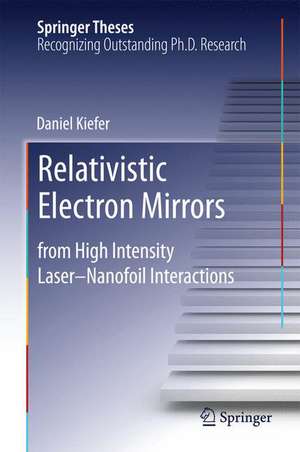
Relativistic Electron Mirrors: Springer Theses
Autor Daniel Kieferen Limba Engleză Hardback – 13 aug 2014
Din seria Springer Theses
- 15%
 Preț: 663.23 lei
 - 15%
 Preț: 661.49 lei
 - 15%
 Preț: 660.04 lei
 - 18%
 Preț: 1186.50 lei
 -
 Preț: 397.39 lei
 - 18%
 Preț: 1078.31 lei
 - 18%
 Preț: 1182.27 lei
 - 15%
 Preț: 665.20 lei
 -
 Preț: 404.91 lei
 -
 Preț: 401.44 lei
 - 18%
 Preț: 1263.02 lei
 -
 Preț: 410.46 lei
 - 18%
 Preț: 1068.71 lei
 - 18%
 Preț: 977.51 lei
 - 18%
 Preț: 1348.61 lei
 - 15%
 Preț: 663.23 lei
 - 18%
 Preț: 1031.60 lei
 - 15%
 Preț: 638.81 lei
 - 18%
 Preț: 978.49 lei
 -
 Preț: 398.83 lei
 - 15%
 Preț: 667.93 lei
 -
 Preț: 399.72 lei
 - 15%
 Preț: 658.80 lei
 - 15%
 Preț: 663.97 lei
 - 15%
 Preț: 664.46 lei
 - 18%
 Preț: 1015.11 lei
 - 15%
 Preț: 663.48 lei
 - 18%
 Preț: 973.50 lei
 - 18%
 Preț: 960.54 lei
 - 18%
 Preț: 1352.59 lei
 - 15%
 Preț: 661.99 lei
 - 18%
 Preț: 1144.10 lei
 - 18%
 Preț: 1264.69 lei
 - 18%
 Preț: 1076.54 lei
 - 18%
 Preț: 1036.63 lei
 - 18%
 Preț: 1156.95 lei
 - 18%
 Preț: 1036.70 lei
 - 18%
 Preț: 979.42 lei
 - 15%
 Preț: 642.59 lei
 - 15%
 Preț: 665.96 lei
 - 18%
 Preț: 976.57 lei
 - 18%
 Preț: 964.49 lei
 -
 Preț: 401.44 lei
 -
 Preț: 399.14 lei
 - 18%
 Preț: 1080.53 lei
 - 18%
 Preț: 1172.17 lei
 - 15%
 Preț: 658.33 lei
 - 15%
 Preț: 662.51 lei
 - 15%
 Preț: 659.03 lei
 - 15%
 Preț: 659.78 lei
Preț: 660.61 lei
Preț vechi: 777.18 lei
-15%
Puncte Express: 991
Carte tipărită la comandă
Livrare economică 26 noiembrie-10 decembrie
Livrare prin curier în România Termenul estimat este afișat lângă disponibilitate.
Transport gratuit pentru acest produs Plată online sau ramburs, în funcție de opțiunile comenzii.
Retur gratuit în 14 zile Comandă securizată și suport în română.
Specificații
ISBN-13: 9783319077512
ISBN-10: 3319077511
Pagini: 132
Ilustrații: XIII, 117 p. 62 illus., 59 illus. in color.
Dimensiuni: 160 x 241 x 13 mm
Greutate: 0.32 kg
Ediția:2015
Editura: Springer
Colecția Springer Theses
Seria Springer Theses
Locul publicării:Cham, Switzerland
ISBN-10: 3319077511
Pagini: 132
Ilustrații: XIII, 117 p. 62 illus., 59 illus. in color.
Dimensiuni: 160 x 241 x 13 mm
Greutate: 0.32 kg
Ediția:2015
Editura: Springer
Colecția Springer Theses
Seria Springer Theses
Locul publicării:Cham, Switzerland
V-ar putea interesa
-
 -31%Preț: 629.58 lei911.20 lei
 -
 Time-Dependent Density-Functional Theory: Concepts and ApplicationsCarsten A. Ullrich-20%Preț: 538.18 lei675.95 lei
 -
 Theory of Nonequilibrium SuperconductivityNikolai Kopnin-25%Preț: 551.05 lei737.08 lei
 -
 The Physics of CloudsB. J. Mason-24%Preț: 609.30 lei805.11 lei
 -
 Layered Superconductors: Volume 1Richard A. Klemm-31%Preț: 972.93 lei1407.22 lei
 -
 -27%Preț: 524.23 lei717.13 lei
 -
 Electricity and Magnetism, Volume 1B. I. Bleaney-11%Preț: 362.38 lei407.28 lei
 -
 Electricity and Magnetism, Volume 2B. I. Bleaney-21%Preț: 470.50 lei594.96 lei
 -
 -23%Preț: 675.69 lei882.79 lei
 -
 Introduction to Plasma PhysicsR. J. Goldston-18%Preț: 761.00 lei928.05 lei
 -
 Plasma MedicineM. Laroussi-14%Preț: 1132.98 lei1317.41 lei
 -
 An Indispensable TruthFrancis Chen-15%Preț: 531.78 lei625.62 lei
 -
 -14%Preț: 793.74 lei922.95 lei
Public țintă
ResearchCuprins
Theoretical Background.- Experimental Methods: Lasers, Targets and Detectors.- Electron Acceleration from Laser-Nanofoil Interactions.- Coherent Thomson Backscattering from Relativistic Electron Mirrors.
Textul de pe ultima copertă
A dense sheet of electrons accelerated to close to the speed of light can act as a tuneable mirror that can generate bright bursts of laser-like radiation in the short wavelength range simply via the reflection of a counter-propagating laser pulse. This thesis investigates the generation of such a relativistic electron mirror structure in a series of experiments accompanied by computer simulations. It is shown that such relativistic mirror can indeed be created from the interaction of a high-intensity laser pulse with a nanometer-scale, ultrathin foil. The reported work gives a intriguing insight into the complex dynamics of high-intensity laser–nanofoil interactions and constitutes a major step towards the development of a relativistic mirror, which could potentially generate bright burst of X-rays on a micro-scale.
Caracteristici
Nominated as an outstanding Ph.D. thesis by the Max Planck Institute for Quantum Optics, Garching, Germany Reports on the generation of a microscopic mirror structure accelerated to close to the speed of light Covers experimental and theoretical aspects in an illustrative manner Includes a comprehensive experimental study on laser-driven electron acceleration from nano-scale freestanding foils Includes supplementary material: sn.pub/extras