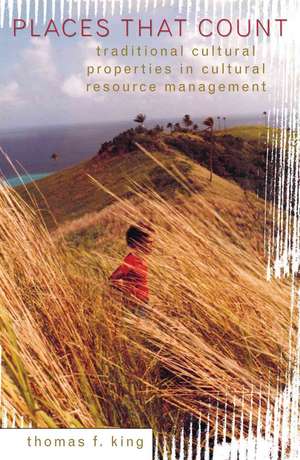
Places That Count: Traditional Cultural Properties in Cultural Resource Management: Heritage Resource Management Series
Autor Thomas F. Kingen Limba Engleză Paperback – 8 sep 2003
Preț: 321.83 lei
Preț vechi: 401.14 lei
-20%
Puncte Express: 483
Carte tipărită la comandă
Livrare economică 07-21 decembrie
Livrare prin curier în România Termenul estimat este afișat lângă disponibilitate.
Transport gratuit de la 400.00 lei Plată online sau ramburs, în funcție de opțiunile comenzii.
Retur gratuit în 14 zile Comandă securizată și suport în română.
Specificații
ISBN-13: 9780759100718
ISBN-10: 0759100713
Pagini: 350
Dimensiuni: 155 x 232 x 18 mm
Greutate: 0.47 kg
Ediția:New.
Editura: Bloomsbury Publishing
Colecția AltaMira Press
Seria Heritage Resource Management Series
Locul publicării:New York, United States
ISBN-10: 0759100713
Pagini: 350
Dimensiuni: 155 x 232 x 18 mm
Greutate: 0.47 kg
Ediția:New.
Editura: Bloomsbury Publishing
Colecția AltaMira Press
Seria Heritage Resource Management Series
Locul publicării:New York, United States
V-ar putea interesa
-
 Mass Media and Free Trade: NAFTA and the Cultural IndustriesEmile G. McAnanyPreț: 331.66 lei
 -
 Preț: 467.81 lei
 -
 Heritage Studies: Methods and ApproachesMarie Louise Stig SørensenPreț: 480.15 lei
 -
 -18%Preț: 1297.75 lei1582.62 lei
 -
 -18%Preț: 1299.91 lei1585.26 lei
 -
 The Idea of Cultural HeritageDerek GillmanPreț: 210.60 lei
 -
 Art of the DealNoah HorowitzPreț: 222.22 lei
 -
 History and memoryGeoffrey CubittPreț: 232.99 lei
 -
 The Heritage-scape: UNESCO, World Heritage, and TourismDr. Michael A. Di Giovine-30%Preț: 406.60 lei583.13 lei
 -
 -19%Preț: 324.00 lei399.29 lei
 -
 Manual of Museum ManagementGail Dexter Lord-19%Preț: 483.22 lei596.56 lei
 -
 The Risk Society and BeyondBarbara Adam-18%Preț: 694.47 lei846.92 lei
 -
 Preț: 301.72 lei
 -
 A Richer HeritageRobert E. StipePreț: 448.96 lei
 -
 The Historic Urban LandscapeFrancesco Bandarin-8%Preț: 476.53 lei517.97 lei
 -
 Issues in Cultural Tourism StudiesMelanie K. Smith-15%Preț: 557.02 lei655.32 lei
 -
 -9%Preț: 2783.84 lei3059.16 lei
 -
 Eco-Architecture VC. A. Brebbia-9%Preț: 2924.71 lei3213.96 lei
 -
 Cultural Heritage and Value CreationGaetano M. Golinelli-18%Preț: 923.32 lei1126.00 lei
 -
 Cultural EconomicsRuth Towse-18%Preț: 911.34 lei1111.40 lei
 -
 Cultural Economics and Cultural PoliciesA T Peacock-18%Preț: 924.81 lei1127.82 lei
Cuprins
Chapter 1: Getting Started With TCPs
Chapter 2: How Did "TCPs" Come Into Our Vernacular?
Chapter 3: TCPs in Broader Perspective: Examples From Far and Wide
Chapter 4: And Closer to Home...
Chapter 5: TCPs in Broader Perspective: Theoretical and Synthesizing Perspectives
Chapter 6: What Makes a TCP?
Chapter 7: Bulletin 38 Revisited: Identifying TCPs
Chapter 8: Bulletin 38 Revisited: Evaluating Eligibility
Chapter 9: Beyond Identification: Managing Effects
Chapter 10: Beyond Bulletin 38: Managing TCPs Themselves
Chapter 11: Consultation
Chapter 12: Some TCP Issues
Chapter 13: A View From The Hill
Chapter 2: How Did "TCPs" Come Into Our Vernacular?
Chapter 3: TCPs in Broader Perspective: Examples From Far and Wide
Chapter 4: And Closer to Home...
Chapter 5: TCPs in Broader Perspective: Theoretical and Synthesizing Perspectives
Chapter 6: What Makes a TCP?
Chapter 7: Bulletin 38 Revisited: Identifying TCPs
Chapter 8: Bulletin 38 Revisited: Evaluating Eligibility
Chapter 9: Beyond Identification: Managing Effects
Chapter 10: Beyond Bulletin 38: Managing TCPs Themselves
Chapter 11: Consultation
Chapter 12: Some TCP Issues
Chapter 13: A View From The Hill
Recenzii
As a cultural resource manager who has worked and struggled with Traditional Cultural Properties for years, Tom King's new book puts many of my past experiences into perspective and provided new ideas and insights for future practice. Anyone responsible for managing and protecting TCPs will find King's compassionate and pragmatic perspectives to be both interesting and valuable.
Places that Count aims to help members of the heritage preservation community understand and recognize traditional cultural places in all their kaleidoscopic and culturally variegated forms. This volume is an elegant and eloquent presentation of preservation laws and regulations, coupled with King's philosophical ruminations about how they might have been, and might yet be, better used in the interests of everyone concerned with historic preservation of places and the multiplicity of meanings attached thereto. King knows preservation laws and regulations perhaps better than any one in the country, and is keenly aware that, in the end, both are matters of (often contested) interpretation. We would do well, in the interests of heritage preservation in general and traditional cultural places in particular, to listen to and act upon-what he has to tell us.
Places that Count aims to help members of the heritage preservation community understand and recognize traditional cultural places in all their kaleidoscopic and culturally variegated forms. This volume is an elegant and eloquent presentation of preservation laws and regulations, coupled with King's philosophical ruminations about how they might have been, and might yet be, better used in the interests of everyone concerned with historic preservation of places and the multiplicity of meanings attached thereto. King knows preservation laws and regulations perhaps better than any one in the country, and is keenly aware that, in the end, both are matters of (often contested) interpretation. We would do well, in the interests of heritage preservation in general and traditional cultural places in particular, to listen to and act upon-what he has to tell us.