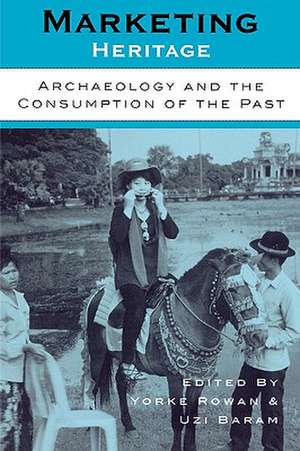
Marketing Heritage: Archaeology and the Consumption of the Past
Editat de Yorke Rowan, Uzi Baramen Limba Engleză Paperback – 27 aug 2004
Preț: 324.00 lei
Preț vechi: 399.29 lei
-19%
Puncte Express: 486
Carte tipărită la comandă
Livrare economică 03-17 decembrie
Livrare prin curier în România Termenul estimat este afișat lângă disponibilitate.
Transport gratuit de la 400.00 lei Plată online sau ramburs, în funcție de opțiunile comenzii.
Retur gratuit în 14 zile Comandă securizată și suport în română.
Specificații
ISBN-13: 9780759103429
ISBN-10: 0759103429
Pagini: 328
Dimensiuni: 155 x 231 x 17 mm
Greutate: 0.45 kg
Ediția:New.
Editura: Bloomsbury Publishing
Colecția AltaMira Press
Locul publicării:New York, United States
ISBN-10: 0759103429
Pagini: 328
Dimensiuni: 155 x 231 x 17 mm
Greutate: 0.45 kg
Ediția:New.
Editura: Bloomsbury Publishing
Colecția AltaMira Press
Locul publicării:New York, United States
V-ar putea interesa
-
 Mass Media and Free Trade: NAFTA and the Cultural IndustriesEmile G. McAnanyPreț: 331.66 lei
 -
 Preț: 467.81 lei
 -
 Heritage Studies: Methods and ApproachesMarie Louise Stig SørensenPreț: 480.15 lei
 -
 -18%Preț: 1254.81 lei1530.26 lei
 -
 -18%Preț: 1299.91 lei1585.26 lei
 -
 The Idea of Cultural HeritageDerek GillmanPreț: 210.60 lei
 -
 Economics and CultureDavid ThrosbyPreț: 346.72 lei
 -
 Art of the DealNoah HorowitzPreț: 222.22 lei
 -
 History and memoryGeoffrey CubittPreț: 225.43 lei
 -
 The Heritage-scape: UNESCO, World Heritage, and TourismDr. Michael A. Di Giovine-30%Preț: 406.60 lei583.13 lei
 -
 Manual of Museum ManagementGail Dexter Lord-19%Preț: 483.22 lei596.56 lei
 -
 The Risk Society and BeyondBarbara Adam-18%Preț: 694.47 lei846.92 lei
 -
 Preț: 301.72 lei
 -
 A Richer HeritageRobert E. StipePreț: 448.96 lei
 -
 The Historic Urban LandscapeFrancesco Bandarin-8%Preț: 476.53 lei517.97 lei
 -
 Issues in Cultural Tourism StudiesMelanie K. Smith-15%Preț: 557.02 lei655.32 lei
 -
 -9%Preț: 2783.84 lei3059.16 lei
 -
 Eco-Architecture VC. A. Brebbia-9%Preț: 2924.71 lei3213.96 lei
 -
 Cultural Heritage and Value CreationGaetano M. Golinelli-18%Preț: 923.32 lei1126.00 lei
 -
 Cultural EconomicsRuth Towse-18%Preț: 911.34 lei1111.40 lei
 -
 Cultural Economics and Cultural PoliciesA T Peacock-18%Preț: 924.81 lei1127.82 lei
Cuprins
Chapter 1 Preface
2 Section I: Introduction
3 Chapter 1 "Archaeology after Nationalism: Globalization and the Consumption of the Past"
4 Section II: The Legal and Historical Context for Marketing Heritage
5 Chapter 2 "International Conventions and Cultural Heritage Protection"
6 Chapter 3 "The Politics of Playing Fair, or, Who's Losing Their Marbles?"
7 Chapter 4 "From Lord Elgin to James Henry Breasted: The Politics of the Past in the First Era of Globalization"
8 Section III: Commodification of the Past
9 Chapter 5 "Conflating Past and Present: Marketing Archaeological Tourism? Advertising and the Appropriation of Culture"
10 Chapter 6 "Mementos of the Past: Material Culture of Tourism at Stonehenge and Avebury"
11 Chapter 7 "Where are the Maya in Ancient Maya Archaeological Tourism? Advertising and the Appropriation of Culture"
12 Section IV: Archaeology in the Global Age
13 Chapter 8 "Archaeological Research and Cultural Heritage Management in Cambodia's Mekong Delta: The Search for the 'Cradle of Khmer Civilization'"
14 Chapter 9 "Recovering the German Nation: Heritage Restoration and the Search for Unity"
15 Chapter 10 "Deep Dirt: Messing up the Past at Colonial Williamsburg"
16 Chapter 11 "Targeting Heritage: The Abuse of Symbolic Sites in Modern Conflicts"
17 Section V: Representing the Past
18 Chapter 12 "Tourism, the Ideology of Design and the Nationalized Past in Zippori/Sepphoris, an Israeli National Park"
19 Chapter 13 "The Roads to Ruins: Accessing Islamic Heritage in Jordan"
20 Chapter 14 "Re-Packaging the Pilgrimage: Visiting the Holy Land in Orlando"
21 Section VI: Conclusions: Archaeologists and the Marketing of Heritage
22 Chapter 15 "Is the medium the message? The art of interpreting archaeology in the U.S. National Parks"
23 Chapter 16 "Engaging with Heritage Issues: The Role of the World Archaeological Congress"
24 Chapter 17 "Making the Past Profitable in an Age of Globalization and National Ownership: contradictions and considerations"
2 Section I: Introduction
3 Chapter 1 "Archaeology after Nationalism: Globalization and the Consumption of the Past"
4 Section II: The Legal and Historical Context for Marketing Heritage
5 Chapter 2 "International Conventions and Cultural Heritage Protection"
6 Chapter 3 "The Politics of Playing Fair, or, Who's Losing Their Marbles?"
7 Chapter 4 "From Lord Elgin to James Henry Breasted: The Politics of the Past in the First Era of Globalization"
8 Section III: Commodification of the Past
9 Chapter 5 "Conflating Past and Present: Marketing Archaeological Tourism? Advertising and the Appropriation of Culture"
10 Chapter 6 "Mementos of the Past: Material Culture of Tourism at Stonehenge and Avebury"
11 Chapter 7 "Where are the Maya in Ancient Maya Archaeological Tourism? Advertising and the Appropriation of Culture"
12 Section IV: Archaeology in the Global Age
13 Chapter 8 "Archaeological Research and Cultural Heritage Management in Cambodia's Mekong Delta: The Search for the 'Cradle of Khmer Civilization'"
14 Chapter 9 "Recovering the German Nation: Heritage Restoration and the Search for Unity"
15 Chapter 10 "Deep Dirt: Messing up the Past at Colonial Williamsburg"
16 Chapter 11 "Targeting Heritage: The Abuse of Symbolic Sites in Modern Conflicts"
17 Section V: Representing the Past
18 Chapter 12 "Tourism, the Ideology of Design and the Nationalized Past in Zippori/Sepphoris, an Israeli National Park"
19 Chapter 13 "The Roads to Ruins: Accessing Islamic Heritage in Jordan"
20 Chapter 14 "Re-Packaging the Pilgrimage: Visiting the Holy Land in Orlando"
21 Section VI: Conclusions: Archaeologists and the Marketing of Heritage
22 Chapter 15 "Is the medium the message? The art of interpreting archaeology in the U.S. National Parks"
23 Chapter 16 "Engaging with Heritage Issues: The Role of the World Archaeological Congress"
24 Chapter 17 "Making the Past Profitable in an Age of Globalization and National Ownership: contradictions and considerations"
Recenzii
This book will rightly make you question the social forces at play in marketing heritage, the politics of of representation apparent in particular pasts, and the way sin which commodification affects your own views about what you see and reach about heritage sites.
This volume is an important contribution to the debates on cultural tourism and the marketing of heritage places. . . I recommend this book to anyone interested in heritage issues and tourism and to any archaeologist wishing to pursue how archaeological knowledge and data is understood and used in the wider world.
It is essential reading for people involved in the presentation of heritage, be they based in museums, interpretive centers, or historical parks. It is equally necessary reading for those in universities and consulting companies who 'produce' heritage because it stimulates us to contemplate how our data will be used after the permit reports and the scientific publications are put on the shelf.
This is no business school analysis or laundry list marketing plan, but, rather, a thought-provoking and wide-ranging analysis of the manifestation and implications of heritage tourism based on the traditions of anthropological theory and inquiry. . . The authors do a tremendous job of presenting this primary thesis, and validate that it is, indeed, a global phenomenon.
This volume marks an important contribution to the growing literature on international heritage management. The chapters are global in scope and include both familiar and unfamiliar sites and issues. . .Marketing Heritage is a very strong work. The case studies are interesting, varied, provocative, well written, and will meet the needs and interests of a wide readership.
It is a well-presented and well-referenced. . . I recommend it to heritage practitioners with site planning roles, for the issues raised stimulate awareness of the risks and processes in marketing our heritage.
While the imporatance of culture and heritage for tourism has been recognized and studied by both tourism academics and destination planners, this book provides a new and valuable perspective on heritage tourism, as it enables readers to understand how archaeologists perceive the growing influence of the sector on hte global marketing of the inherited past.
This volume is an important contribution to the debates on cultural tourism and the marketing of heritage places. . . I recommend this book to anyone interested in heritage issues and tourism and to any archaeologist wishing to pursue how archaeological knowledge and data is understood and used in the wider world.
It is essential reading for people involved in the presentation of heritage, be they based in museums, interpretive centers, or historical parks. It is equally necessary reading for those in universities and consulting companies who 'produce' heritage because it stimulates us to contemplate how our data will be used after the permit reports and the scientific publications are put on the shelf.
This is no business school analysis or laundry list marketing plan, but, rather, a thought-provoking and wide-ranging analysis of the manifestation and implications of heritage tourism based on the traditions of anthropological theory and inquiry. . . The authors do a tremendous job of presenting this primary thesis, and validate that it is, indeed, a global phenomenon.
This volume marks an important contribution to the growing literature on international heritage management. The chapters are global in scope and include both familiar and unfamiliar sites and issues. . .Marketing Heritage is a very strong work. The case studies are interesting, varied, provocative, well written, and will meet the needs and interests of a wide readership.
It is a well-presented and well-referenced. . . I recommend it to heritage practitioners with site planning roles, for the issues raised stimulate awareness of the risks and processes in marketing our heritage.
While the imporatance of culture and heritage for tourism has been recognized and studied by both tourism academics and destination planners, this book provides a new and valuable perspective on heritage tourism, as it enables readers to understand how archaeologists perceive the growing influence of the sector on hte global marketing of the inherited past.