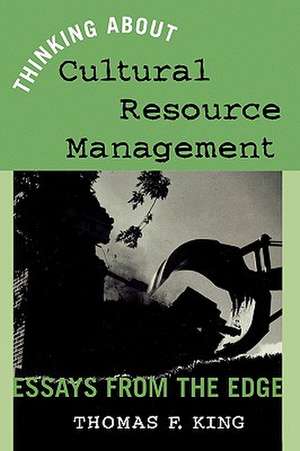
Thinking About Cultural Resource Management: Essays from the Edge: Heritage Resource Management Series
Autor Thomas F. Kingen Limba Engleză Paperback – 27 aug 2002
Preț: 277.56 lei
Preț vechi: 361.68 lei
-23%
Puncte Express: 416
Carte tipărită la comandă
Livrare economică 17 noiembrie-01 decembrie
Livrare prin curier în România Termenul estimat este afișat lângă disponibilitate.
Transport gratuit de la 400.00 lei Plată online sau ramburs, în funcție de opțiunile comenzii.
Retur gratuit în 14 zile Comandă securizată și suport în română.
Specificații
ISBN-13: 9780759102149
ISBN-10: 0759102147
Pagini: 216
Dimensiuni: 153 x 231 x 14 mm
Greutate: 0.33 kg
Editura: Bloomsbury Publishing
Colecția AltaMira Press
Seria Heritage Resource Management Series
Locul publicării:New York, United States
ISBN-10: 0759102147
Pagini: 216
Dimensiuni: 153 x 231 x 14 mm
Greutate: 0.33 kg
Editura: Bloomsbury Publishing
Colecția AltaMira Press
Seria Heritage Resource Management Series
Locul publicării:New York, United States
V-ar putea interesa
-
 -19%Preț: 312.66 lei387.90 lei
 -
 -20%Preț: 321.83 lei401.14 lei
 -
 Amelia Earhart's ShoesThomas F. King-15%Preț: 136.43 lei159.63 lei
 -
 Cultural Resources Archaeology: An IntroductionThomas W. Neumann-33%Preț: 792.22 lei1185.50 lei
 -
 Cultural Resource Laws and PracticeThomas F. King-34%Preț: 721.64 lei1098.91 lei
 -
 An Archaeology of ReligionKit W. Wesler-26%Preț: 281.73 lei380.96 lei
 -
 People and Plants in Ancient Eastern North AmericaPaul E. MinnisPreț: 273.13 lei
 -
 The Athenian Agora Site GuideJohn McK CampPreț: 139.09 lei
 -
 -8%Preț: 402.03 lei436.98 lei
 -
 Documentation of Associated and Unassociated Caddo Funerary ObjectsTimothy K. PerttulaPreț: 241.84 lei
 -
 -19%Preț: 675.62 lei834.10 lei
 -
 Johannes Wiedewelt: A Danish Artist in Search of the Past, Shaping the FutureMarjatta Nielsen Ph.D.-24%Preț: 359.02 lei472.97 lei
Cuprins
Acknowledgments
Introduction
Chapter 1: Rethinking Cultural Resource Management
Chapter 2: Thinking About Cultural Resources Management as an Extradisciplinary Enterprise
Chapter 3: Doing a Job on Culture
Chapter 4: It's Not Ethnography, Either
Chapter 5: An Uninspired Centerpiece: The National Register of Historic Places
Chapter 6: The Hester
Chapter 7: Process vs. Preservation: a False Dichotomy
Chapter 8: Thinking About Impact Assessment and Mitigation
Chapter 9: What Is Section 106 Review Anyhow? Two Views
Chapter 10: What if We Lost Section 106? Is the Worst Case Necessarily the Worst Case?
Chapter 11: What's in a Name? The Case of "Potentially Eligible" Historic Properties
Chapter 12: In the Eye of the Beholder: Visual Impacts and Section 106 Review
Chapter 13: "Historic Preservation's Responsibility" and Section 4(f) of the Department of Transportation Act
Chapter 14: The Letter of the Law
Chapter 15: A Consultant's Duty
Chapter 16: Thinking about Indigenous Issues
Chapter 17: What's Really Wrong with NAGPRA
Chapter 18: Stupid TCP Tricks
Chapter 19: Bigger Than a Breadbox?
Chapter 20: What Should We Consult About, and How Much Information Do We Need to Do It?
Chapter 21: Thinking About Archeology in CRM
Chapter 22: Archeo-Bias: Recognition and Prevention
Chapter 23: Integrity Among Archeologists: The Dirty Truth
Chapter 24: A 1937 Winged Liberty Head Dime From Silver Spring, Maryland
Chapter 25: Lafayette, Where Are You? The European Union, Cultural Heritage, and CRM in the United States
Glossary
Bibliography
About the Author
Introduction
Chapter 1: Rethinking Cultural Resource Management
Chapter 2: Thinking About Cultural Resources Management as an Extradisciplinary Enterprise
Chapter 3: Doing a Job on Culture
Chapter 4: It's Not Ethnography, Either
Chapter 5: An Uninspired Centerpiece: The National Register of Historic Places
Chapter 6: The Hester
Chapter 7: Process vs. Preservation: a False Dichotomy
Chapter 8: Thinking About Impact Assessment and Mitigation
Chapter 9: What Is Section 106 Review Anyhow? Two Views
Chapter 10: What if We Lost Section 106? Is the Worst Case Necessarily the Worst Case?
Chapter 11: What's in a Name? The Case of "Potentially Eligible" Historic Properties
Chapter 12: In the Eye of the Beholder: Visual Impacts and Section 106 Review
Chapter 13: "Historic Preservation's Responsibility" and Section 4(f) of the Department of Transportation Act
Chapter 14: The Letter of the Law
Chapter 15: A Consultant's Duty
Chapter 16: Thinking about Indigenous Issues
Chapter 17: What's Really Wrong with NAGPRA
Chapter 18: Stupid TCP Tricks
Chapter 19: Bigger Than a Breadbox?
Chapter 20: What Should We Consult About, and How Much Information Do We Need to Do It?
Chapter 21: Thinking About Archeology in CRM
Chapter 22: Archeo-Bias: Recognition and Prevention
Chapter 23: Integrity Among Archeologists: The Dirty Truth
Chapter 24: A 1937 Winged Liberty Head Dime From Silver Spring, Maryland
Chapter 25: Lafayette, Where Are You? The European Union, Cultural Heritage, and CRM in the United States
Glossary
Bibliography
About the Author
Recenzii
Thinking About Cultural Resource Management: Essays from the Edge...includes thoughtful articles on a wide range of topics including meaningful consultation with Native People and biases among archaeologists.
King's critical voice is indeed a refreshing retort to the uncritical literature that frequently appears in cultural resource management and historic preservation policy publications...King's rebukes encourage a new line of thinking about CRM: a much more critical understanding of the regulations that govern our work and the fragmented sources of power that often lie behind it.
A substantial contribution to American historical and archaeological resources at both intellectual and hands-on levels...a worthy enterprise...I can commend this to anybody in CRM domains...happily and strongly recommend[ed]
This book is...interesting in providing a context for the growth of the heritage industry...the underpinning issues are highly relevant...the book should be compulsory reading for heritage professionals, both within and outside government agencies.
This book contains the same rational, articulate and pointed critique of CRM laws and their implementation that we have come to expect and enjoy from King....I strongly recommend this book to anyone involved in cultural resource management and believe it should be a fundamental teaching tool for university courses.
I promise you a great read, lots of opportunities to live inside of Tom King's head for a little while and find out exactly what a cosmic, marvelously contentious and critically important thought space that really is. Anyone who is on the consulting or receiving end of CRM practice should see this book as a must-read. It is not a primer on process, but rather a sequence of considerations on the 'why'-ness of it all, and how we as a national community have more, or less, managed our collective cultural affairs....you will get high humor in the midst of the dandy diatribes.
King effectively provoked me into a critical evaluation of what we are trying to accomplish with CRM. I recommend this volume as food for thougt to CRM practitioners, government regulators and teachers of CRM practice at universities and colleges.
Few individuals are better placed to provide sage advice and observation about the current state of CRM practice than King.
King's critical voice is indeed a refreshing retort to the uncritical literature that frequently appears in cultural resource management and historic preservation policy publications...King's rebukes encourage a new line of thinking about CRM: a much more critical understanding of the regulations that govern our work and the fragmented sources of power that often lie behind it.
A substantial contribution to American historical and archaeological resources at both intellectual and hands-on levels...a worthy enterprise...I can commend this to anybody in CRM domains...happily and strongly recommend[ed]
This book is...interesting in providing a context for the growth of the heritage industry...the underpinning issues are highly relevant...the book should be compulsory reading for heritage professionals, both within and outside government agencies.
This book contains the same rational, articulate and pointed critique of CRM laws and their implementation that we have come to expect and enjoy from King....I strongly recommend this book to anyone involved in cultural resource management and believe it should be a fundamental teaching tool for university courses.
I promise you a great read, lots of opportunities to live inside of Tom King's head for a little while and find out exactly what a cosmic, marvelously contentious and critically important thought space that really is. Anyone who is on the consulting or receiving end of CRM practice should see this book as a must-read. It is not a primer on process, but rather a sequence of considerations on the 'why'-ness of it all, and how we as a national community have more, or less, managed our collective cultural affairs....you will get high humor in the midst of the dandy diatribes.
King effectively provoked me into a critical evaluation of what we are trying to accomplish with CRM. I recommend this volume as food for thougt to CRM practitioners, government regulators and teachers of CRM practice at universities and colleges.
Few individuals are better placed to provide sage advice and observation about the current state of CRM practice than King.