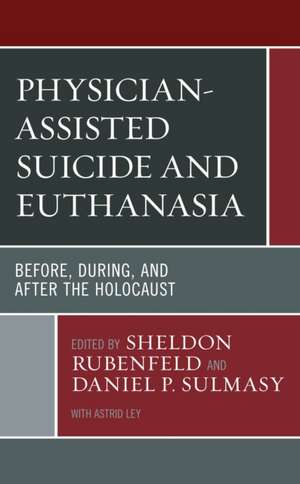
Physician-Assisted Suicide and Euthanasia: Before, During, and After the Holocaust: Revolutionary Bioethics
Editat de Sheldon Rubenfeld, Daniel P. Sulmasy Cu Astrid Ley Contribuţii de Florian Bruns, LaVera Crawley, James Downar, Alan Elbaum, Ashley K. Fernandes, Gerrit Hohendorf, Scott Kim, Eric Kodish, Barron H. Lerner, Diane E. Meier, H. Christof Müller-Busch, Kenneth Prager, Robert A. Pearlman, Timothy E. Quill, Volker Roelcke, Stephan Sahm, Avraham Steinberg, Eduard Verhagenen Limba Engleză Paperback – 11 mai 2022


Preț: 246.52 lei
Preț vechi: 352.07 lei
-30%
Puncte Express: 370
Carte tipărită la comandă
Livrare economică 02-16 decembrie
Livrare prin curier în România Termenul estimat este afișat lângă disponibilitate.
Transport gratuit de la 400.00 lei Plată online sau ramburs, în funcție de opțiunile comenzii.
Retur gratuit în 14 zile Comandă securizată și suport în română.
Specificații
ISBN-13: 9781793609519
ISBN-10: 1793609519
Pagini: 358
Dimensiuni: 154 x 230 x 21 mm
Greutate: 0.48 kg
Editura: Bloomsbury Publishing
Colecția Lexington Books
Seria Revolutionary Bioethics
Locul publicării:New York, United States
ISBN-10: 1793609519
Pagini: 358
Dimensiuni: 154 x 230 x 21 mm
Greutate: 0.48 kg
Editura: Bloomsbury Publishing
Colecția Lexington Books
Seria Revolutionary Bioethics
Locul publicării:New York, United States
Cuprins
List of Tables
Acknowledgments
Introduction
Sheldon Rubenfeld
Part I: The History of Physician-Assisted Suicide, Euthanasia and the Third Reich, and Their Current State of Affairs in Europe
1. On a Slippery Slope: The Historical Debate on Euthanasia in Germany
Gerrit Hohendorf
2. International and German Eugenics from ca. 1880 up to Post-World War II Period: Medical Expertise-Political Ambition-Relations to Euthanasia in the Nazi Context
Volker Roelcke
3. Euthanasia in Nazi Germany: Children's Euthanasia Program, Aktion T4, and Decentralized Killing
Gerrit Hohendorf
4. Ethics and Ideology for Future Doctors: How Nazi Values Were Taught in the German Medical Curriculum 1939-1945
Florian Bruns
5. A Protagonist's View of Euthanasia in the Netherlands Today
Eduard (A.A.E.) Verhagen
6. The Case Against Physician-Assisted Suicide and Euthanasia
Stephan Sahm
7. Palliative Medicine and the Debate on Physician-Assisted Death in Germany
H. Christof Müller-Busch
Part II. Physician-Assisted Suicide a
Acknowledgments
Introduction
Sheldon Rubenfeld
Part I: The History of Physician-Assisted Suicide, Euthanasia and the Third Reich, and Their Current State of Affairs in Europe
1. On a Slippery Slope: The Historical Debate on Euthanasia in Germany
Gerrit Hohendorf
2. International and German Eugenics from ca. 1880 up to Post-World War II Period: Medical Expertise-Political Ambition-Relations to Euthanasia in the Nazi Context
Volker Roelcke
3. Euthanasia in Nazi Germany: Children's Euthanasia Program, Aktion T4, and Decentralized Killing
Gerrit Hohendorf
4. Ethics and Ideology for Future Doctors: How Nazi Values Were Taught in the German Medical Curriculum 1939-1945
Florian Bruns
5. A Protagonist's View of Euthanasia in the Netherlands Today
Eduard (A.A.E.) Verhagen
6. The Case Against Physician-Assisted Suicide and Euthanasia
Stephan Sahm
7. Palliative Medicine and the Debate on Physician-Assisted Death in Germany
H. Christof Müller-Busch
Part II. Physician-Assisted Suicide a
Recenzii
Physician-Assisted Suicide and Euthanasia offers thoughtful reflections of a group of scholars and palliative care physicians on involuntary euthanasia of "defective" persons, a concept that was endorsed by a large percentage of physicians in the Third Reich. While they are mostly successful in distinguishing this eugenics-based practice from contemporary PAD, some envision a slippery slope by which safeguards will decrease and nonautonomous persons will qualify for PAD in their own "best interest." This is a stimulating, but sobering, book.
This is, at once, both a deeply engaging and deeply unsettling book. It is a rigorous and nuanced exploration of the complex topic of contemporary physician-assisted suicide and euthanasia as seen through the shadow of the Holocaust. It forces the reader to account for the dignity of the person and what it means to be human. This important book will long be discussed.
Physician-Assisted Suicide and Euthanasia: Before, During, and After the Holocaust is an erudite and timely volume that refracts the history of state-sponsored killing during the Third Reich against the contemporary debate over euthanasia and physician-assisted suicide. Rubenfeld and Sulmasy are to be commended for bringing together a stellar group of European and American scholars on both sides of the issue. Collectively they draw upon their expertise in the history of medicine, medical ethics, philosophy, and palliative care to inform and elevate the debate beyond the usual polemics. This brilliant anthology constitutes an enduring contribution to the literature.
What lessons does the Nazi experience of euthanasia and eugenics have for the contemporary debate about legalizing so-called 'physician-assisted dying'? As this timely, valuable and disturbing book shows, more than many might think.
This is, at once, both a deeply engaging and deeply unsettling book. It is a rigorous and nuanced exploration of the complex topic of contemporary physician-assisted suicide and euthanasia as seen through the shadow of the Holocaust. It forces the reader to account for the dignity of the person and what it means to be human. This important book will long be discussed.
Physician-Assisted Suicide and Euthanasia: Before, During, and After the Holocaust is an erudite and timely volume that refracts the history of state-sponsored killing during the Third Reich against the contemporary debate over euthanasia and physician-assisted suicide. Rubenfeld and Sulmasy are to be commended for bringing together a stellar group of European and American scholars on both sides of the issue. Collectively they draw upon their expertise in the history of medicine, medical ethics, philosophy, and palliative care to inform and elevate the debate beyond the usual polemics. This brilliant anthology constitutes an enduring contribution to the literature.
What lessons does the Nazi experience of euthanasia and eugenics have for the contemporary debate about legalizing so-called 'physician-assisted dying'? As this timely, valuable and disturbing book shows, more than many might think.