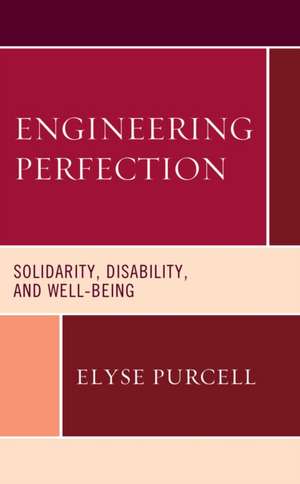
Engineering Perfection: Solidarity, Disability, and Well-being: Revolutionary Bioethics
Autor Elyse Purcellen Limba Engleză Paperback – 22 aug 2023
Elyse Purcell offers an opposing view, one guided by existential insights and Marxist reflections. Engineering Perfection: Solidarity, Disability, and Well-being explores the effect global capitalism may have on the selection of traits for our future children and how the commercialization of these technologies may lead to the elimination of bodily diversity. Although philosophers have addressed the possible widening between the haves and have-nots, this book considers the role oppression and exploitation may play in enhancing bodies for profit. As a challenge to the global economy of debility, Purcell proposes the Solidarity view, which embraces human vulnerability and embodied difference. By reflecting on facets of the human condition, the Solidarity view challenges us to reject our conception of the good life as human perfection, and instead reconceive of the good as one's self-realization through the interdependent mutual recognition and co-belonging with others.


Preț: 219.85 lei
Preț vechi: 306.45 lei
-28%
Puncte Express: 330
Carte tipărită la comandă
Livrare economică 08-22 decembrie
Livrare prin curier în România Termenul estimat este afișat lângă disponibilitate.
Transport gratuit de la 400.00 lei Plată online sau ramburs, în funcție de opțiunile comenzii.
Retur gratuit în 14 zile Comandă securizată și suport în română.
Specificații
ISBN-13: 9781793624130
ISBN-10: 1793624135
Pagini: 196
Dimensiuni: 148 x 226 x 16 mm
Greutate: 0.3 kg
Editura: Bloomsbury Publishing
Colecția Lexington Books
Seria Revolutionary Bioethics
Locul publicării:New York, United States
ISBN-10: 1793624135
Pagini: 196
Dimensiuni: 148 x 226 x 16 mm
Greutate: 0.3 kg
Editura: Bloomsbury Publishing
Colecția Lexington Books
Seria Revolutionary Bioethics
Locul publicării:New York, United States
V-ar putea interesa
-
 Human Cloning in the MediaJoan HaranPreț: 461.37 lei
 -
 Successful Agricultural Innovation in Emerging EconomiesDavid J. Bennett-11%Preț: 447.57 lei502.90 lei
 -
 -9%Preț: 987.83 lei1085.54 lei
 -
 -15%Preț: 677.64 lei797.22 lei
 -
 Enhancing Extraction Processes in the Food IndustryNikolai Lebovka-15%Preț: 564.11 lei663.66 lei
 -
 Valorization of Food Processing By-ProductsM. Chandrasekaran-18%Preț: 823.11 lei1003.80 lei
 -
 Managing Biogas Plants: A Practical GuideMario Alejandro Rosato-18%Preț: 1260.06 lei1536.66 lei
 -
 -15%Preț: 436.43 lei513.44 lei
 -
 BioCoder #2Nina DiprimioPreț: 35.61 lei
 -
 Metabolic EngineeringH. SahmPreț: 371.03 lei
 -
 Microbial ProcessesV. L. Yarovenko-15%Preț: 637.50 lei749.99 lei
 -
 NanoimagingBeth A. Goins-5%Preț: 1055.41 lei1110.95 lei
Cuprins
Acknowledgments
Introduction: Genetic Technologies and My Existential Journey
Chapter 1: Solidarity and the Five Faces of Vulnerability
Chapter 2: Facing Aging and Illness: Oppression and the Exploitable Body
Chapter 3: Facing Death: Invulnerability and the "Cure"
Chapter 4: Facing Misfortune: Perfection, Designer Babies, and Imaginary Appetites
Chapter 5: Facing Suffering: Capitalism, QALY, and Well-being
Bibliography
Introduction: Genetic Technologies and My Existential Journey
Chapter 1: Solidarity and the Five Faces of Vulnerability
Chapter 2: Facing Aging and Illness: Oppression and the Exploitable Body
Chapter 3: Facing Death: Invulnerability and the "Cure"
Chapter 4: Facing Misfortune: Perfection, Designer Babies, and Imaginary Appetites
Chapter 5: Facing Suffering: Capitalism, QALY, and Well-being
Bibliography
Recenzii
Advances in medical technologies appear to offer new opportunities for improving the human condition-especially for future generations. Purcell explains how the notion that such technologies are tools that can protect humans from vulnerability is not only mistaken but also harmful. Framing her discussion within the context of her experience with fertility treatments and the process of adoption, Purcell provides an insightful critique of the commercialized and economic distortions affecting notions of the quality of life and what people owe one another and their children.. Purcell's style is clear and engaging, and her argument is not only cogent and persuasive but also an important call for reflection as current scientific developments threaten to outpace the human capacity for moral understanding. Highly recommended. Lower- and upper-division undergraduates. Graduate students, faculty, and professionals.
In her monograph, Engineering Perfection, Elyse Purcell weaves compelling stories that center 'imperfection' with cogent philosophical insights drawing on feminist disability studies and standpoint epistemology. Purcell roots her analysis in a solidarity view that reimagines Iris Marion Young's five faces of oppression as faces of vulnerability. Engineering Perfection showcases an important critique of transhumanism and its late capitalist ideology of genetic enhancement.
A lucid and enlightening exploration of the value of our inescapable vulnerabilities, of the ways in which social-economic processes push us toward the pathological perfectionism of genetic engineering, and of how a saner society can be created through social solidarity by means of respect for bodily difference, relational authenticity, empowered self-direction, and mutual recognition. A must-read!
Elyse Purcell's Engineering Perfection is a fearless, clear, and exemplary work of moral philosophy. Drawing on what Purcell calls 'the Solidarity view,' the book effortlessly weaves personal narrative and reflection on the experiences of infertility, adoption, and disability with a careful consideration of the literature covering genetic technology, disability studies, Marxism, ethics, and virtue theory. The book is a careful explication of life's vulnerabilities-illness, aging, death, misfortune, and suffering-and the way capitalism exploits those vulnerabilities. Hopefully, Purcell suggests that a model for social transformation will depend on the virtues of respect for bodily diversity, relational authenticity, empowered self-direction, and mutual recognition. This important and expansive book will be of benefit to teachers and students across many disciplines and to the general reader who desires to work toward the well-being of all in society."
Elyse Purcell's Engineering Perfection takes readers on a riveting journey that explores the promise and perils of biotechnology applications. While genetic engineering tools do many things, recent innovations brought designer babies from thought-experiment to reality. This book is a must-read for those grappling with how best to apply these technologies to future generations-our children.
In her monograph, Engineering Perfection, Elyse Purcell weaves compelling stories that center 'imperfection' with cogent philosophical insights drawing on feminist disability studies and standpoint epistemology. Purcell roots her analysis in a solidarity view that reimagines Iris Marion Young's five faces of oppression as faces of vulnerability. Engineering Perfection showcases an important critique of transhumanism and its late capitalist ideology of genetic enhancement.
A lucid and enlightening exploration of the value of our inescapable vulnerabilities, of the ways in which social-economic processes push us toward the pathological perfectionism of genetic engineering, and of how a saner society can be created through social solidarity by means of respect for bodily difference, relational authenticity, empowered self-direction, and mutual recognition. A must-read!
Elyse Purcell's Engineering Perfection is a fearless, clear, and exemplary work of moral philosophy. Drawing on what Purcell calls 'the Solidarity view,' the book effortlessly weaves personal narrative and reflection on the experiences of infertility, adoption, and disability with a careful consideration of the literature covering genetic technology, disability studies, Marxism, ethics, and virtue theory. The book is a careful explication of life's vulnerabilities-illness, aging, death, misfortune, and suffering-and the way capitalism exploits those vulnerabilities. Hopefully, Purcell suggests that a model for social transformation will depend on the virtues of respect for bodily diversity, relational authenticity, empowered self-direction, and mutual recognition. This important and expansive book will be of benefit to teachers and students across many disciplines and to the general reader who desires to work toward the well-being of all in society."
Elyse Purcell's Engineering Perfection takes readers on a riveting journey that explores the promise and perils of biotechnology applications. While genetic engineering tools do many things, recent innovations brought designer babies from thought-experiment to reality. This book is a must-read for those grappling with how best to apply these technologies to future generations-our children.