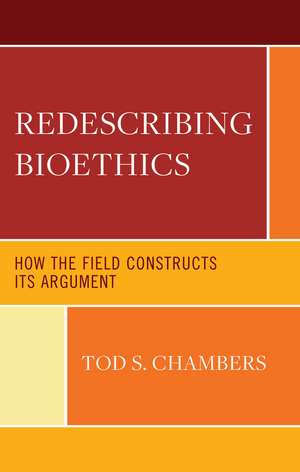
Redescribing Bioethics: How the Field Constructs Its Argument: Revolutionary Bioethics
Autor Tod S. Chambersen Limba Engleză Hardback – 18 noi 2024
It has traditionally been accepted that one cannot derive how the world ought to be from the way the world is. The discipline of bioethics endeavors to respond to ethical issues as they arise in the world. For these issues to be analyzed, they must first be described. Redescribing Bioethics: How the Field Constructs Its Argument argues the descriptions bioethicists provide of the moral problems anticipate the proposed solution to these problems. To understand the rhetorical power of bioethics arguments, we need to reverse the structure of the argument, seeing the anticipated solution as driving the presentation of the problem.
Arguing the story of bioethics is as much one of powerful redescriptions as of proposed solutions, Tod S. Chambers examines seven rhetorical strategies in how bioethics texts have steered readers toward a particular moral vision of the world: retrodiction, anagnorisis, imbalance, dissociation, metaphor, sources, and hypertextuality. Through these techniques, bioethicists construct a world in which their particular moral theory thrives, and alternative theories will struggle.


Preț: 524.82 lei
Preț vechi: 777.83 lei
-33%
Puncte Express: 787
Carte tipărită la comandă
Livrare economică 02-16 decembrie
Livrare prin curier în România Termenul estimat este afișat lângă disponibilitate.
Transport gratuit pentru acest produs Plată online sau ramburs, în funcție de opțiunile comenzii.
Retur gratuit în 14 zile Comandă securizată și suport în română.
Specificații
ISBN-13: 9781666924442
ISBN-10: 166692444X
Pagini: 198
Dimensiuni: 144 x 232 x 18 mm
Greutate: 0.44 kg
Editura: Bloomsbury Publishing
Colecția Lexington Books
Seria Revolutionary Bioethics
Locul publicării:New York, United States
ISBN-10: 166692444X
Pagini: 198
Dimensiuni: 144 x 232 x 18 mm
Greutate: 0.44 kg
Editura: Bloomsbury Publishing
Colecția Lexington Books
Seria Revolutionary Bioethics
Locul publicării:New York, United States
Cuprins
Acknowledgments
Introduction: Describing the World
1. Retrodiction
2. Anagnorisis
3. Trouble
4. Dissociation
5. Metaphor
6. Sources
7. Hypertextuality
Conclusion: The Bioethicist as Poet
Bibliography
Index
About the Author
Introduction: Describing the World
1. Retrodiction
2. Anagnorisis
3. Trouble
4. Dissociation
5. Metaphor
6. Sources
7. Hypertextuality
Conclusion: The Bioethicist as Poet
Bibliography
Index
About the Author
Recenzii
"In this long-awaited sequel to The Fiction of Bioethics, Tod S. Chambers invites readers to explore how bioethicists 'construct a world for their theories and then invite us in.' This engaging account of the 'rhetorical mechanics' that drive bioethical arguments is also a deeply learned tour of 'bioethical fights' across the decades. Redescribing Bioethics will be of interest to bioethics and humanities scholars and of use in critical reflection on the field's canonical texts and future directions."
"Tod S. Chambers excavates the constructed, 'redescriptive' nature of American bioethics' leading foundational arguments. His adroit analysis discovers and deciphers the rhetorical mechanisms by which the authors of major bioethics texts seek to persuade us of their positions. A deeply informed, illuminating volume for students, scholars, and practitioners of bioethics alike."
A fascinating, highly intelligent, and beautifully written book. Essential reading for everyone who wants to understand the rhetorical strategies academic writers use in the discipline of bioethics. In a series of remarkable essays, Chambers pulls aside the curtain to reveal how major battles over key moral issues gain their power to persuade us of what is right and true.
Occasionally you run into a book that changes not only how you think about the world, but also how you think about yourself. This is one of those books. In accessible and lively prose, Chambers articulates the structure, form, and motivations that animate the canonical texts of so-called Western Bioethics. Chapter 4, which discusses the strategy of "dissociation" (a rhetorical scheme in which elements thought to be a single entity are redescribed as fundamentally distinct) in bioethical argumentation, is worth the cost of the book alone. I will not be the same kind of writer after reading this book.
"Tod S. Chambers excavates the constructed, 'redescriptive' nature of American bioethics' leading foundational arguments. His adroit analysis discovers and deciphers the rhetorical mechanisms by which the authors of major bioethics texts seek to persuade us of their positions. A deeply informed, illuminating volume for students, scholars, and practitioners of bioethics alike."
A fascinating, highly intelligent, and beautifully written book. Essential reading for everyone who wants to understand the rhetorical strategies academic writers use in the discipline of bioethics. In a series of remarkable essays, Chambers pulls aside the curtain to reveal how major battles over key moral issues gain their power to persuade us of what is right and true.
Occasionally you run into a book that changes not only how you think about the world, but also how you think about yourself. This is one of those books. In accessible and lively prose, Chambers articulates the structure, form, and motivations that animate the canonical texts of so-called Western Bioethics. Chapter 4, which discusses the strategy of "dissociation" (a rhetorical scheme in which elements thought to be a single entity are redescribed as fundamentally distinct) in bioethical argumentation, is worth the cost of the book alone. I will not be the same kind of writer after reading this book.