
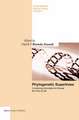
Phylogenetic Supertrees: Computational Biology, cartea 4
Editat de Olaf R. P. Bininda-Emondsen Limba Engleză Hardback – 25 aug 2004
Din seria Computational Biology
- 5%
 Preț: 521.87 lei
 - 15%
 Preț: 624.19 lei
 - 15%
 Preț: 612.18 lei
 - 15%
 Preț: 610.53 lei
 - 5%
 Preț: 1378.38 lei
 - 5%
 Preț: 1431.80 lei
 -
 Preț: 316.43 lei
 - 18%
 Preț: 950.66 lei
 - 15%
 Preț: 649.05 lei
 -
 Preț: 501.54 lei
 - 15%
 Preț: 621.78 lei
 - 15%
 Preț: 651.75 lei
 - 18%
 Preț: 905.53 lei
 - 15%
 Preț: 624.75 lei
 - 15%
 Preț: 656.41 lei
 -
 Preț: 388.29 lei
 - 15%
 Preț: 718.43 lei
 -
 Preț: 373.24 lei
 - 15%
 Preț: 624.00 lei
 - 20%
 Preț: 648.51 lei
 - 15%
 Preț: 713.42 lei
 - 15%
 Preț: 617.46 lei
 - 20%
 Preț: 635.04 lei
 - 18%
 Preț: 1117.09 lei
 - 18%
 Preț: 898.67 lei
 - 20%
 Preț: 1051.95 lei
 - 18%
 Preț: 1235.49 lei
 - 18%
 Preț: 922.08 lei
 - 15%
 Preț: 640.28 lei
 -
 Preț: 388.38 lei
Preț: 1241.07 lei
Preț vechi: 1513.50 lei
-18%
Puncte Express: 1862
Carte tipărită la comandă
Livrare economică 17 noiembrie-01 decembrie
Livrare prin curier în România Termenul estimat este afișat lângă disponibilitate.
Transport gratuit pentru acest produs Plată online sau ramburs, în funcție de opțiunile comenzii.
Retur gratuit în 14 zile Comandă securizată și suport în română.
Specificații
ISBN-13: 9781402023286
ISBN-10: 1402023286
Pagini: 568
Ilustrații: XIV, 550 p.
Dimensiuni: 160 x 241 x 35 mm
Greutate: 1.01 kg
Ediția:2004
Editura: Springer
Colecția Computational Biology
Seria Computational Biology
Locul publicării:Dordrecht, Netherlands
ISBN-10: 1402023286
Pagini: 568
Ilustrații: XIV, 550 p.
Dimensiuni: 160 x 241 x 35 mm
Greutate: 1.01 kg
Ediția:2004
Editura: Springer
Colecția Computational Biology
Seria Computational Biology
Locul publicării:Dordrecht, Netherlands
V-ar putea interesa
-
 It Was Snowing ButterfliesCharles Darwin-21%Preț: 16.18 lei20.47 lei
 -
 The Invention of NatureAndrea WulfPreț: 133.85 lei
 -
 Mathematical Population Genetics 1Warren J. Ewens-18%Preț: 1078.33 lei1315.04 lei
 -
 Evolution: The Whole StorySteve Parker-10%Preț: 144.11 lei159.61 lei
 -
 When Life Nearly DiedMichael J. Benton-18%Preț: 132.90 lei162.23 lei
 -
 Primates and PhilosophersFrans De WaalPreț: 99.11 lei
 -
 River Out of Eden: A Darwinian View of LifeProf Richard Dawkins-27%Preț: 67.19 lei92.61 lei
 -
 Arrival of the FittestAndreas WagnerPreț: 93.72 lei
 -
 -26%Preț: 67.77 lei92.11 lei
 -
 Preț: 427.07 lei
Public țintă
ResearchCuprins
New uses for old phylogenies: an introduction to the volume.- 1. Reviews of existing methods.- The MRP method.- An assessment of matrix representation with compatibility in supertree construction.- MRF supertrees.- Everything you always wanted to know about average consensus, and more.- Tangled trees from multiple markers: reconciling conflict between phylogenies to build molecular supertrees.- 2. New supertree methods.- Supertree methods for ancestral divergence dates and other applications.- Supertree algorithms for nested taxa.- Quartet supertrees.- Bayesian supertrees.- 3. Methodological considerations.- Some desiderata for liberal supertrees.- Taxonomy, supertrees, and the Tree of Life.- Garbage in, garbage out: data issues in supertree construction.- Reconstructing divergence times for supertrees: a molecular approach.- Performance of supertree methods on various data set decompositions.- 4. A critical look at supertrees.- Unrooted supertrees: limitations, traps, and phylogenetic patchworks.- The cladistics of matrix representation with parsimony analysis.- A critique of matrix representation with parsimony supertrees.- Supertrees, components and three-item data.- 5. Supertrees and their applications.- A molecular supertree of the Artiodactyla.- Supertrees: using complete phylogenies in comparative biology.- Using supertrees to investigate species richness in grasses and flowering plants.- Detecting diversification rate variation in supertrees.- Taxon index.
Recenzii
From the reviews:
"It provides a very worthwhile introduction to a topic that is receiving a lot of attention among phylogeneticists in the new millennium: how to combine the information contained in multiple phylogenetic trees with partially overlapping sets of taxa. … this book achieves what it sets out to achieve, which is to provide an overview and evaluation of possible approaches to the construction of supertrees. … This book does a good job of explaining the arithmetic and the mathematics of supertrees … ." (David A. Morrison, Systematic Biology, Vol. 55 (3), 2006)
"It provides a very worthwhile introduction to a topic that is receiving a lot of attention among phylogeneticists in the new millennium: how to combine the information contained in multiple phylogenetic trees with partially overlapping sets of taxa. … this book achieves what it sets out to achieve, which is to provide an overview and evaluation of possible approaches to the construction of supertrees. … This book does a good job of explaining the arithmetic and the mathematics of supertrees … ." (David A. Morrison, Systematic Biology, Vol. 55 (3), 2006)