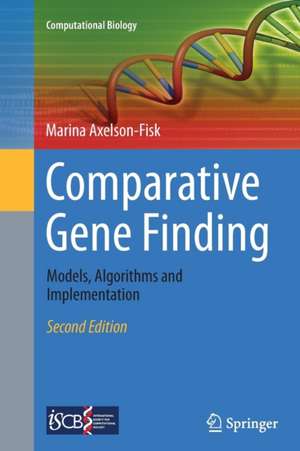
Comparative Gene Finding: Computational Biology, cartea 20
Autor Marina Axelson-Fisken Limba Engleză Paperback – 5 oct 2016
Din seria Computational Biology
- 5%
 Preț: 521.87 lei
 - 15%
 Preț: 668.91 lei
 - 15%
 Preț: 612.18 lei
 - 15%
 Preț: 610.53 lei
 - 5%
 Preț: 1477.74 lei
 -
 Preț: 316.43 lei
 - 18%
 Preț: 950.66 lei
 - 15%
 Preț: 649.05 lei
 -
 Preț: 501.54 lei
 - 15%
 Preț: 666.33 lei
 - 15%
 Preț: 672.01 lei
 - 18%
 Preț: 929.87 lei
 - 15%
 Preț: 676.83 lei
 -
 Preț: 414.85 lei
 - 15%
 Preț: 720.91 lei
 -
 Preț: 399.06 lei
 - 15%
 Preț: 668.72 lei
 - 20%
 Preț: 656.33 lei
 - 15%
 Preț: 735.84 lei
 - 15%
 Preț: 617.46 lei
 - 20%
 Preț: 635.04 lei
 - 18%
 Preț: 1117.09 lei
 - 18%
 Preț: 898.67 lei
 - 20%
 Preț: 1051.95 lei
 - 18%
 Preț: 1235.49 lei
 - 18%
 Preț: 922.08 lei
 - 15%
 Preț: 640.28 lei
 -
 Preț: 408.44 lei
Preț: 624.75 lei
Preț vechi: 735.01 lei
-15%
Puncte Express: 937
Carte tipărită la comandă
Livrare economică 26 noiembrie-10 decembrie
Livrare prin curier în România Termenul estimat este afișat lângă disponibilitate.
Transport gratuit pentru acest produs Plată online sau ramburs, în funcție de opțiunile comenzii.
Retur gratuit în 14 zile Comandă securizată și suport în română.
Specificații
ISBN-13: 9781447168751
ISBN-10: 1447168755
Pagini: 404
Ilustrații: XX, 382 p. 81 illus.
Dimensiuni: 155 x 235 x 22 mm
Greutate: 0.61 kg
Ediția:Softcover reprint of the original 2nd edition 2015
Editura: Springer
Colecția Computational Biology
Seria Computational Biology
Locul publicării:London, United Kingdom
ISBN-10: 1447168755
Pagini: 404
Ilustrații: XX, 382 p. 81 illus.
Dimensiuni: 155 x 235 x 22 mm
Greutate: 0.61 kg
Ediția:Softcover reprint of the original 2nd edition 2015
Editura: Springer
Colecția Computational Biology
Seria Computational Biology
Locul publicării:London, United Kingdom
Cuprins
Introduction.- Single Species Gene Finding.- Sequence Alignment.- Comparative Gene Finding.- Gene Structure Submodels.- Parameter Training.- Implementation of a Comparative Gene Finder.- Annotation Pipelines for Next Generation Sequencing Projects.
Recenzii
“The structure of the book mirrors the learning steps for understanding how to perform gene finding. … Its target audience is mainly post-graduate researchers or established researchers with a background in mathematics or statistics applied in bioinformatics who need a thorough yet concise overview of this field.” (Irina Ioana Mohorianu, zbMATH 1350.92001, 2017)
“It skillfully introduces readers to a difficult subject, while at the same time motivating them to enter this very important area. … It is best suited for a graduate course or as an introduction for researchers not familiar with this field. … this is an excellent introduction to comparative gene finding. … I especially recommend this book to any computer scientist with an interest in current problems in bioinformatics.” (Burkhard Englert, Computing Reviews, December, 2015)
“It skillfully introduces readers to a difficult subject, while at the same time motivating them to enter this very important area. … It is best suited for a graduate course or as an introduction for researchers not familiar with this field. … this is an excellent introduction to comparative gene finding. … I especially recommend this book to any computer scientist with an interest in current problems in bioinformatics.” (Burkhard Englert, Computing Reviews, December, 2015)
Textul de pe ultima copertă
This unique text/reference presents a concise guide to building computational gene finders, and describes the state of the art in computational gene finding methods, with a particular focus on comparative approaches. Fully updated and expanded, this new edition examines next-generation sequencing (NGS) technology, including annotation pipelines for NGS data. The book also discusses conditional random fields, enhancing the broad coverage of topics spanning probability theory, statistics, information theory, optimization theory, and numerical analysis.
Topics and features:
Dr. Marina Axelson-Fisk is an Associate Professor at the Department of Mathematical Sciences of Chalmers University of Technology, Gothenburg, Sweden.
Topics and features:
- Introduces the fundamental terms and concepts in the field, and provides an historical overview of algorithm development
- Discusses algorithms for single-species gene finding, and approaches to pairwise and multiple sequence alignments, then describes how the strengths in both areas can be combined to improve the accuracy of gene finding
- Explores the gene features most commonly captured by a computational gene model, and explains the basics of parameter training
- Illustrates how to implement a comparative gene finder, reviewing the different steps and accuracy assessment measures used to debug and benchmark the software
- Examines NGS techniques, and how to build a genome annotation pipeline, discussing sequence assembly, de novo repeat masking, and gene prediction (NEW)
Dr. Marina Axelson-Fisk is an Associate Professor at the Department of Mathematical Sciences of Chalmers University of Technology, Gothenburg, Sweden.
Caracteristici
Provides detailed descriptions of the models and algorithms and how to implement them Summarizes the advances in the field and gives clear and concise instructions on how to proceed though the project process Updated and expanded new edition, now covering next-generation sequencing technology and conditional random fields Includes supplementary material: sn.pub/extras