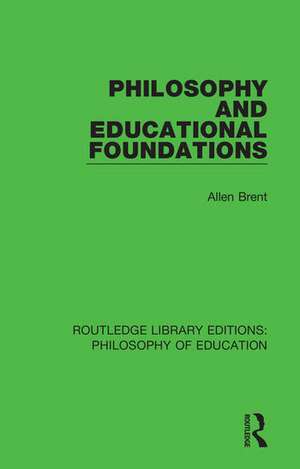
Philosophy and Educational Foundations: Routledge Library Editions: Philosophy of Education
Autor Allen Brenten Limba Engleză Paperback – 27 feb 2018
Wittgenstein’s understanding of ‘family resemblance’ and Chomsky’s ‘linguistic universals’ are interpreted, contrary to Hamlyn, as reconcilable notions that can both illuminate and refine Hirst’s understanding of ‘categorical concepts’. In the light of such a reformulated theory, Brent suggest ways in which a unified model of the social sciences could yield a unified curriculum theory. This title will be of interest to students of the philosophy of education and curriculum studies.
Din seria Routledge Library Editions: Philosophy of Education
-
 Preț: 400.40 lei
 -
 Preț: 365.16 lei
 -
 Preț: 399.42 lei
 -
 Preț: 177.88 lei
 -
 Preț: 277.79 lei
 -
 Preț: 370.01 lei
 -
 Preț: 262.06 lei
 -
 Preț: 338.62 lei
 -
 Preț: 239.74 lei
 -
 Preț: 403.64 lei
 -
 Preț: 340.45 lei
 -
 Preț: 249.38 lei
 -
 Preț: 334.75 lei
 -
 Preț: 376.30 lei
 -
 Preț: 202.66 lei
 -
 Preț: 231.46 lei
 -
 Preț: 372.89 lei
 -
 Preț: 371.63 lei
 -
 Preț: 252.10 lei
 -
 Preț: 330.91 lei
 - 33%
 Preț: 16156.24 lei
 - 33%
 Preț: 933.65 lei
Preț: 448.57 lei
Puncte Express: 673
Carte tipărită la comandă
Livrare economică 05-19 decembrie
Livrare prin curier în România Termenul estimat este afișat lângă disponibilitate.
Transport gratuit pentru acest produs Plată online sau ramburs, în funcție de opțiunile comenzii.
Retur gratuit în 14 zile Comandă securizată și suport în română.
Specificații
ISBN-13: 9781138692565
ISBN-10: 1138692565
Pagini: 382
Dimensiuni: 138 x 216 x 20 mm
Greutate: 0.71 kg
Ediția:1
Editura: Taylor & Francis
Colecția Routledge
Seria Routledge Library Editions: Philosophy of Education
Locul publicării:Oxford, United Kingdom
ISBN-10: 1138692565
Pagini: 382
Dimensiuni: 138 x 216 x 20 mm
Greutate: 0.71 kg
Ediția:1
Editura: Taylor & Francis
Colecția Routledge
Seria Routledge Library Editions: Philosophy of Education
Locul publicării:Oxford, United Kingdom
Public țintă
General, Postgraduate, and UndergraduateCuprins
1. Behaviourist Foundations and Approaches to Pedagogy 2. Behaviourism and the Philosophy of Language 3. Skinner’s Conflicting Paradigms of Science 4. Behaviourism: Curricular Deductions 5. Marxist Alternatives 6. Classical and Phenomenological Marxist Pedagogy 7. Bernstein, Hirst and Rule-Following Models 8. Forms of Knowledge, Categorical Concepts and Linguistic Universals 9. Categorial and Substantive Concepts, Morphemes and Family-Resemblance 10. Conclusions: Multicultural Education and the Place of Religion; Bibliographical References; Index
Descriere
What models in the social sciences underlie existing or proposed patterns of educational practice? What theories of knowledge inform such models and thus arguably sanction such practice? In this book, first published in 1983, the author seeks some tentative answers. This title will be of interest to students of the philosophy of education and curriculum studies.