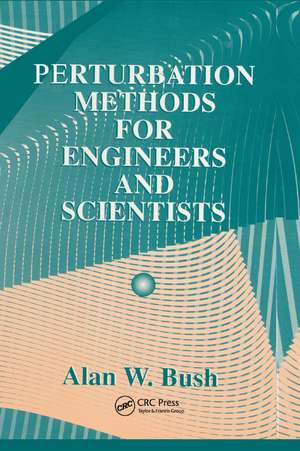
Perturbation Methods for Engineers and Scientists
Autor Alan W. Bushen Limba Engleză Paperback – 19 iun 2019
Preț: 530.47 lei
Preț vechi: 624.09 lei
-15%
Puncte Express: 796
Carte tipărită la comandă
Livrare economică 10-24 noiembrie
Livrare prin curier în România Termenul estimat este afișat lângă disponibilitate.
Transport gratuit pentru acest produs Plată online sau ramburs, în funcție de opțiunile comenzii.
Retur gratuit în 14 zile Comandă securizată și suport în română.
Specificații
ISBN-13: 9780367402846
ISBN-10: 036740284X
Pagini: 320
Dimensiuni: 156 x 234 x 18 mm
Greutate: 0.45 kg
Ediția:1
Editura: CRC Press
Colecția CRC Press
ISBN-10: 036740284X
Pagini: 320
Dimensiuni: 156 x 234 x 18 mm
Greutate: 0.45 kg
Ediția:1
Editura: CRC Press
Colecția CRC Press
V-ar putea interesa
-
 Stick and Rudder: An Explanation of the Art of FlyingWolfgang Langewiesche-33%Preț: 188.69 lei280.45 lei
 -
 Fluid MechanicsPijush K. Kundu-32%Preț: 652.99 lei967.29 lei
 -
 Turbulence: An Introduction for Scientists and EngineersPeter Davidson-20%Preț: 535.93 lei670.57 lei
 -
 -20%Preț: 510.68 lei636.05 lei
 -
 Kermode, A: Mechanics of FlightD.R. Philpott-13%Preț: 611.03 lei702.33 lei
 -
 -33%Preț: 614.48 lei917.08 lei
 -
 Mathematical PhysicsDonald H. MenzelPreț: 110.74 lei
 -
 Theory of Wing SectionsIra H. AbbottPreț: 293.98 lei
 -
 Handbook of Mathematical FunctionsIrene A. Stegun-20%Preț: 660.52 lei825.03 lei
 -
 Partial Differential Equations for Scientists and EngineersStanley J FarlowPreț: 147.27 lei
 -
 Mathematical Methods for Physics and EngineeringK. F. Riley-8%Preț: 442.60 lei481.09 lei
 -
 Aerodynamics for EngineersJohn J Bertin-19%Preț: 705.93 lei871.52 lei
 -
 Fluid Mechanics: Volume 4David TongPreț: 272.25 lei
 -
 Handbook of Mathematics for Engineers and ScientistsAndrei D. Polyanin-9%Preț: 2021.28 lei2221.19 lei
 -
 Essential Perturbation MethodsC. y. Wang-15%Preț: 619.65 lei728.99 lei
 -
 Select Ideas in Partial Differential EquationsPeter J. Costa-15%Preț: 566.78 lei666.80 lei
 -
 Mathematics of Engineering and ScienceMehdi Rahmani-AndebiliPreț: 369.56 lei
 -
 Distributions in the Physical and Engineering Sciences, Volume 1Alexander I. SaichevPreț: 401.49 lei
 -
 -14%Preț: 758.53 lei882.02 lei
Cuprins
Introduction to Perturbation Expansions
Asymptotics
Strained Co-ordinates
Multiple Scales
Boundary Layers
The Dominant Balance and WKB Methods
The Asymptotic Approximation of Integrals
References and Bibliography
Asymptotics
Strained Co-ordinates
Multiple Scales
Boundary Layers
The Dominant Balance and WKB Methods
The Asymptotic Approximation of Integrals
References and Bibliography
Descriere
Perturbation Methods for Engineers and Scientists examines the main techniques of perturbation expansions applied to both differential equations and integral expressions. It describes several fluid dynamics applications, including aerofoils, boundary layers in momentum heat, and mass transfer. In addition, it applies the multiple scale technique to the description of surface roughness effects in lubrication. The book's intuitive, rather than formal, approach enables these advanced techniques to be used by scientists and engineers as well as by students.