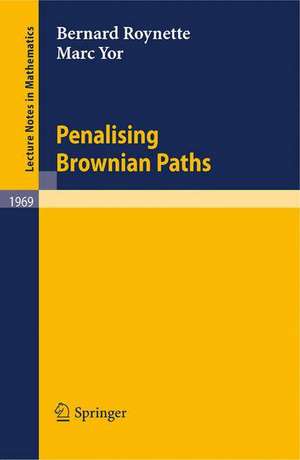
Penalising Brownian Paths
Autor Bernard Roynette, Marc Yoren Limba Engleză Paperback – 25 mar 2009
Preț: 374.84 lei
Puncte Express: 562
Preț estimativ în valută:
66.30€ • 78.62$ • 57.76£
66.30€ • 78.62$ • 57.76£
Carte tipărită la comandă
Livrare economică 25 martie-08 aprilie
Specificații
ISBN-13: 9783540896982
ISBN-10: 3540896988
Pagini: 296
Ilustrații: XIII, 275 p.
Dimensiuni: 155 x 235 x 17 mm
Greutate: 0.45 kg
Ediția:2009
Editura: Springer
Locul publicării:Berlin, Heidelberg, Germany
ISBN-10: 3540896988
Pagini: 296
Ilustrații: XIII, 275 p.
Dimensiuni: 155 x 235 x 17 mm
Greutate: 0.45 kg
Ediția:2009
Editura: Springer
Locul publicării:Berlin, Heidelberg, Germany
V-ar putea interesa
-
 -34%Preț: 723.90 lei1102.45 lei
 -
 The Oxford Dictionary of Statistical TermsYadolah Dodge-13%Preț: 324.20 lei372.54 lei
 -
 Bayesian Statistics 8J. M. Bernardo-33%Preț: 716.70 lei1072.98 lei
 -
 Spatial Statistics and ModelingCarlo Gaetan-18%Preț: 1071.45 lei1306.65 lei
 -
 An Introduction to the BootstrapBradley Efron-9%Preț: 1199.65 lei1318.30 lei
 -
 Probability with MartingalesDavid WilliamsPreț: 336.17 lei
 -
 New Cambridge Statistical TablesD. V. LindleyPreț: 125.40 lei
 -
 Asymptotic StatisticsA. W. van der Vaart-11%Preț: 443.79 lei498.65 lei
 -
 -11%Preț: 635.35 lei713.87 lei
 -
 -11%Preț: 422.37 lei474.57 lei
 -
 S ProgrammingWilliam Venables-15%Preț: 668.96 lei787.01 lei
 -
 -15%Preț: 510.83 lei600.98 lei
 -
 Theory of Random SetsIlya Molchanov-18%Preț: 755.27 lei921.06 lei
 -
 Laws of Small Numbers: Extremes and Rare EventsMichael Falk-18%Preț: 765.60 lei933.65 lei
 -
 -18%Preț: 781.68 lei953.27 lei
Public țintă
ResearchCuprins
Some penalisations of theWiener measure.- Feynman-Kac penalisations for Brownian motion.- Penalisations of a Bessel process with dimension d(0 d 2) by a function of the ranked lengths of its excursions.- A general principle and some questions about penalisations.
Recenzii
From the reviews:“In this book the authors give a systematic study of penalisation. The book is divided into 5 chapters. … This book is very useful for graduate students and researchers interested in learning penalisations.” (Ren Ming Song, Mathematical Reviews, Issue 2010 e)
Textul de pe ultima copertă
Penalising a process is to modify its distribution with a limiting procedure, thus defining a new process whose properties differ somewhat from those of the original one.
We are presenting a number of examples of such penalisations in the Brownian and Bessel processes framework. The Martingale theory plays a crucial role.
A general principle for penalisation emerges from these examples. In particular, it is shown in the Brownian framework that a positive sigma-finite measure takes a large class of penalisations into account.
We are presenting a number of examples of such penalisations in the Brownian and Bessel processes framework. The Martingale theory plays a crucial role.
A general principle for penalisation emerges from these examples. In particular, it is shown in the Brownian framework that a positive sigma-finite measure takes a large class of penalisations into account.