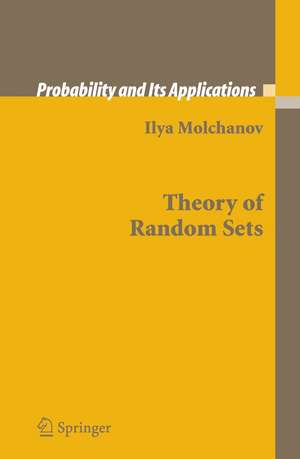
Theory of Random Sets
Autor Ilya Molchanoven Limba Engleză Paperback – 14 mar 2012
Descoperim în Theory of Random Sets o resursă fundamentală pentru cercetarea avansată, ce sistematizează un domeniu aflat la intersecția dintre topologie, geometrie convexă și teoria probabilităților. Această ediție, publicată de Springer, este remarcabilă prin modul în care integrează progresele realizate după 2005, ancorând teoria în aplicații practice din econometrie și finanțe matematice. Notăm cu interes capitolul dedicat funcționalelor de capacitate și seturilor închise aleatorii, care stabilește un cadru riguros pentru analiza structurilor geometrice incerte.
Structura volumului urmează o progresie logică, pornind de la valorile așteptate ale seturilor aleatorii și adunarea Minkowski, până la uniuni și funcții aleatorii, totul fiind susținut de o serie vastă de anexe matematice care fac textul complet autonom. Găsim aici o rigoare de tip teoremă-demonstrație, menită să elimine ambiguitățile terminologice din literatura de specialitate. Această abordare completează perspectiva oferită de Stochastic Geometry de A. Baddeley, adăugând o analiză mult mai detaliată a fundamentelor analitice și a inferenței statistice specifice seturilor.
Poziționată în contextul operei lui Ilya Molchanov, lucrarea reprezintă o sinteză matură a temelor explorate anterior în New Perspectives in Stochastic Geometry și Risk Measures. Dacă lucrările sale precedente se concentrau pe aspecte particulare ale tiparelor aleatorii sau ale riscului financiar, acest tratat oferă fundamentul teoretic unificat necesar pentru ambele direcții. Este, în esență, platforma pe care autorul își consolidează contribuția la teoria modernă a probabilităților, oferind instrumente esențiale pentru cuantificarea incertitudinii în spații multidimensionale.
Preț: 749.55 lei
Preț vechi: 914.09 lei
-18%
Carte tipărită la comandă
Livrare economică 15-29 iunie
Specificații
ISBN-10: 1849969493
Pagini: 504
Ilustrații: XVI, 488 p.
Dimensiuni: 155 x 235 x 28 mm
Greutate: 0.76 kg
Ediția:2005
Editura: Springer
Locul publicării:London, United Kingdom
V-ar putea interesa
-
 Statistics: A Very Short IntroductionDavid J. Hand-21%Preț: 53.18 lei67.61 lei
 -
 Spatial Statistics and ModelingCarlo Gaetan-18%Preț: 1075.61 lei1311.72 lei
 -
 Bayesian Computation with RJim AlbertPreț: 473.32 lei
 -
 Statistical ModelsDavid A. Freedman-8%Preț: 429.86 lei467.23 lei
 -
 Elementary Probability for ApplicationsRick Durrett-19%Preț: 544.16 lei671.79 lei
 -
 Analysis of Multivariate Social Science DataDavid J. Bartholomew-15%Preț: 459.42 lei540.49 lei
 -
 The Manga Guide to StatisticsShin Takahashi-20%Preț: 130.38 lei163.95 lei
 -
 Laws of Small Numbers: Extremes and Rare EventsMichael Falk-18%Preț: 761.86 lei929.10 lei
 -
 Limit Theorems for Stochastic ProcessesJean Jacod-18%Preț: 1074.36 lei1310.19 lei
 -
 -18%Preț: 784.70 lei956.95 lei
 -
 Long-Memory ProcessesJan Beran-18%Preț: 1310.23 lei1597.85 lei
 -
 Efficiency Measures in the Agricultural SectorArmando Mendes-15%Preț: 620.73 lei730.27 lei
Public țintă
ResearchDe ce să citești această carte
Recomandăm această monografie cercetătorilor care au nevoie de un cadru matematic riguros pentru analiza datelor spațiale sau econometrice complexe. Cititorul câștigă o înțelegere profundă a seturilor aleatorii prin demonstrații complete și o terminologie unificată. Este o investiție esențială pentru cei care activează în geometrie integrală, finanțe matematice sau procesarea imaginilor, oferind instrumentele necesare pentru a trece de la teorie la modelare avansată.
Despre autor
Ilya Molchanov este profesor de teoria probabilităților în cadrul Departamentului de Statistică Matematică și Științe Actuariale la Universitatea din Berna, Elveția. Cu o carieră dedicată studiului structurilor geometrice aleatorii, Molchanov este o autoritate în geometria stochastică și analiza set-valued. Lucrările sale, precum Random Sets in Econometrics sau Limit Theorems for Unions of Random Closed Sets, reflectă capacitatea sa de a aplica concepte matematice abstracte în domenii diverse, de la economie la inginerie electrică, fiind recunoscut pentru claritatea prezentării demonstrațiilor complexe.
Cuprins
Recenzii
"Together with the foundations of the modern probability theory Kolmogorov introduced the concept of a random set. … The book is written in a theorem-proof style, where the proofs are quite detailed and clearly presented. … to enable easier reading, the author provides visual illustrations where necessary. … the author provides a vast bibliography on the subject, which is completely searchable on author’s website. The book should be read and even more studied by any researcher or a student considering research in this field." (Ita Cirovic Donev, MathDL, January, 2006)
"This book is part of the Springer-Verlag series ‘Probability and its applications’. … The most remarkable aspect of the book is the reader-friendly structure and the style in which it has been written. There are masses of examples either worked out in the book or left for the reader. A number of facts are equipped with graphical illustrations. This book has a good index and index of notations, and a very detailed bibliography … . It will be an essential part of every mathematical library." (V. K. Oganyan, Mathematical Reviews, Issue 2006 b)
"The book under review develops … an approach in a self-contained and systematic manner. Full proofs are given, and many steps are illustrated by graphs and drawings. The interdisciplinary nature of the theory of random sets within mathematics is well shown. … The book will be an invaluable reference for probabilists, mathematicians, statisticians and electronic and electrical engineers in the fields of image analysis. … The book is highly recommended both for personal use and for libraries." (Janos Galambos, Zentralblatt MATH, Vol. 1109 (11), 2007)
"Random sets play an important role in many applications of mathematics … . This book is an important contribution to the mathematical theory and will surely serve as a valuable textbook for students as well as researchers. It presentsa self-contained survey of all the significant results … . A number of open problems are presented and each chapter concludes with a list of bibliographical notes." (EMS Newsletter, September, 2007)
Notă biografică
Textul de pe ultima copertă
The book is entirely self-contained, systematic and exhaustive, with the full proofs that are necessary to gain insight. It shows the various interdisciplinary relationships of random set theory within other parts of mathematics, and at the same time, fixes terminology and notation that are often varying in the current literature to establish it as a natural part of modern probability theory, and to provide a platform for future development. An extensive, searchable bibliography to accompany the book is freely available via the web.
The book will be an invaluable reference for probabilists, mathematicians in convex and integral geometry, set-valued analysis, capacity and potential theory, mathematical statisticians in spatial statistics and image analysis, specialists in mathematical economics, and electronic and electrical engineers interested in image analysis.