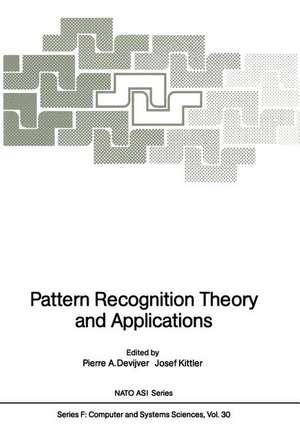
Pattern Recognition Theory and Applications: NATO ASI Subseries F:, cartea 30
Editat de Pierre A. Devijver, Josef Kittleren Limba Engleză Paperback – mar 2012
Din seria NATO ASI Subseries F:
- 20%
 Preț: 642.70 lei
 - 20%
 Preț: 953.88 lei
 - 18%
 Preț: 1190.96 lei
 - 20%
 Preț: 1847.73 lei
 - 20%
 Preț: 631.95 lei
 - 18%
 Preț: 1185.98 lei
 - 20%
 Preț: 682.34 lei
 - 20%
 Preț: 630.68 lei
 - 18%
 Preț: 1782.54 lei
 - 20%
 Preț: 360.65 lei
 - 20%
 Preț: 953.40 lei
 - 20%
 Preț: 645.09 lei
 - 20%
 Preț: 1850.75 lei
 - 20%
 Preț: 956.09 lei
 -
 Preț: 374.71 lei
 - 20%
 Preț: 632.58 lei
 - 20%
 Preț: 658.19 lei
 - 18%
 Preț: 1177.62 lei
 - 18%
 Preț: 915.13 lei
 - 20%
 Preț: 319.42 lei
 - 20%
 Preț: 1289.49 lei
 - 20%
 Preț: 619.89 lei
 -
 Preț: 380.82 lei
 - 18%
 Preț: 1173.54 lei
 - 15%
 Preț: 646.82 lei
 - 20%
 Preț: 620.52 lei
 - 20%
 Preț: 1233.02 lei
 - 20%
 Preț: 631.00 lei
 - 20%
 Preț: 1233.33 lei
 - 20%
 Preț: 1849.02 lei
 - 20%
 Preț: 348.43 lei
 - 20%
 Preț: 621.81 lei
 - 20%
 Preț: 322.93 lei
 - 20%
 Preț: 664.12 lei
Preț: 636.86 lei
Preț vechi: 796.08 lei
-20%
Puncte Express: 955
Carte tipărită la comandă
Livrare economică 14-28 octombrie
Livrare prin curier în România Termenul estimat este afișat lângă disponibilitate.
Transport gratuit pentru acest produs Plată online sau ramburs, în funcție de opțiunile comenzii.
Retur gratuit în 14 zile Comandă securizată și suport în română.
Specificații
ISBN-13: 9783642830716
ISBN-10: 3642830714
Pagini: 564
Ilustrații: XI, 543 p.
Dimensiuni: 170 x 244 x 30 mm
Greutate: 0.89 kg
Ediția:Softcover reprint of the original 1st ed. 1987
Editura: Springer Berlin, Heidelberg
Colecția Springer
Seria NATO ASI Subseries F:
Locul publicării:Berlin, Heidelberg, Germany
ISBN-10: 3642830714
Pagini: 564
Ilustrații: XI, 543 p.
Dimensiuni: 170 x 244 x 30 mm
Greutate: 0.89 kg
Ediția:Softcover reprint of the original 1st ed. 1987
Editura: Springer Berlin, Heidelberg
Colecția Springer
Seria NATO ASI Subseries F:
Locul publicării:Berlin, Heidelberg, Germany
V-ar putea interesa
-
 Digital FingerprintingCliff Wang-20%Preț: 714.97 lei893.72 lei
 -
 Multiple Classifier SystemsFriedhelm Schwenker-20%Preț: 332.03 lei415.04 lei
 -
 -20%Preț: 348.37 lei435.46 lei
 -
 -20%Preț: 257.61 lei322.01 lei
 -
 Belief Functions: Theory and ApplicationsJi¿ina Vejnarová-20%Preț: 320.32 lei400.41 lei
 -
 String Processing and Information RetrievalShunsuke Inenaga-20%Preț: 334.59 lei418.24 lei
 -
 Machine Learning and Knowledge Discovery in DatabasesPaolo Frasconi-20%Preț: 678.57 lei848.21 lei
 -
 Artificial Neural Networks in Pattern RecognitionFriedhelm Schwenker-20%Preț: 461.76 lei577.20 lei
 -
 Algorithmic Learning TheoryRonald Ortner-20%Preț: 339.95 lei424.94 lei
 -
 Nature of Computation and CommunicationPhan Cong Vinh-20%Preț: 329.48 lei411.85 lei
 -
 Patch-Based Techniques in Medical ImagingGuorong Wu-20%Preț: 327.16 lei408.95 lei
 -
 -20%Preț: 324.22 lei405.27 lei
 -
 Latent Variable Analysis and Signal SeparationPetr Tichavský-20%Preț: 337.13 lei421.41 lei
 -
 Pattern Recognition and Information ProcessingViktor V. Krasnoproshin-20%Preț: 320.58 lei400.72 lei
 -
 Reproducible Research in Pattern RecognitionBertrand Kerautret-20%Preț: 316.62 lei395.77 lei
 -
 Guide to Convolutional Neural NetworksHamed Habibi Aghdam-20%Preț: 499.23 lei624.04 lei
 -
 -20%Preț: 309.93 lei387.41 lei
 -
 Advances in Pattern RecognitionFrancesc J. Ferri-20%Preț: 649.08 lei811.35 lei
 -
 Combinatorial Pattern MatchingPaolo Ferragina-20%Preț: 324.22 lei405.27 lei
 -
 Pattern RecognitionGerhard Rigoll-20%Preț: 348.66 lei435.83 lei
 -
 Computational ForensicsZeno J. M. H. Geradts-20%Preț: 316.62 lei395.77 lei
 -
 Contemporary ComputingSanjay Ranka-15%Preț: 649.95 lei764.65 lei
 -
 Pattern RecognitionJoachim Denzler-20%Preț: 350.16 lei437.70 lei
 -
 -20%Preț: 675.39 lei844.24 lei
 -
 Multiple Classifier SystemsNeamat El Gayar-20%Preț: 324.41 lei405.51 lei
 -
 -15%Preț: 647.80 lei762.11 lei
 -
 -20%Preț: 325.79 lei407.24 lei
 -
 Multiple Classifier SystemsZhi-Hua Zhou-20%Preț: 341.01 lei426.26 lei
Public țintă
ResearchCuprins
Statistical Methods and Clustering Techniques.- 1. Advances in statistical pattern recognition.- 2. Texture subspaces.- 3. Automatic selection of a discrimination rule based upon minimization of the empirical risk.- 4. Linear models in spatial discriminant analysis.- 5. Non supervised classification tools adapted to supervised classification.- 6. The bootstrap approach to clustering.- 7. On the distribution equivalence in cluster analysis.- 8. Spatial point processes and clustering tendency in exploratory data analysis.- Probabilistic Relaxation Techniques.- 9. Relaxation labelling.- 10. Optimisation algorithms in probabilistic relaxation labelling.- 11. Feature point matching using temporal smoothness in velocity.- 12. Multiresolutional cluster segmentation using spatial context.- From Markovian to Connectionist Models.- 13. Learning the parameters of a hidden Markov random field image model: A simple example.- 14. Locating texture and object boundaries.- 15. Simulated annealing: A pedestrian review of the theory and some applications.- 16. The detection of geological fault lines in radar images.- 17. Speech recognition experiment with 10,000 words dictionary.- 18. Adaptive networks and speech pattern processing.- 19. Energy methods in connectionist modelling.- 20. Learning and associative memory.- 21. Network representations and match filters for invariant object recognition.- Graph Theory And Geometry.- 22. Problems and possible solutions in the analysis of sparse images.- 23. Stochastic geometry and perception.- 24. Computational geometry: Recent results relevant to pattern recognition.- Structural Methods.- 25. Structural methods in pattern analysis.- 26. Structural pattern recognition: A random graph approach.- 27. Inexact graph matching used in machine vision.- 28. Development of an incremental graph matching device.- Hybrid Methods And Fuzzy Sets.- 29. Hybrid methods in pattern recognition.- 30. Fuzzy sets in pattern recognition.- Knowledge-Based Recognition Techniques.- 31. Classification problem solving: A tutorial from an AI perspective.- 32. On the structure of parallel adaptive search.- 33. Three dimensional organ recognition by tomographic image analysis.- 34. Knowledge-based computer recognition of speech.- 35. Modelling (sub)string-Iength based constraints through a grammatical inference method.- Machine Vision And Image Processing.- 36. Intrinsic characteristics as the interface between CAD and machine vision systems.- 37. The tensor differential scale space representation.- 38. The application of image tensors and a new decomposition.- 39. Image understanding strategies: Application to electron microscopy.- 40. A diffusion-based description of shape.- 41. Statistical evaluation of computer extracted blood cell features for screening populations to detect leukemias.- 42. Tissue image segmentation with multicolor, multifocal algorithms.- 43. Methods for computer analysis and comparison of two-dimensional protein patterns obtained by electrophoresis.- List Of Participants.