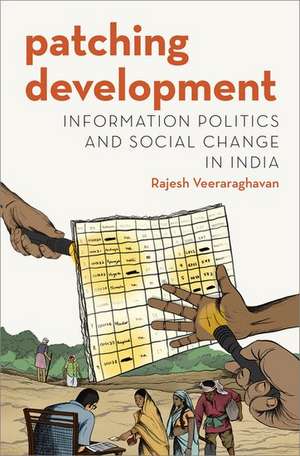
Patching Development: Information Politics and Social Change in India: Modern South Asia
Autor Rajesh Veeraraghavanen Limba Engleză Paperback – 31 mar 2022
Din seria Modern South Asia
- 21%
 Preț: 193.96 lei
 - 16%
 Preț: 193.48 lei
 - 15%
 Preț: 223.83 lei
 - 29%
 Preț: 458.76 lei
 - 21%
 Preț: 150.74 lei
 - 21%
 Preț: 168.24 lei
 - 30%
 Preț: 438.83 lei
 -
 Preț: 389.15 lei
 - 16%
 Preț: 211.09 lei
 - 16%
 Preț: 283.36 lei
 - 23%
 Preț: 257.19 lei
 -
 Preț: 257.28 lei
 -
 Preț: 296.56 lei
 - 21%
 Preț: 165.95 lei
 - 24%
 Preț: 215.02 lei
 - 14%
 Preț: 617.88 lei
 - 31%
 Preț: 351.83 lei
 - 19%
 Preț: 328.44 lei
 - 17%
 Preț: 276.21 lei
 - 23%
 Preț: 147.50 lei
 - nou
 Preț: 170.32 lei
 - nou
 Preț: 463.49 lei
 - nou
 Preț: 122.47 lei
Preț: 193.96 lei
Preț vechi: 231.76 lei
-16%
Puncte Express: 291
Carte disponibilă
Livrare economică 06-11 noiembrie
Livrare prin curier în România Termenul estimat este afișat lângă disponibilitate.
Transport gratuit de la 400.00 lei Plată online sau ramburs, în funcție de opțiunile comenzii.
Retur gratuit în 14 zile Comandă securizată și suport în română.
Specificații
ISBN-13: 9780197567821
ISBN-10: 0197567827
Pagini: 256
Dimensiuni: 241 x 157 x 18 mm
Greutate: 0.39 kg
Editura: Oxford University Press
Colecția OUP USA
Seria Modern South Asia
Locul publicării:New York, United States
ISBN-10: 0197567827
Pagini: 256
Dimensiuni: 241 x 157 x 18 mm
Greutate: 0.39 kg
Editura: Oxford University Press
Colecția OUP USA
Seria Modern South Asia
Locul publicării:New York, United States
Recenzii
How do you get cash payments for labor to the rural poor in the world's largest anti-poverty program? From the commanding heights of the bureaucracy to the front-lines of the village, from sophisticated software to grass roots social audits, Patching Development brilliantly shows us how the National Rural Employment Guarantee program in India has confronted the infamous problems of the last mile. The challenges and conflicts of implementing public policies to fight poverty have never been illuminated in such detail and with such analytic power.
Brilliant! In Patching Development, Veeraraghavan offers an innovative solution to bureaucratic hierarchy that is unable to respond to clients as it faces off against local power structures.
Peppered with exhilarating stories from in-depth research among tribal communities, village councils, social activists, and state officials, Patching Development illuminates a rare case where a combination of political will and digital technology enables democratically accountable socio-economic transformation.
Veeraraghavan provides an excellent sectional analysis of social audit as patching—a mechanism to check misuse of money and authority in MGNREGA, a massive Indian public works programme. An important addition to systemic research on poverty and unemployment, Patching Development enriches the discussion on the challenges and potential of this emergent process.
Development theory needs fresh thinking to move forward. Patching Development answers the call. The multilevel contestation of public officials, local politicians, and social movements is dissected together with the possibilities and limits of information technology to create a synthetic, original vision of how the needs of the poor might be better served.
Brilliant! In Patching Development, Veeraraghavan offers an innovative solution to bureaucratic hierarchy that is unable to respond to clients as it faces off against local power structures.
Peppered with exhilarating stories from in-depth research among tribal communities, village councils, social activists, and state officials, Patching Development illuminates a rare case where a combination of political will and digital technology enables democratically accountable socio-economic transformation.
Veeraraghavan provides an excellent sectional analysis of social audit as patching—a mechanism to check misuse of money and authority in MGNREGA, a massive Indian public works programme. An important addition to systemic research on poverty and unemployment, Patching Development enriches the discussion on the challenges and potential of this emergent process.
Development theory needs fresh thinking to move forward. Patching Development answers the call. The multilevel contestation of public officials, local politicians, and social movements is dissected together with the possibilities and limits of information technology to create a synthetic, original vision of how the needs of the poor might be better served.
Notă biografică
Rajesh Veeraraghavan is an Assistant Professor at Georgetown University. He received his Ph.D from the University of California, Berkeley in 2015. He has been researching and writing about the politics of data and technology and its role in improving the lives of marginalized citizens for the last 15 years.