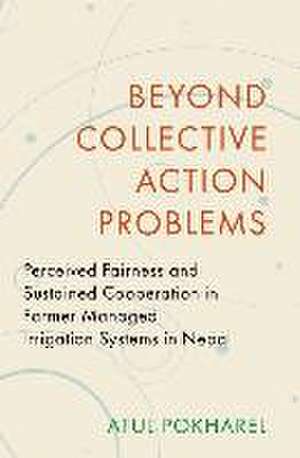
Beyond Collective Action Problems: Perceived Fairness and Sustained Cooperation in Farmer Managed Irrigation Systems in Nepal: Modern South Asia
Autor Atul Pokharelen Limba Engleză Hardback – 19 iun 2024
Din seria Modern South Asia
- 21%
 Preț: 198.75 lei
 - 15%
 Preț: 200.04 lei
 - 16%
 Preț: 193.96 lei
 - 14%
 Preț: 226.06 lei
 - 21%
 Preț: 150.74 lei
 - 21%
 Preț: 168.24 lei
 - 29%
 Preț: 446.74 lei
 -
 Preț: 389.15 lei
 - 16%
 Preț: 211.09 lei
 - 15%
 Preț: 293.00 lei
 - 22%
 Preț: 265.91 lei
 -
 Preț: 257.28 lei
 -
 Preț: 296.56 lei
 - 20%
 Preț: 171.74 lei
 - 23%
 Preț: 222.32 lei
 - 14%
 Preț: 617.88 lei
 - 30%
 Preț: 363.59 lei
 - 19%
 Preț: 328.44 lei
 - 17%
 Preț: 276.21 lei
 - 23%
 Preț: 147.50 lei
 - nou
 Preț: 170.32 lei
 - nou
 Preț: 463.49 lei
 - nou
 Preț: 122.47 lei
Preț: 458.76 lei
Preț vechi: 648.77 lei
-29%
Puncte Express: 688
Carte disponibilă
Livrare economică 13-24 noiembrie
Livrare prin curier în România Termenul estimat este afișat lângă disponibilitate.
Transport gratuit pentru acest produs Plată online sau ramburs, în funcție de opțiunile comenzii.
Retur gratuit în 14 zile Comandă securizată și suport în română.
Specificații
ISBN-13: 9780197755792
ISBN-10: 0197755798
Pagini: 320
Ilustrații: 13 b/w figures
Dimensiuni: 196 x 160 x 38 mm
Greutate: 0.59 kg
Editura: Oxford University Press
Colecția OUP USA
Seria Modern South Asia
Locul publicării:New York, United States
ISBN-10: 0197755798
Pagini: 320
Ilustrații: 13 b/w figures
Dimensiuni: 196 x 160 x 38 mm
Greutate: 0.59 kg
Editura: Oxford University Press
Colecția OUP USA
Seria Modern South Asia
Locul publicării:New York, United States
Recenzii
Nobel prize winning Elinor Ostrom's study of farmer-managed irrigation systems in Nepal was the foundation of her famous theory of governance of the commons. With Ostrom's blessings and data, Atul Pokharel, whose own family played a pivotal role in these successful community-managed irrigation systems returns to them to compare how they have fared three decades later. What emerges is a gem of a book, a rare large scale, temporal study of shared resource management, as painstakingly researched as it is powerfully argued. A magisterial multi-methods research design allows Pokharel to develop a sophisticated theoretical framework that centers a novel factor-famers' perceptions of fairness. Pokharel's remarkable work is essential, accessible reading for scholars and practitioners of development alike.
Climate change has pushed us into a world where survival can depend on solving collective action problems. Atul Pokharel revisits Elinor Ostrom's classic study of collective action to explore why cooperation can fail
Beyond Collective Action Problems is a major new contribution to our understanding of how societies resolve governance problems in the presence of externalities. Drawing on rich evidence from the experience of Nepali farmers in managing an important common pool resource for their livelihoods, Atul Pokharel argues that existing theories of how societies resolve collective action problems have missed a key element: the concern for fairness. When individuals believe that the governance system is fair, they are more likely to behave cooperatively, and the system survives in a self-sustaining fashion. The opposite is true when individuals believe the system is unfair. Pokharel develops a pathbreaking theory of unfairness aversion to explain these differences in behavior. The book is a must read for students across all of the behavioral sciences.
Atul Pokharel has shown once again that irrigation management is an ideal arena in which to study and understand collective action as a generic problem. The costs and benefits are very tangible, as is their distribution. His analysis with a time perspective of more than 30 years, combining quantitative and qualitative data, shows that sustained cooperation is a more significant phenomenon than just 'collective action' which formal game theory has usually framed as a one-off decision. Pokharel's focus on perceived fairness as a determining factor is consistent with my own experience introducing participatory irrigation management in Sri Lanka, Nepal and other countries. He elaborates usefully on Elinor Ostrom's consideration of equity, something that social scientists have mostly paid little attention to.
For scholars as well as practitioners who care about community management of physical infrastructure, this book demonstrates, conclusively, that a sense of fairness in the way organizations operate is the key to their performance. This book takes forward the research by Elinor Ostrom, a Nobel Laureate in Economics, to a new height by showing that only community based organizations that distribute work load and resources fairly are sustainable in the long run. A must read for Political Economists and development planners who seek institutional understanding of success in developmental outcomes.
This pathbreaking, empirically grounded analysis of sustained cooperation makes a major contribution to public policy, economic development, and planning. Pokharel extends Ostrom's seminal research by showing how considerations of justice rival those of rationality for cooperation to endure.
Brilliant! Pokharel challenges the prevailing focus on the collective action problem in understanding sustained cooperation. A fresh perspective centered on the fairness question, the book provides valuable implications for scholars and policymakers interested in cooperation across diverse domains, from irrigation projects to free and open-source software. By transcending the notion of relying solely on local actions, this book offers a paradigm-shifting understanding of sustained cooperation, emphasizing the pivotal role of fairness as the solution.
Atul Pokharel has given us a fresh approach to a bundle of vexing societal problems: cooperation, fairness, and governmental roles in promoting the public interest. The prose is engaging, the insights are profound, and the implications will ripple across a wide variety of communities of scholars and practitioners, from irrigation and farming to cities and digital infrastructure.
Climate change has pushed us into a world where survival can depend on solving collective action problems. Atul Pokharel revisits Elinor Ostrom's classic study of collective action to explore why cooperation can fail
Beyond Collective Action Problems is a major new contribution to our understanding of how societies resolve governance problems in the presence of externalities. Drawing on rich evidence from the experience of Nepali farmers in managing an important common pool resource for their livelihoods, Atul Pokharel argues that existing theories of how societies resolve collective action problems have missed a key element: the concern for fairness. When individuals believe that the governance system is fair, they are more likely to behave cooperatively, and the system survives in a self-sustaining fashion. The opposite is true when individuals believe the system is unfair. Pokharel develops a pathbreaking theory of unfairness aversion to explain these differences in behavior. The book is a must read for students across all of the behavioral sciences.
Atul Pokharel has shown once again that irrigation management is an ideal arena in which to study and understand collective action as a generic problem. The costs and benefits are very tangible, as is their distribution. His analysis with a time perspective of more than 30 years, combining quantitative and qualitative data, shows that sustained cooperation is a more significant phenomenon than just 'collective action' which formal game theory has usually framed as a one-off decision. Pokharel's focus on perceived fairness as a determining factor is consistent with my own experience introducing participatory irrigation management in Sri Lanka, Nepal and other countries. He elaborates usefully on Elinor Ostrom's consideration of equity, something that social scientists have mostly paid little attention to.
For scholars as well as practitioners who care about community management of physical infrastructure, this book demonstrates, conclusively, that a sense of fairness in the way organizations operate is the key to their performance. This book takes forward the research by Elinor Ostrom, a Nobel Laureate in Economics, to a new height by showing that only community based organizations that distribute work load and resources fairly are sustainable in the long run. A must read for Political Economists and development planners who seek institutional understanding of success in developmental outcomes.
This pathbreaking, empirically grounded analysis of sustained cooperation makes a major contribution to public policy, economic development, and planning. Pokharel extends Ostrom's seminal research by showing how considerations of justice rival those of rationality for cooperation to endure.
Brilliant! Pokharel challenges the prevailing focus on the collective action problem in understanding sustained cooperation. A fresh perspective centered on the fairness question, the book provides valuable implications for scholars and policymakers interested in cooperation across diverse domains, from irrigation projects to free and open-source software. By transcending the notion of relying solely on local actions, this book offers a paradigm-shifting understanding of sustained cooperation, emphasizing the pivotal role of fairness as the solution.
Atul Pokharel has given us a fresh approach to a bundle of vexing societal problems: cooperation, fairness, and governmental roles in promoting the public interest. The prose is engaging, the insights are profound, and the implications will ripple across a wide variety of communities of scholars and practitioners, from irrigation and farming to cities and digital infrastructure.
Notă biografică
Atul Pokharel, currently at Yale University, was an Assistant Professor at the NYU Robert F. Wagner Graduate School of Public Service. He studies the political economy of infrastructure governance, and the community maintenance of shared physical and digital resources. His areas of expertise include Urban Governance, International Development Planning, and Political Economy. He focuses on the role of fairness in the community maintenance of infrastructure commons. His research interests include free and open-source software, and the "greening" of transportation systems in global cities. He was a postdoctoral fellow at the Thomas J. Watson Institute of International and Public Affairs at Brown University and holds a Ph.D. in Urban Studies and Planning from MIT as well as a Bachelor's degree in Mathematics from Princeton University with a minor in Applied and Computational Mathematics.