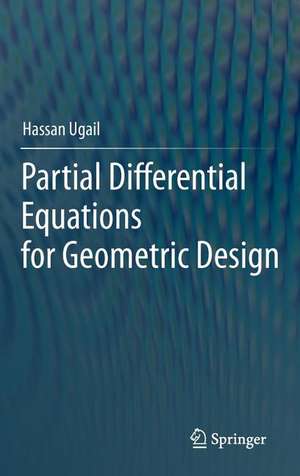
Partial Differential Equations for Geometric Design
Autor Hassan Ugailen Limba Engleză Hardback – 24 aug 2011
Preț: 397.45 lei
Puncte Express: 596
Carte tipărită la comandă
Livrare economică 27 noiembrie-11 decembrie
Livrare prin curier în România Termenul estimat este afișat lângă disponibilitate.
Transport gratuit de la 400.00 lei Plată online sau ramburs, în funcție de opțiunile comenzii.
Retur gratuit în 14 zile Comandă securizată și suport în română.
Specificații
ISBN-13: 9780857297839
ISBN-10: 085729783X
Pagini: 120
Ilustrații: IX, 107 p.
Dimensiuni: 160 x 241 x 10 mm
Greutate: 0.3 kg
Ediția:2011
Editura: Springer
Locul publicării:London, United Kingdom
ISBN-10: 085729783X
Pagini: 120
Ilustrații: IX, 107 p.
Dimensiuni: 160 x 241 x 10 mm
Greutate: 0.3 kg
Ediția:2011
Editura: Springer
Locul publicării:London, United Kingdom
V-ar putea interesa
-
 Cybersecurity and Applied MathematicsLeigh Metcalf-29%Preț: 340.35 lei479.85 lei
 -
 Automata and LanguagesJohn M. Howie-35%Preț: 339.47 lei520.04 lei
 -
 -36%Preț: 593.72 lei934.03 lei
 -
 Lambda Calculi: A Guide for Computer ScientistsChris Hankin-36%Preț: 359.37 lei564.70 lei
 -
 Advances in Logic Programming TheoryGiorgio Levi-38%Preț: 794.97 lei1280.71 lei
 -
 Concrete MathematicsRonald Graham-20%Preț: 560.73 lei700.91 lei
 -
 GraphsThulasiraman-9%Preț: 1683.73 lei1850.25 lei
 -
 A Distributed Pi-CalculusMatthew Hennessy-20%Preț: 552.00 lei690.01 lei
 -
 Essential Linear Algebra with ApplicationsTitu Andreescu-15%Preț: 534.62 lei628.97 lei
 -
 -23%Preț: 487.76 lei633.45 lei
 -
 Seamless R and C++ Integration with RcppDirk Eddelbuettel-20%Preț: 561.37 lei701.71 lei
 -
 Approximation AlgorithmsVijay V. Vazirani-20%Preț: 595.17 lei743.97 lei
Public țintă
GraduateCuprins
Elementary Mathematics for Geometric Design.-Introduction to Geometric Design.-Introduction to Partial Differential Equations.-Elliptic PDEs for Geometric Design.-Interactive Design.-Parametric Design.-Functional Design.-Other Applications.-Conclusions.
Recenzii
From the reviews:
“The book is devoted to the application of partial differential equations (PDEs) in geometric design. The main idea of the book is to describe how elliptic PDEs can be used as an intuitive surface generation and manipulation tool. … The book should equally serve as a reference for the mathematical foundamentals and modern applications using PDEs and as a tool for geometric design. It is suitable both as a textbook and a professional reference for students, researchers and engineers.” (Agnieszka Lisowska, Zentralblatt MATH, Vol. 1230, 2012)
“The book is devoted to the application of partial differential equations (PDEs) in geometric design. The main idea of the book is to describe how elliptic PDEs can be used as an intuitive surface generation and manipulation tool. … The book should equally serve as a reference for the mathematical foundamentals and modern applications using PDEs and as a tool for geometric design. It is suitable both as a textbook and a professional reference for students, researchers and engineers.” (Agnieszka Lisowska, Zentralblatt MATH, Vol. 1230, 2012)
Textul de pe ultima copertă
The subject of Partial Differential Equations (PDEs) which first emerged in the 18th century holds an exciting and special position in the applications relating to the mathematical modelling of physical phenomena. The subject of PDEs has been developed by major names in applied mathematics such as Euler, Legendre, Laplace and Fourier and has applications to each and every physical phenomenon known to us e.g. fluid flow, elasticity, electricity and magnetism, weather forecasting and financial modelling.
This book introduces the recent developments of PDEs in the field of geometric design particularly for computer based design and analysis involving the geometry of physical objects. Starting from the basic theory through to the discussion of practical applications the book describes how PDEs can be used in the area of Computer Aided Design and Simulation Based Design. Extensive examples with real life applications of PDEs in the area of geometric design are discussed in the book.
This book introduces the recent developments of PDEs in the field of geometric design particularly for computer based design and analysis involving the geometry of physical objects. Starting from the basic theory through to the discussion of practical applications the book describes how PDEs can be used in the area of Computer Aided Design and Simulation Based Design. Extensive examples with real life applications of PDEs in the area of geometric design are discussed in the book.
Caracteristici
Provides detailed description of how Partial Differential Equations are used in the field of geometric design Supplies clear and concise explanations of how to implement the techniques described Offers extensive discussions (with examples) or practical applications of Partial Differential Equations in geometric design Includes supplementary material: sn.pub/extras
Notă biografică
Howell Edwards is Professor Emeritus of Molecular Spectroscopy at the University of Bradford. He studied Chemistry at Jesus College, Oxford, completing his B.A. and B.Sc. before undertaking doctoral work in Raman spectroscopy. He later became a Research Fellow at Jesus College, Cambridge. After joining the University of Bradford as a Lecturer in Structural and Inorganic Chemistry, he became Head of the Department of Chemical and Forensic Sciences and was awarded a Personal Chair in Molecular Spectroscopy in 1996.
His career in spectroscopy has been recognised through major international awards, including the Sir Harold Thompson Award, the Charles Mann Award, the Emanuel Boricky Medal, and the Norman Sheppard Award. He has published more than 1,420 research papers on Raman spectroscopy and the analysis of materials in art, archaeology, and forensic science. He has also maintained a long-standing interest in the porcelains of William Billingsley, especially those made at Derby, Nantgarw, and Swansea.
Professor Edwards is the author of eleven books on ceramics, porcelain, and cultural heritage science, including Swansea and Nantgarw Porcelains: A Scientific Reappraisal; Nantgarw and Swansea Porcelains: An Analytical Perspective; Porcelain to Silica Bricks; 18th and 19th Century Porcelain Analysis; Porcelain Analysis and Its Role in the Forensic Attribution of Ceramic Specimens; Raman Spectroscopy in Cultural Heritage Preservation; Armorial Porcelain: The Genesis; Welsh Armorial Porcelains; The Pendock-Barry Porcelain Service; The Farnley Hall Service; and Blue by Fire. His forthcoming book, A¿Marked Porcelains: Their History, Chemistry, Decoration and Attribution, cöauthored with Ross and Gael Ramsay, is scheduled for 2026. He also serves as Honorary Scientific Adviser to the de Brecy Trust on the scientific evaluation of artworks.
Hassan Ugail is Professor of Visual Computing at the University of Bradford and Director of the Centre for Visual Computing and Intelligent Systems. With over three decades of experience in computer science, applied mathematics, and machine learning, his work centres on visual analysis, pattern recognition, and AI¿enabled decision support.
He is internationally recognised for pioneering the use of artificial intelligence in the analysis and attribution of historical artworks. His research has shown how deep learning and handcrafted image features can detect subtle stylistic signatures in paintings and decorative art. He is especially known for his AI¿assisted attribution studies on Raphael, including the widely reported analysis of the Madonna della Rosa, which helped establish computational connoisseurship as a credible method in art history.
This volume extends that work into ceramic art, applying similar methods to the decorated porcelain of William Billingsley and his contemporaries. By combining deep learning, one¿class classification, and handcrafted image analysis, it introduces new tools for attribution and authentication in an area traditionally dominated by connoisseurship and physical examination.
Beyond cultural heritage, Professor Ugail has led significant research in biometrics, forensic imaging, healthcare AI, and public¿sector decision support. He has worked with NHS Blood and Transplant and collaborated with teams at Oxford and Newcastle on NIHR¿funded projects in medical image analysis and organ quality assessment. He has undertaken biometric research with Dubai Police and advised the United Nations on AI implementation. His work has generated patents, supported university spin¿outs, and attracted funding from NIHR, EPSRC, UKRI, Innovate UK, DASA, DSTL, and the UK Ministry of Defence. His achievements have been recognised by the University of Bradford Vice¿Chancellor’s Award for Excellence in Knowledge Transfer (2010, 2019) and the Maldives National Award for Innovation (2011).