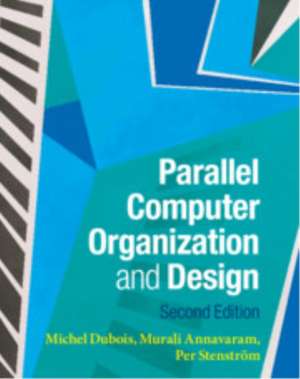
Parallel Computer Organization and Design
Autor Michel Dubois, Murali Annavaram, Per Stenströmen Limba Engleză Hardback – sep 2025
Preț: 640.83 lei
Preț vechi: 696.55 lei
-8%
Puncte Express: 961
Carte tipărită la comandă
Livrare economică 25 noiembrie-09 decembrie
Livrare prin curier în România Termenul estimat este afișat lângă disponibilitate.
Transport gratuit pentru acest produs Plată online sau ramburs, în funcție de opțiunile comenzii.
Retur gratuit în 14 zile Comandă securizată și suport în română.
Specificații
ISBN-13: 9781009447591
ISBN-10: 1009447599
Pagini: 604
Dimensiuni: 208 x 260 x 37 mm
Greutate: 1.43 kg
Ediția:2 Revised edition
Editura: Cambridge University Press
ISBN-10: 1009447599
Pagini: 604
Dimensiuni: 208 x 260 x 37 mm
Greutate: 1.43 kg
Ediția:2 Revised edition
Editura: Cambridge University Press
V-ar putea interesa
-
 The Art of Multiprocessor ProgrammingMaurice Herlihy-40%Preț: 375.12 lei620.73 lei
 -
 -41%Preț: 457.81 lei769.47 lei
 -
 An Introduction to Parallel ProgrammingPeter Pacheco-41%Preț: 382.32 lei644.49 lei
 -
 Multicore and GPU Programming: An Integrated ApproachGerassimos Barlas-40%Preț: 530.07 lei888.37 lei
 -
 Computer Networks: A Systems ApproachLarry L. Peterson-41%Preț: 558.53 lei941.05 lei
 -
 -40%Preț: 492.21 lei824.42 lei
 -
 -40%Preț: 493.63 lei823.98 lei
 -
 High Performance Computing: Modern Systems and PracticesThomas Sterling-40%Preț: 437.18 lei729.97 lei
 -
 Principles of Computer HardwareAlan Clements-29%Preț: 602.71 lei846.14 lei
 -
 ARM System-on-Chip ArchitectureSteve Furber-23%Preț: 591.53 lei768.22 lei
 -
 -20%Preț: 580.64 lei725.81 lei
 -
 Essentials of Computer ArchitectureDouglas Comer-20%Preț: 370.93 lei463.66 lei
 -
 Computer Architecture: A Quantitative ApproachJohn L. Hennessy-39%Preț: 536.81 lei884.58 lei
 -
 Computer Systems: A Programmer's Perspective, Global EditionRandal E. Bryant-20%Preț: 652.59 lei815.74 lei
 -
 Operating Systems: Internals and Design Principles, Global EditionWilliam Stallings-20%Preț: 703.73 lei879.66 lei
 -
 Computer Organization and Architecture, Global EditionWilliam Stallings-20%Preț: 576.60 lei720.75 lei
 -
 Foundations of Analog and Digital Electronic CircuitsAnant Agarwal-28%Preț: 546.19 lei754.30 lei
 -
 Computer ArchitectureCharles Fox-35%Preț: 302.86 lei467.47 lei
 -
 Parallel ProgrammingThomas Rauber-20%Preț: 407.64 lei509.55 lei
 -
 Understanding Computer OrganizationPatricio Buli¿-20%Preț: 385.10 lei481.38 lei
Cuprins
1. Introduction; 2. Impact of technology; 3. Processor microarchitecture; 4. Memory hierarchies; 5. Multiprocessor systems; 6. Interconnection networks; 7. Coherence, synchronization, and memory consistency; 8. Chip multiprocessors; 9. Quantitative evaluations.
Recenzii
'An excellent book in an area that has long cried out for tutorial material - it will be an indispensable resource to students and educators in parallel computer architecture.' Josep Torrellas, University of Illinois
'… an excellent textbook which can serve both as an introduction to multi-core and parallel architectures, as well as a reference for engineers and researchers.' Olivier Temam, INRIA, France
'… fills an urgent need for a comprehensive and authoritative yet approachable tutorial and reference text for advanced computer architecture topics. All of the key principles and concepts covered in Wisconsin's three-course computer architecture sequence are addressed in a well-organized, thoughtful, and pedagogically appealing manner, without overwhelming the reader with distracting trivia or an excess of quantitative data … the final chapter on quantitative evaluation - a true gem! - is a unique and valuable asset that will clearly set this book apart from its competition.' Mikko Lipasti, University of Wisconsin, Madison
'Its content is rich, coherent and clear. Its questions are crafted to stimulate creative thinking. I recommend the book as a must read to all graduate students and young researchers and engineers designing computers.' Lixin Zhang, Institute of Computing Technology, Chinese Academy of Sciences
'This is a perfect text for a one semester graduate course.' Lawrence Rauchwerger, Texas A&M University
'It is the best of today's books on the subject, and I plan to use it in my class. It is an up-to-date picture of parallel computing that is written in a style that is clear and accessible.' Trevor Mudge, University of Michigan
'I want to particularly stress the uniquely clear way in which the authors explain the hardest among these topics: coherence, synchronization, and memory consistency.' Manolis Katevenis, University of Crete and Head of the Computer Architecture and VLSI Systems Laboratory, FORTH-ICS
'… an excellent textbook which can serve both as an introduction to multi-core and parallel architectures, as well as a reference for engineers and researchers.' Olivier Temam, INRIA, France
'… fills an urgent need for a comprehensive and authoritative yet approachable tutorial and reference text for advanced computer architecture topics. All of the key principles and concepts covered in Wisconsin's three-course computer architecture sequence are addressed in a well-organized, thoughtful, and pedagogically appealing manner, without overwhelming the reader with distracting trivia or an excess of quantitative data … the final chapter on quantitative evaluation - a true gem! - is a unique and valuable asset that will clearly set this book apart from its competition.' Mikko Lipasti, University of Wisconsin, Madison
'Its content is rich, coherent and clear. Its questions are crafted to stimulate creative thinking. I recommend the book as a must read to all graduate students and young researchers and engineers designing computers.' Lixin Zhang, Institute of Computing Technology, Chinese Academy of Sciences
'This is a perfect text for a one semester graduate course.' Lawrence Rauchwerger, Texas A&M University
'It is the best of today's books on the subject, and I plan to use it in my class. It is an up-to-date picture of parallel computing that is written in a style that is clear and accessible.' Trevor Mudge, University of Michigan
'I want to particularly stress the uniquely clear way in which the authors explain the hardest among these topics: coherence, synchronization, and memory consistency.' Manolis Katevenis, University of Crete and Head of the Computer Architecture and VLSI Systems Laboratory, FORTH-ICS