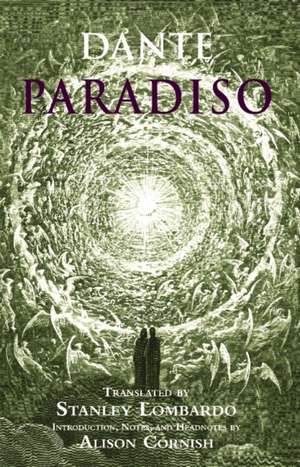
Paradiso
Traducere de Dante Alighieri Autor Stanley Lombardo Introducere și note de Alison Cornishen Limba Engleză Paperback – 14 feb 2017
Like his groundbreaking Inferno (Hackett, 2009) and Purgatorio (Hackett, 2016), Stanley Lombardo's Paradiso features a close yet dynamic verse translation, innovative verse paragraphing for reader-friendliness, and a facing-page Italian text. It also offers an extraordinarily helpful set of notes and headnotes as well as Introduction—all designed for first-time readers of the canticle—by Alison Cornish.
Preț: 147.86 lei
Preț vechi: 174.96 lei
-15%
Puncte Express: 222
Carte disponibilă
Livrare economică 17 noiembrie-01 decembrie
Livrare prin curier în România Termenul estimat este afișat lângă disponibilitate.
Transport gratuit de la 400.00 lei Plată online sau ramburs, în funcție de opțiunile comenzii.
Retur gratuit în 14 zile Comandă securizată și suport în română.
Specificații
ISBN-13: 9781624665905
ISBN-10: 162466590X
Pagini: 598
Dimensiuni: 140 x 216 x 29 mm
Greutate: 0.68 kg
Editura: Hackett Publishing Company,Inc
Colecția Hackett Publishing Company, Inc.
Locul publicării:United States
ISBN-10: 162466590X
Pagini: 598
Dimensiuni: 140 x 216 x 29 mm
Greutate: 0.68 kg
Editura: Hackett Publishing Company,Inc
Colecția Hackett Publishing Company, Inc.
Locul publicării:United States
V-ar putea interesa
-
 Works and Days and TheogonyHesiodPreț: 105.81 lei
 -
 The Essential AeneidVirgilPreț: 102.70 lei
 -
 -15%Preț: 119.13 lei140.80 lei
 -
 Vernacular Translation in Dante's ItalyAlison CornishPreț: 300.32 lei
 -
 Preț: 174.45 lei
 -
 Preț: 308.74 lei
 -
 Preț: 172.32 lei
 -
 Preț: 181.94 lei
 -
 Preț: 181.94 lei
 -
 Preț: 237.22 lei
 -
 Preț: 237.22 lei
 -
 Preț: 238.00 lei
 -
 Preț: 172.32 lei
 -
 Preț: 181.94 lei
 -
 Preț: 172.32 lei
 -
 Preț: 172.32 lei
 -
 Preț: 172.32 lei
 -
 Preț: 234.25 lei
 -
 Arthur Morrison, Collection NovelsArthur MorrisonPreț: 165.40 lei
 -
 Anthology of Classical Myth: Primary Sources in TranslationStephen M. Trzaskoma-21%Preț: 254.13 lei320.67 lei
 -
 -16%Preț: 131.21 lei156.60 lei
Recenzii
"Lombardo makes Dante's verses come alive in so many ways that this crowning achievement stands on its own as inspired poetry, readily comprehensible and reliably attentive to the many different registers that the Florentine poet incorporates in his text. Despite its reputation as the most challenging of the three canticles, the Paradiso, in Lombardo's dramatically charged version, becomes remarkably transparent. . . . As is characteristic of his previous translations, Lombardo addresses his version of Paradiso not only to readers but also to listeners and succeeds in recreating the various stages on which the Comedy was originally received and presented: private readings at home and more public oral performances either for small, intimate groups within the palazzo walls or before large crowds in the town square. . . . In her fine Introduction, instructive headnotes to individual cantos, and extensive explanatory endnotes, Alison Cornish provides all the information necessary for a profitable reading of the Paradiso. . . . This handsome bilingual edition is a welcome addition to the large and ever increasing number of annotated translations of Dante's Comedy."
—Christopher Kleinhenz, Carol Mason Kirk Professor Emeritus of Italian, University of Wisconsin–Madison
—Christopher Kleinhenz, Carol Mason Kirk Professor Emeritus of Italian, University of Wisconsin–Madison
"The distinctive combination of Lombardo's lucid rendering of Dante's poem with Cornish's judicious commentary will make this volume a remarkable resource for both new and seasoned readers. It not only provides the necessary coordinates to comprehend Dante's daring description of eternity but also offers new insights about the work’s relation to its historical, philosophical, and literary contexts."
—Martin Eisner, Associate Professor of Romance Studies, Duke University
—Martin Eisner, Associate Professor of Romance Studies, Duke University
"This translation and commentary are an essential contribution to Dante's reception in English. Stanley Lombardo's translation is accurate, elegant, and transparent, a mirror of the original text. Alison Cornish's commentary is lucid, graceful, and precise, with just the right level of detail; it penetrates and opens the Paradiso's philosophical, scientific, and theological dimensions with authority, balance, sensitivity, and simplicity. Perhaps now more readers will follow Dante to Paradise."
—Christian Moevs, Associate Professor of Italian, University of Notre Dame
—Christian Moevs, Associate Professor of Italian, University of Notre Dame
"Unlike the crowd-pleasing, visceral and eviscerating Inferno, the Paradiso is not exactly a page-turner. It's rather a quiet journey that demands we slow down, think, and feel before attempting to assimilate higher wisdom, more divine geometry, choreography, and optic theory, and before we meet more of the heroes from the Christian canon, cherishing their divine placement (Look how high Augustine made it. Great to see Joachim of Fiore!, etc.). Lombardo's and Cornish's book, as a book, is engineered to inspire and facilitate this sort of reading, with ample access to the language, ingenuity, creativity and care that Dante summons as he attempted, as far as a poet ever could, to express God's justice and His grace. This is a great classroom text, a tremendously useful parallel-text edition for students, general readers, and anyone at any level studying Dante.
"Parallel texts serve best in the modern multicultural classroom where multilingual and monolingual speakers alike can directly engage with the majestic text. I have been teaching Dante for 25 years in a historically Hispanic institution and always cherished them because my bilingual students hear the roots of their own linguistic cultures in the Italian and experience both joy and empowerment in doing so.
"One should never underestimate how timely and important are the many themes that one encounters in the Paradiso, such as the experiences of the holy women in the early cantos who were forced into marriage and away from their monastic vows, a stunning episode that explores human and particular female agency in shaping one's own personal and spiritual destiny. Also the depictions of equity, equality, and diversity in heaven will be of great interest to modern readers concerned with social order and social justice. What fascinating class discussions can arise from contemplating the medieval and the modern—and the divine and earthly—urges for justice! Such questions help keep Dante alive and relevant at a time when many teachers fear for the future of the Humanities. To this labor of preserving the past and its great Humanist writers, Lombardo and Cornish have contributed mightily."Lombardo in his Translator's Preface (xxix) says that his translation of the Inferno has been accused of sounding something like the dialogue in a Scorsese movie. And there are in fact some Scorsese-esque moments even here in paradise, such as when Charles Martel lists various illustrious figures born to great destiny during a discussion of how both birth and divine influence play a part in shaping human destiny: "So one is born a Solon, another Xerxes, / one Melchizedek, and another the one / who flew through the air and lost his son" (81: VIII 124-126), lines directly modeled on the Wizard's rundown of human vocational differences to Travis in Scorsese's Taxi Driver. Among a thousand gems, that is, moments when the translation just nails the moment in mood, diction, tone and or register, I would note some favorites: XII.91-94 (p. 119); XII.70-74 (p. 117); and XII.37-39 (p. 95).
"Cornish's notes to each canto, judicious and hyper-clear, are in the back of the book, supporting undistracted reading. The notes guide and mentor the reader, reinforcing what we just read and providing historical information or identification of figures and concepts. Cornish begins each canto with an overview of the characters and content, and uses key words in the original Italian to introduce major terms and concepts. Her introduction is particularly warm and welcoming, emphasizing the themes of knowledge and most of all love that animate Dante's journey and his relationship with Beatrice. The entire apparatus forged by Cornish breaks down many barriers to reading Dante, in part by directly addressing the traditional preference for the Inferno. One could build a course on Dante out of her economic survey of the liberal arts authors she nimbly weaves into the discussion of cosmology, justice, order, and heaven.
After the Introduction a spatial map with an elegant rose and spread sheet of canto, location, class of the blessed, and major characters helps readers to chart their personal journey upward.
"This publication will help ensure that new generations of readers are welcomed into this unique and ineffable journey. I look forward to teaching it as soon as possible."
—Michael Calabrese, California State University, Los Angeles, in The Medieval Review