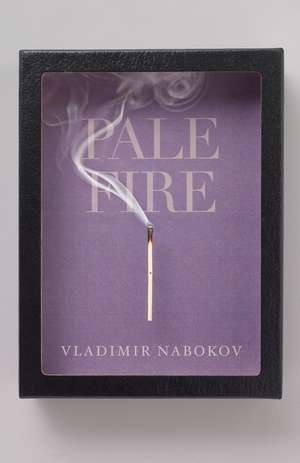
Pale Fire
Autor Vladimir Nabokoven Limba Engleză Paperback – 23 apr 1989
| Toate formatele și edițiile | Preț | Express |
|---|---|---|
| Paperback (3) | 54.13 lei 24-35 zile | +22.87 lei 7-11 zile |
| Penguin Books – 31 aug 2000 | 54.13 lei 24-35 zile | +22.87 lei 7-11 zile |
| Orion Publishing Group – 30 mai 2024 | 54.77 lei 3-5 săpt. | +32.01 lei 7-11 zile |
| Knopf Doubleday Publishing Group – 23 apr 1989 | 92.52 lei 3-5 săpt. | |
| Hardback (2) | 83.67 lei 24-35 zile | |
| EVERYMAN – 18 mar 1992 | 83.67 lei 24-35 zile | |
| Knopf Doubleday Publishing Group – 10 mar 1992 | 174.98 lei 3-5 săpt. |
Preț: 92.52 lei
Puncte Express: 139
Preț estimativ în valută:
16.38€ • 19.07$ • 14.23£
16.38€ • 19.07$ • 14.23£
Carte disponibilă
Livrare economică 03-17 februarie
Preluare comenzi: 021 569.72.76
Specificații
ISBN-13: 9780679723424
ISBN-10: 0679723420
Pagini: 320
Dimensiuni: 132 x 205 x 23 mm
Greutate: 0.24 kg
Ediția:Vintage Intl.
Editura: Knopf Doubleday Publishing Group
ISBN-10: 0679723420
Pagini: 320
Dimensiuni: 132 x 205 x 23 mm
Greutate: 0.24 kg
Ediția:Vintage Intl.
Editura: Knopf Doubleday Publishing Group
V-ar putea interesa
-
 The Virgin SuicidesJeffrey EugenidesPreț: 68.28 lei
 -
 MiddlesexJeffrey EugenidesPreț: 77.28 lei
 -
 Sabbath's TheaterPhilip Roth-18%Preț: 57.46 lei70.40 lei
 -
 One Hundred Years of SolitudeGabriel Garcia Marquez-26%Preț: 56.68 lei76.51 lei
 -
 The GiftVladimir Nabokov-20%Preț: 61.38 lei76.31 lei
 -
 Atlas ShruggedAyn RandPreț: 95.55 lei
 -
 Look at the Harlequins!Vladimir Nabokov-27%Preț: 55.07 lei75.52 lei
 -
 Eugénie GrandetHonoré de Balzac-21%Preț: 53.44 lei67.94 lei
 -
 Falling ManDon DeLillo-50%Preț: 44.01 lei88.15 lei
 -
 GlamoramaBret Easton Ellis-33%Preț: 51.17 lei76.82 lei
 -
 House of LeavesMark Z. DanielewskiPreț: 198.43 lei
 -
 The Unabridged Journals of Sylvia PlathSylvia PlathPreț: 136.10 lei
 -
 The Stories of Vladimir NabokovVladimir NabokovPreț: 136.35 lei
 -
 The Roots of Romanticism – Second EditionIsaiah BerlinPreț: 68.93 lei
 -
 The Crack-UpF. Scott FitzgeraldPreț: 107.68 lei
 -
 -25%Preț: 68.35 lei91.62 lei
 -
 The Angel Esmeralda: Nine StoriesDon DeLilloPreț: 74.88 lei
 -
 I'd Die for You: And Other Lost StoriesF. Scott Fitzgerald-23%Preț: 58.34 lei76.06 lei
 -
 Tender is the Night / The Last TycoonF. Scott FitzgeraldPreț: 29.93 lei
 -
 Man's Search For MeaningViktor E. FranklPreț: 60.46 lei
 -
 Plays by Lars NorenLars NorenPreț: 116.46 lei
Notă biografică
Vladimir Vladimirovich Nabokov was born on April 23, 1899, in St. Petersburg, Russia. The Nabokovs were known for their high culture and commitment to public service, and the elder Nabokov was an outspoken opponent of antisemitism and one of the leaders of the opposition party, the Kadets. In 1919, following the Bolshevik revolution, he took his family into exile. Four years later he was shot and killed at a political rally in Berlin while trying to shield the speaker from right-wing assassins.
The Nabokov household was trilingual, and as a child Nabokov was already reading Wells, Poe, Browning, Keats, Flaubert, Verlaine, Rimbaud, Tolstoy, and Chekhov, alongside the popular entertainments of Sir Arthur Conan Doyle and Jules Verne. As a young man, he studied Slavic and romance languages at Trinity College, Cambridge, taking his honors degree in 1922. For the next eighteen years he lived in Berlin and Paris, writing prolifically in Russian under the pseudonym Sirin and supporting himself through translations, lessons in English and tennis, and by composing the first crossword puzzles in Russian. In 1925 he married Vera Slonim, with whom he had one child, a son, Dmitri.
Having already fled Russia and Germany, Nabokov became a refugee once more in 1940, when he was forced to leave France for the United States. There he taught at Wellesley, Harvard, and Cornell. He also gave up writing in Russian and began composing fiction in English. In his afterword to Lolita he claimed: "My private tragedy, which cannot, and indeed should not, be anybody's concern, is that I had to abandon my natural idiom, my untrammeled, rich, and infinitely docile Russian tongue for a second-rate brand of English, devoid of any of those apparatuses–the baffling mirror, the black velvet backdrop, the implied associations and traditions–which the native illusionist, frac-tails flying, can magically use to transcend the heritage in his own way." [p. 317] Yet Nabokov's American period saw the creation of what are arguably his greatest works, Bend Sinister (1947), Lolita (1955), Pnin (1957), and Pale Fire (1962), as well as the translation of his earlier Russian novels into English. He also undertook English translations of works by Lermontov and Pushkin and wrote several books of criticism. Vladimir Nabokov died in Montreux, Switzerland, in 1977.
From the Hardcover edition.
The Nabokov household was trilingual, and as a child Nabokov was already reading Wells, Poe, Browning, Keats, Flaubert, Verlaine, Rimbaud, Tolstoy, and Chekhov, alongside the popular entertainments of Sir Arthur Conan Doyle and Jules Verne. As a young man, he studied Slavic and romance languages at Trinity College, Cambridge, taking his honors degree in 1922. For the next eighteen years he lived in Berlin and Paris, writing prolifically in Russian under the pseudonym Sirin and supporting himself through translations, lessons in English and tennis, and by composing the first crossword puzzles in Russian. In 1925 he married Vera Slonim, with whom he had one child, a son, Dmitri.
Having already fled Russia and Germany, Nabokov became a refugee once more in 1940, when he was forced to leave France for the United States. There he taught at Wellesley, Harvard, and Cornell. He also gave up writing in Russian and began composing fiction in English. In his afterword to Lolita he claimed: "My private tragedy, which cannot, and indeed should not, be anybody's concern, is that I had to abandon my natural idiom, my untrammeled, rich, and infinitely docile Russian tongue for a second-rate brand of English, devoid of any of those apparatuses–the baffling mirror, the black velvet backdrop, the implied associations and traditions–which the native illusionist, frac-tails flying, can magically use to transcend the heritage in his own way." [p. 317] Yet Nabokov's American period saw the creation of what are arguably his greatest works, Bend Sinister (1947), Lolita (1955), Pnin (1957), and Pale Fire (1962), as well as the translation of his earlier Russian novels into English. He also undertook English translations of works by Lermontov and Pushkin and wrote several books of criticism. Vladimir Nabokov died in Montreux, Switzerland, in 1977.
From the Hardcover edition.
Recenzii
"This centaur work, half-poem, half-prose . . . is a creation of perfect beauty, symmetry, strangeness, originality and moral truth. Pretending to be a curio, it cannot disguise the fact that it is one of the great works of art of this century." --Mary McCarthy
Descriere
Descriere de la o altă ediție sau format:
'One of the greatest books I've ever read. Its heart is strange, but it is huge; let yours beat in response' MARY GAITSKILL
Pale Fire, a 999-line poem, is the final work of the celebrated - and recently murdered - American author, John Francis Shade.
Here that poem is transcribed, introduced and annotated (at length) by Shade's fellow scholar, neighbour and apparent friend, Charles Kinbote.
Approaching this task with gusto, Kinbote's annotations reveal conclusive evidence of his own impact on Shade, disguised references to the northern land of Zembla, which he may or may not have once ruled over, and fuel for his many preoccupations and paranoia.
And - as his annotations become more desperate, more deluded, more deranged - Kinbote unintentionally sheds new light on the poet's last days and the pair's 'glorious friendship'.
A murder mystery, a work of wild invention, a reimagining of what the novel can do, a piece of exquisite comedy, Pale Fire is widely regarded as Nabokov's masterpiece and one of the most brilliant novels ever written.
A W&N Essential with an introduction from Mary Gaitskill
'One of the greatest books I've ever read. Its heart is strange, but it is huge; let yours beat in response' MARY GAITSKILL
Pale Fire, a 999-line poem, is the final work of the celebrated - and recently murdered - American author, John Francis Shade.
Here that poem is transcribed, introduced and annotated (at length) by Shade's fellow scholar, neighbour and apparent friend, Charles Kinbote.
Approaching this task with gusto, Kinbote's annotations reveal conclusive evidence of his own impact on Shade, disguised references to the northern land of Zembla, which he may or may not have once ruled over, and fuel for his many preoccupations and paranoia.
And - as his annotations become more desperate, more deluded, more deranged - Kinbote unintentionally sheds new light on the poet's last days and the pair's 'glorious friendship'.
A murder mystery, a work of wild invention, a reimagining of what the novel can do, a piece of exquisite comedy, Pale Fire is widely regarded as Nabokov's masterpiece and one of the most brilliant novels ever written.
A W&N Essential with an introduction from Mary Gaitskill