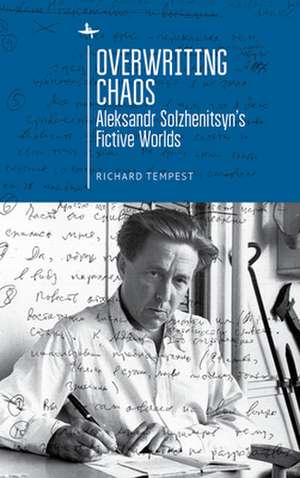
Overwriting Chaos: Cultural Revolutions: Russia in the Twentieth Century
Autor Richard Tempesten Limba Engleză Hardback – 17 dec 2019


Preț: 866.98 lei
Preț vechi: 1125.94 lei
-23%
Puncte Express: 1300
Carte tipărită la comandă
Livrare economică 29 mai-12 iunie
Specificații
ISBN-13: 9781644690123
ISBN-10: 1644690128
Pagini: 750
Dimensiuni: 161 x 240 x 44 mm
Greutate: 1.22 kg
Editura: Academic Studies Press
Seria Cultural Revolutions: Russia in the Twentieth Century
ISBN-10: 1644690128
Pagini: 750
Dimensiuni: 161 x 240 x 44 mm
Greutate: 1.22 kg
Editura: Academic Studies Press
Seria Cultural Revolutions: Russia in the Twentieth Century
Cuprins
Acknowledgments
A Note on Translations and Transliterations
Preface
Timeline of Solzhenitsyn¿s Life and Works
Part One: The Writer In Situ
1. The Quilted Jerkin: Solzhenitsyn¿s Life and Art
2. Ice, Squared: ¿One Day in the Life of Ivan Denisovich¿
3. ¿Turgenev Never Knew¿: The Shorter Fictions of the 1950s and 1960s
4. Meteor Man: Love the Revolution
5. Helots and Heroes: In the First Circle
6. Rebel versus Rabble: Cancer Ward
Part Two: The Writer Ex Situ
7. Twilight of All the Russias: The Red Wheel
8. Return: The Shorter Fictions of the 1990s
9: Modernist?
Appendix. Three Interviews with Aleksandr Solzhenitsyn (2003¿7)
Notes
Selected Bibliography
Index
A Note on Translations and Transliterations
Preface
Timeline of Solzhenitsyn¿s Life and Works
Part One: The Writer In Situ
1. The Quilted Jerkin: Solzhenitsyn¿s Life and Art
2. Ice, Squared: ¿One Day in the Life of Ivan Denisovich¿
3. ¿Turgenev Never Knew¿: The Shorter Fictions of the 1950s and 1960s
4. Meteor Man: Love the Revolution
5. Helots and Heroes: In the First Circle
6. Rebel versus Rabble: Cancer Ward
Part Two: The Writer Ex Situ
7. Twilight of All the Russias: The Red Wheel
8. Return: The Shorter Fictions of the 1990s
9: Modernist?
Appendix. Three Interviews with Aleksandr Solzhenitsyn (2003¿7)
Notes
Selected Bibliography
Index
Descriere
Examines Aleksandr Solzhenitsyn's evolution as a literary artist from his early autobiographical novel Love the Revolution to the experimental mega-saga The Red Wheel, and beyond. Tempest shows how this author gives his characters a presence so textured that we can readily imagine them as figures of flesh and blood.
Recenzii
“[A] massive and provocative book by the Slavist Richard Tempest has appeared, that aims to come to terms with the entirety of Solzhenitsyn’s ‘fictive worlds.’ With clarity and erudition, Tempest attempts to demonstrate how Solzhenitsyn used numerous experimental and modernist techniques to defend and revivify the realist tradition in literature, a tradition where good and evil are real and utterly palpable, where authentic heroes exist, and where an author committed to truth, responsibility, and the integrity of art manfully resists the chaos and nihilism of the age. Tempest… fully appreciates why Solzhenitsyn rejected ‘the howl of existentialism’ and fashionable but morally and culturally corrosive doctrines about ‘the death of the author.’ Solzhenitsyn refused to fiddle while Rome burned.”
— Daniel J. Mahoney, Perspectives on Political Science
“Richard Tempest’s Overwriting Chaos is a systematic up-to-date study of the structures of Solzhenitsyn’s artistic imagination. It places Solzhenitsyn in three widening frames: as a writer dealing with the Gulag and its pre-history, as an integral part of the Russian literary tradition, and, importantly and innovatively, as a major presence in world literature. It combines intratextual insight with discussions of intertextuality, connections with real-life phenomena, and effect on audiences. … The language of the book is rich, vivid, accessible, and methodologically and multilingually precise. … The book should be taken into account in all further research on Solzhenitsyn’s fiction, as a theory of Solzhenitsyn’s poetics, a source of local insights, a pilot, or a springboard.”
—Leona Toker, The Hebrew University of Jerusalem, Russian Review
“Richard Tempest’s book is a wide-ranging study ofSolzhenitsyn’s prose texts in the context of the Russian and Western literarytraditions. … On the pages ofthis book Solzhenitsyn emerges not only as a writer (even though he isprimarily considered as such), but also as a reader, traveller, paterfamilias,and a victim of (and victor over) the chaos of history. On top of it all,Tempest shares his own phone interviews with Solzhenitsyn (the full texts areattached in an appendix of the book), as well as encounters and conversationswith the writer’s widow, Natalia Solzhenitsyna, which adds to the lively andcomprehensive nature of this scholarly treatise.”
—Anna Arkatova, Hong KongBaptist University, UIC College, Australian Slavonic and East European Studies
— Daniel J. Mahoney, Perspectives on Political Science
“Richard Tempest’s Overwriting Chaos is a systematic up-to-date study of the structures of Solzhenitsyn’s artistic imagination. It places Solzhenitsyn in three widening frames: as a writer dealing with the Gulag and its pre-history, as an integral part of the Russian literary tradition, and, importantly and innovatively, as a major presence in world literature. It combines intratextual insight with discussions of intertextuality, connections with real-life phenomena, and effect on audiences. … The language of the book is rich, vivid, accessible, and methodologically and multilingually precise. … The book should be taken into account in all further research on Solzhenitsyn’s fiction, as a theory of Solzhenitsyn’s poetics, a source of local insights, a pilot, or a springboard.”
—Leona Toker, The Hebrew University of Jerusalem, Russian Review
“Richard Tempest’s book is a wide-ranging study ofSolzhenitsyn’s prose texts in the context of the Russian and Western literarytraditions. … On the pages ofthis book Solzhenitsyn emerges not only as a writer (even though he isprimarily considered as such), but also as a reader, traveller, paterfamilias,and a victim of (and victor over) the chaos of history. On top of it all,Tempest shares his own phone interviews with Solzhenitsyn (the full texts areattached in an appendix of the book), as well as encounters and conversationswith the writer’s widow, Natalia Solzhenitsyna, which adds to the lively andcomprehensive nature of this scholarly treatise.”
—Anna Arkatova, Hong KongBaptist University, UIC College, Australian Slavonic and East European Studies