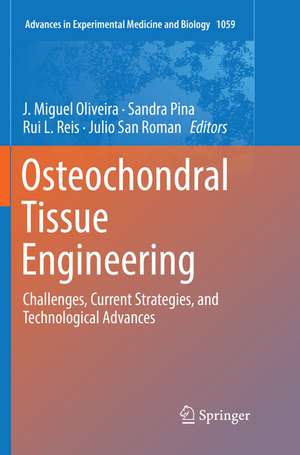
Osteochondral Tissue Engineering: Advances in Experimental Medicine and Biology, cartea 1059
Editat de J. Miguel Oliveira, Sandra Pina, Rui L. Reis, Julio San Románen Limba Engleză Paperback – 8 feb 2019
Din seria Advances in Experimental Medicine and Biology
- 30%
 Preț: 752.07 lei
 - 5%
 Preț: 1382.79 lei
 - 5%
 Preț: 1334.86 lei
 - 5%
 Preț: 1212.42 lei
 - 5%
 Preț: 1335.15 lei
 - 5%
 Preț: 1207.57 lei
 - 5%
 Preț: 1142.42 lei
 - 18%
 Preț: 1163.92 lei
 - 5%
 Preț: 1057.02 lei
 - 5%
 Preț: 1487.84 lei
 - 5%
 Preț: 1200.13 lei
 - 18%
 Preț: 980.33 lei
 - 5%
 Preț: 942.82 lei
 - 18%
 Preț: 992.48 lei
 - 18%
 Preț: 1274.22 lei
 - 5%
 Preț: 1275.48 lei
 - 18%
 Preț: 1157.14 lei
 - 5%
 Preț: 1138.79 lei
 - 18%
 Preț: 1165.27 lei
 - 5%
 Preț: 1206.95 lei
 - 18%
 Preț: 1268.90 lei
 - 5%
 Preț: 1347.73 lei
 - 18%
 Preț: 1391.33 lei
 - 18%
 Preț: 1459.28 lei
 - 18%
 Preț: 1283.66 lei
 - 5%
 Preț: 1679.37 lei
 - 5%
 Preț: 1352.87 lei
 - 18%
 Preț: 1166.87 lei
 - 5%
 Preț: 1138.79 lei
 - 24%
 Preț: 966.03 lei
 - 15%
 Preț: 667.86 lei
 - 5%
 Preț: 1137.79 lei
 - 18%
 Preț: 981.18 lei
 - 18%
 Preț: 980.36 lei
 - 5%
 Preț: 1199.06 lei
 - 20%
 Preț: 1742.49 lei
 - 5%
 Preț: 750.62 lei
 - 18%
 Preț: 1451.34 lei
 - 5%
 Preț: 1133.64 lei
 - 18%
 Preț: 2616.27 lei
 - 5%
 Preț: 1075.08 lei
 - 18%
 Preț: 1443.07 lei
 - 5%
 Preț: 745.85 lei
 - 5%
 Preț: 1146.99 lei
 - 5%
 Preț: 696.54 lei
 - 18%
 Preț: 1037.10 lei
 - 5%
 Preț: 1363.25 lei
 - 5%
 Preț: 1084.55 lei
Preț: 1186.33 lei
Preț vechi: 1446.75 lei
-18%
Puncte Express: 1779
Carte tipărită la comandă
Livrare economică 30 noiembrie-14 decembrie
Livrare prin curier în România Termenul estimat este afișat lângă disponibilitate.
Transport gratuit pentru acest produs Plată online sau ramburs, în funcție de opțiunile comenzii.
Retur gratuit în 14 zile Comandă securizată și suport în română.
Specificații
ISBN-13: 9783030095697
ISBN-10: 303009569X
Pagini: 524
Ilustrații: IX, 511 p. 86 illus., 79 illus. in color.
Dimensiuni: 155 x 235 x 29 mm
Greutate: 0.79 kg
Ediția:Softcover reprint of the original 1st ed. 2018
Editura: Springer
Colecția Advances in Experimental Medicine and Biology
Seria Advances in Experimental Medicine and Biology
Locul publicării:Cham, Switzerland
ISBN-10: 303009569X
Pagini: 524
Ilustrații: IX, 511 p. 86 illus., 79 illus. in color.
Dimensiuni: 155 x 235 x 29 mm
Greutate: 0.79 kg
Ediția:Softcover reprint of the original 1st ed. 2018
Editura: Springer
Colecția Advances in Experimental Medicine and Biology
Seria Advances in Experimental Medicine and Biology
Locul publicării:Cham, Switzerland
V-ar putea interesa
-
 Biomaterials Science: An Introduction to Materials in MedicineWilliam R Wagner-29%Preț: 922.59 lei1293.49 lei
 -
 -26%Preț: 2032.60 lei2761.32 lei
 -
 -29%Preț: 1089.08 lei1528.20 lei
 -
 Atlas of Orthoses and Assistive DevicesDouglas P. Murphy-28%Preț: 1169.10 lei1618.81 leiRecomandat
 -
 -24%Preț: 1770.85 lei2325.88 lei
 -
 -5%Preț: 383.85 lei404.05 leiRecomandat
 -
 -30%Preț: 97.81 lei139.80 lei
 -
 -22%Preț: 1920.49 lei2446.62 lei
 -
 Orthobiologics for Fractures and Nonunion ManagementDr. J Tracy Watson, MD-22%Preț: 755.01 lei964.20 lei
 -
 The Illustrative Book of Cartilage RepairDeepak Rajkumar Goyal-5%Preț: 1672.18 lei1760.19 lei
 -
 Electromechanobiology of Cartilage and OsteoarthritisBrianne K. Connizzo-5%Preț: 303.50 lei319.47 lei
 -
 Engineering Mineralized and Load Bearing TissuesLuiz E. Bertassoni-18%Preț: 991.51 lei1209.16 lei
 -
 CartilageSusanne Grässel-5%Preț: 1142.13 lei1202.24 lei
 -
 General Orthopaedics and Basic ScienceNikolaos K. Paschos-5%Preț: 683.46 lei719.44 lei
 -
 Adipose Stem Cells and Regenerative MedicineYves-Gerard Illouz-5%Preț: 1115.38 lei1174.09 lei
 -
 -5%Preț: 692.85 lei729.31 lei
 -
 -5%Preț: 1067.21 lei1123.38 lei
 -
 Techniques in Cartilage Repair SurgeryA. Ananthram Shetty-5%Preț: 829.58 lei873.24 lei
 -
 Natural Product Inspired ScaffoldsMohit Kumar-18%Preț: 1270.36 lei1549.22 lei
Cuprins
Part I: Current Challenges in Osteochondral Repair and Regeneration: Trauma vs Disease.- Advances for treatment of knee OC defects.- Emerging Concepts in Treating Cartilage, Osteochondral Defects and Osteoarthritis of the Knee and Ankle.- Osteoarthritis: Trauma Vs Disease.- Surgical Treatment Paradigms of Ankle Lateral Instability, Osteochondral Defects and Impingement.- Part II: Viscosupplementation.- Clinical management in early OA.- Hyaluronic Acid.- Semi-IPNs and IPNs Based Hydrogels.- Promising biomolecules.- Part III: Technological Advances in Osteochondral Tissue Engineering.- Nanoparticles-based systems for Osteochondral Tissue Engineering.- Stem cells for osteochondral regeneration.- PRP Therapy.- Enhancing biological and biomechanical fixation of osteochondral scaffold: a grand challenge.- Part IV: Osteochondral Tissue Engineering approaches.- Combination of polymeric supports and drug delivery systems for ostechondral regeneration.- Osteochondral Angiogenesis and Promoted Vascularization: New Therapeutic Target.- Models Of Disease.- Part V: In vitro models for Osteochondral Regeneration.- Tissue Engineering Strategies for Osteochondral Repair.- In vitro mimetic models for the bone-cartilage interface regeneration.- Bioreactors and microfluidics for osteochondral interface maturation.- Part VI: In vivo models for Osteochondral Regeneratio.- nSmall Animal Models.- Large animal models for Osteochondral Regeneration.- Index.
Notă biografică
Dr. Joaquim Miguel Oliveira, BSc, PhD is a senior researcher “Investigador FCT 2012 and FCT 2015” at the Portuguese Government Associate Laboratory ICVS/3B´s-University of Minho. Currently, he is a volunteer lecturer at the Faculty of Medicine, U. Porto and Dept. of Polymer Eng., UM. Since 2001, he has been involved in the development of biomaterials from natural origin for tissue engineering and regenerative medicine. His research activities have been increasingly focused on nanomedicine, stem cells and 3D in vitro models of disease.
Dr. Sandra Pina, MsC, PhD, is an assistant researcherat the Portuguese Government Associate Laboratory ICVS/3B’s, University of Minho. Her research interests include bioresorbable calcium phosphate-based nanomaterials and ionic incorporated calcium phosphates nanocomposites for internal fracture fixation in traumatology, cranio-maxillofacial, spine and orthopaedic surgery.
Prof. Rui L. Reis, PhD, DSc, Hon. Causa MD (UGranada) is the Vice-Rector for R&D, Director of the 3B’s Research Group and of the ICVS/3B´s, of UMinho – Portugal. He is the CEO of the European Institute of Excellence on TERM, and the President-elect of Global TERMIS (Tissue Engineering & Regenerative Medicine International Society) and the editor-in-chief of the JTERM.
Prof. Julio San Roman, PhD, is director of Instituto de Ciencia y Tecnología de Polímeros CSIC. His scientific activities are centred in the study and development of polymer systems for biomedical applications, and specifically in tissue engineering, polymer drugs and drug delivery systems.
Dr. Sandra Pina, MsC, PhD, is an assistant researcherat the Portuguese Government Associate Laboratory ICVS/3B’s, University of Minho. Her research interests include bioresorbable calcium phosphate-based nanomaterials and ionic incorporated calcium phosphates nanocomposites for internal fracture fixation in traumatology, cranio-maxillofacial, spine and orthopaedic surgery.
Prof. Rui L. Reis, PhD, DSc, Hon. Causa MD (UGranada) is the Vice-Rector for R&D, Director of the 3B’s Research Group and of the ICVS/3B´s, of UMinho – Portugal. He is the CEO of the European Institute of Excellence on TERM, and the President-elect of Global TERMIS (Tissue Engineering & Regenerative Medicine International Society) and the editor-in-chief of the JTERM.
Prof. Julio San Roman, PhD, is director of Instituto de Ciencia y Tecnología de Polímeros CSIC. His scientific activities are centred in the study and development of polymer systems for biomedical applications, and specifically in tissue engineering, polymer drugs and drug delivery systems.
Textul de pe ultima copertă
This book covers the most recent developments in the field of osteochondral tissue engineering (OCTE) and covers in detail the concepts and current challenges for bone and cartilage repair and regeneration. Specific topics include viscosupplementation, biologicals, tissue engineering approaches, in vitro and in vivo models, and technological advances with stem cells, bioreactors, and microfluidics. Osteochondral Tissue Engineering: Challenges, Current Strategies, and Technological Advances presents challenges and strategies in the field of osteochondral regeneration and serves as a core reference for biomedical engineering students and a wide range of established researchers and professionals working in orthopedics.
Caracteristici
Presents the latest developments and challenges as well as emerging technologies for the treatment of osteochondral lesions and defects Highlights in vitro mimetic models, and in vivo studies using small and big animal models for OCTE Presents the use of bioreactors and microfluidics for OCTE, including multi-chamber bioreactors Discusses properties of stem cells and cell-based therapies with applications for OCTE