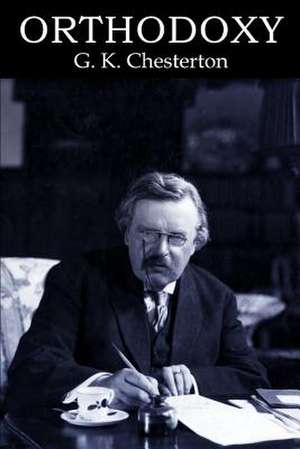
Orthodoxy
Autor G. K. Chestertonen Limba Engleză Paperback
Observăm că Orthodoxy completează o lacună esențială în literatura apologetică a secolului XX: nevoia unei justificări a credinței bazate nu pe autoritate dogmatică externă, ci pe experiența umană și pe rațiune. Scrisă ca replică la criticile aduse volumului Heretics, lucrarea nu se prezintă ca un tratat teologic arid, ci ca o explorare personală a modului în care autorul a ajuns să accepte creștinismul ca răspuns la „ghicitoarea” existenței. Apreciem modul în care G. K. Chesterton extinde cadrul propus de Heretics cu date noi din propria sa evoluție spirituală, transformând apărarea ortodoxiei dintr-o obligație morală într-o aventură intelectuală.
Structura volumului reflectă această progresie logică, începând cu analiza limitărilor raționalismului extrem în capitolul „The Maniac” și culminând cu sinteza dintre autoritate și libertate în „Authority and the Adventurer”. Remarcăm utilizarea paradoxului și a alegoriei — elemente distinctive ale stilului chestertonian — pentru a demonstra că dogmele creștine sunt, de fapt, soluții la nevoile psihologice fundamentale. Această abordare rezonează cu temele explorate în The Everlasting Man, unde autorul plasează creștinismul în contextul mai larg al istoriei umanității. Ediția de față, publicată în seria Dover Thrift Editions, oferă accesibilitate fără a sacrifica profunzimea textului original din 1908, fiind un punct de referință pentru studiul filozofiei religiei.
Preț: 42.04 lei
Carte disponibilă
Livrare economică 06-20 noiembrie
Specificații
ISBN-10: 1511680083
Pagini: 116
Dimensiuni: 152 x 229 x 7 mm
Greutate: 0.18 kg
Editura: CREATESPACE
V-ar putea interesa
-
 Mere ChristianityC. S. LewisPreț: 79.23 lei
 -
 Philip Yancey Recommends: OrthodoxyG. K. ChestertonPreț: 73.55 lei
 -
 G K Chesterton: a ReappraisalConlon DenisPreț: 247.25 lei
 -
 Why I Am Not a ChristianBertrand RussellPreț: 106.13 lei
 -
 Collected Works of G.K. ChestertonG. K. ChestertonPreț: 124.34 lei
 -
 The Cultural Revolution: A People's History, 1962—1976Frank Dikötter-25%Preț: 81.04 lei108.72 lei
 -
 St. Thomas AquinasG. K. ChestertonPreț: 46.53 lei
 -
 What's Wrong with the WorldG. K. ChestertonPreț: 44.19 lei
 -
 OrthodoxyGilbert K. ChestertonPreț: 47.95 lei
 -
 Heretics and OrthodoxyG. K. ChestertonPreț: 90.29 lei
 -
 The Everlasting ManG. K. ChestertonPreț: 55.93 lei
 -
 HereticsG. K. ChestertonPreț: 46.29 lei
 -
 The Everyman ChestertonG. K. Chesterton-16%Preț: 125.06 lei149.03 lei
 -
 Philosophy of MindEdward FeserPreț: 79.98 lei
 -
 The Man Who Was ThursdayG. K. ChestertonPreț: 38.95 lei
 -
 The Ball and the CrossG. K. ChestertonPreț: 44.87 lei
 -
 The New JerusalemG. K. ChestertonPreț: 44.37 lei
 -
 Everlasting Man (Edition2023)G. K. ChestertonPreț: 102.00 lei
De ce să citești această carte
Recomandăm această carte cititorilor care caută o perspectivă proaspătă, lipsită de clișee, asupra credinței. Veți descoperi un text plin de umor și vitalitate care transformă apologetica într-o narațiune captivantă. Este lectura ideală pentru cei care apreciază argumentația logică împletită cu metafora literară, oferind un model de gândire care reconciliază miraculosul cu bunul simț, într-un format compact și accesibil.
Despre autor
G. K. Chesterton (1874–1936) a fost un scriitor, filozof și critic englez, supranumit „prințul paradoxului”. Stilul său unic, care răstoarnă proverbe și idei primite de-a gata pentru a releva adevăruri profunde, l-a impus ca pe unul dintre cei mai influenți gânditori creștini ai modernității. Autor prolific, a creat celebrul personaj Father Brown și a scris lucrări fundamentale de apologetică, precum Orthodoxy și The Everlasting Man. Deși a scris Orthodoxy în perioada sa anglicană, viziunea sa s-a îndreptat constant către catolicism, la care a aderat oficial 14 ani mai târziu, devenind un succesor spiritual al marilor autori victorieni precum Newman sau Ruskin.
Descriere scurtă
--- G.K. Chesterton, Orthodoxy
Orthodoxy (1908) is a book by G. K. Chesterton that has become a classic of Christian apologetics. Chesterton considered this book a companion to his other work, Heretics. In the book's preface Chesterton states the purpose is to "attempt an explanation, not of whether the Christian faith can be believed, but of how he personally has come to believe it." In it, Chesterton presents an original view of Christian religion. He sees it as the answer to natural human needs, the "answer to a riddle" in his own words, and not simply as an arbitrary truth received from somewhere outside the boundaries of human experience.
The book was written when Chesterton was an Anglican. He converted to Catholicism 14 years later. The title, Orthodoxy, is meant to avoid such sectarian questions.
Descriere
Orthodoxy, as G. K. Chesterton employs the term here, means "right opinion." In this, the masterpiece of his brilliant literary career, he applies the concept of correct reasoning to his acceptance of Christianity. Written in a down-to-earth and familiar style, he presents formal and scholarly arguments in the explanation and defense of the tenets underlying his faith.
Paradox and contradiction, Chesterton maintains, do not constitute barriers to belief; imagination and intuition are as relevant to the processes of thought and understanding as logic and rationality. "Whenever we feel there is something odd in Christian theology," he observes, "we shall generally find that there is something odd in the truth." He defines his insights with thought-provoking analogies, personal anecdotes, and engaging humor, making this century-old book a work of enduring charm and persuasion.
Notă biografică
Extras
THE MANIAC
Thoroughly worldly people never understand even the world; they rely altogether on a few cynical maxims which are not true. Once I remember walking with a prosperous publisher, who made a remark which I had often heard before; it is, indeed, almost a motto of the modern world. Yet I had heard it once too often, and I saw suddenly that there was nothing in it. The publisher said of somebody, "That man will get on; he believes in himself." And I remember that as I lifted my head to listen, my eye caught an omnibus on which was written "Hanwell." I said to him, "Shall I tell you where the men are who believe most in themselves? For I can tell you. I know of men who believe in themselves more colossally than Napoleon or Caesar. I know where flames the fixed star of certainty and success. I can guide you to the thrones of the Supermen. The men who really believe in themselves are all in lunatic asylums." He said mildly that there were a good many men after all who believed in themselves and who were not in lunatic asylums. "Yes, there are," I retorted, "and you of all men ought to know them. That drunken poet from whom you would not take a dreary tragedy, he believed in himself. That elderly minister with an epic from whom you were hiding in a back room, he believed in himself. If you consulted your business experience instead of your ugly individualistic philosophy, you would know that believing in himself is one of the commonest signs of a rotter. Actors who can't act believe in themselves; and debtors who won't pay. It would be much truer to say that a man will certainly fail, because he believes in himself. Complete self-confidence is not merely a sin; complete self-confidence is a weakness. Believing utterly in one's self is a hysterical and superstitious belief like believing in Joanna Southcote: the man who has it has 'Hanwell' written on his face as plain as it is written on that omnibus." And to all this my friend the publisher made this very deep and effective reply, "Well, if a man is not to believe in himself, in what is he to believe?" After a long pause I replied, "I will go home and write a book in answer to that question." This is the book that I have written in answer to it.
But I think this book may well start where our argument started--in the neighbourhood of the mad-house. Modern masters of science are much impressed with the need of beginning all inquiry with a fact. The ancient masters of religion were quite equally impressed with that necessity. They began with the fact of sin--a fact as practical as potatoes. Whether or no man could be washed in miraculous waters, there was no doubt at any rate that he wanted washing. But certain religious leaders in London, not mere materialists, have begun in our day not to deny the highly disputable water, but to deny the indisputable dirt. Certain new theologians dispute original sin, which is the only part of Christian theology which can really be proved. Some followers of the Reverend R. J. Campbell, in their almost too fastidious spirituality, admit divine sinlessness, which they cannot see even in their dreams. But they essentially deny human sin, which they can see in the street. The strongest saints and the strongest sceptics alike took positive evil as the starting-point of their argument. If it be true (as it certainly is) that a man can feel exquisite happiness in skinning a cat, then the religious philosopher can only draw one of two deductions. He must either deny the existence of God, as all atheists do; or he must deny the present union between God and man, as all Christians do. The new theologians seem to think it a highly rationalistic solution to deny the cat.
In this remarkable situation it is plainly not now possible (with any hope of a universal appeal) to start, as our fathers did, with the fact of sin. This very fact which was to them (and is to me) as plain as a pikestaff, is the very fact that has been specially diluted or denied. But though moderns deny the existence of sin, I do not think that they have yet denied the existence of a lunatic asylum. We all agree still that there is a collapse of the intellect as unmistakable as a falling house. Men deny hell, but not, as yet, Hanwell. For the purpose of our primary argument the one may very well stand where the other stood. I mean that as all thoughts and theories were once judged by whether they tended to make a man lose his soul, so for our present purpose all modern thoughts and theories may be judged by whether they tend to make a man lose his wits.
It is true that some speak lightly and loosely of insanity as in itself attractive. But a moment's thought will show that if disease is beautiful, it is generally some one else's disease. A blind man may be picturesque; but it requires two eyes to see the picture. And similarly even the wildest poetry of insanity can only be enjoyed by the sane. To the insane man his insanity is quite prosaic, because it is quite true. A man who thinks himself a chicken is to himself as ordinary as a chicken. A man who thinks he is a bit of glass is to himself as dull as a bit of glass. It is the homogeneity of his mind which makes him dull, and which makes him mad. It is only because we see the irony of his idea that we think him even amusing; it is only because he does not see the irony of his idea that he is put in Hanwell at all. In short, oddities only strike ordinary people. Oddities do not strike odd people. This is why ordinary people have a much more exciting time; while odd people are always complaining of the dulness of life. This is also why the new novels die so quickly, and why the old fairy tales endure for ever. The old fairy tale makes the hero a normal human boy; it is his adventures that are startling; they startle him because he is normal. But in the modern psychological novel the hero is abnormal; the centre is not central. Hence the fiercest adventures fail to affect him adequately, and the book is monotonous. You can make a story out of a hero among dragons; but not out of a dragon among dragons. The fairy tale discusses what a sane man will do in a mad world. The sober realistic novel of to-day discusses what an essential lunatic will do in a dull world.
Let us begin, then, with the mad-house; from this evil and fantastic inn let us set forth on our intellectual journey. Now, if we are to glance at the philosophy of sanity, the first thing to do in the matter is to blot out one big and common mistake. There is a notion adrift everywhere that imagination, especially mystical imagination, is dangerous to man's mental balance. Poets are commonly spoken of as psychologically unreliable; and generally there is a vague association between wreathing laurels in your hair and sticking straws in it. Facts and history utterly contradict this view. Most of the very great poets have been not only sane, but extremely business-like; and if Shakespeare ever really held horses, it was because he was much the safest man to hold them. Imagination does not breed insanity. Exactly what does breed insanity is reason. Poets do not go mad; but chess-players do. Mathematicians go mad, and cashiers; but creative artists very seldom. I am not, as will be seen, in any sense attacking logic: I only say that this danger does lie in logic, not in imagination. Artistic paternity is as wholesome as physical paternity. Moreover, it is worthy of remark that when a poet really was morbid it was commonly because he had some weak spot of rationality on his brain. Poe, for instance, really was morbid; not because he was poetical, but because he was specially analytical. Even chess was too poetical for him; he disliked chess because it was full of knights and castles, like a poem. He avowedly preferred the black discs of draughts, because they were more like the mere black dots on a diagram. Perhaps the strongest case of all is this: that only one great English poet went mad, Cowper. And he was definitely driven mad by logic, by the ugly and alien logic of predestination. Poetry was not the disease, but the medicine; poetry partly kept him in health. He could sometimes forget the red and thirsty hell to which his hideous necessitarianism dragged him among the wide waters and the white flat lilies of the Ouse. He was damned by John Calvin; he was almost saved by John Gilpin. Everywhere we see that men do not go mad by dreaming. Critics are much madder than poets. Homer is complete and calm enough; it is his critics who tear him into extravagant tatters. Shakespeare is quite himself; it is only some of his critics who have discovered that he was somebody else. And though St. John the Evangelist saw many strange monsters in his vision, he saw no creature so wild as one of his own commentators. The general fact is simple. Poetry is sane because it floats easily in an infinite sea; reason seeks to cross the infinite sea, and so make it finite. The result is mental exhaustion, like the physical exhaustion of Mr. Holbein. To accept everything is an exercise, to understand everything a strain. The poet only desires exaltation and expansion, a world to stretch himself in. The poet only asks to get his head into the heavens. It is the logician who seeks to get the heavens into his head. And it is his head that splits.
It is a small matter, but not irrelevant, that this striking mistake is commonly supported by a striking misquotation. We have all heard people cite the celebrated line of Dryden as "Great genius is to madness near allied." But Dryden did not say that great genius was to madness near allied. Dryden was a great genius himself, and knew better. It would have been hard to find a man more romantic than he, or more sensible. What Dryden said was this, "Great wits are oft to madness near allied"; and that is true. It is the pure promptitude of the intellect that is in peril of a breakdown. Also people might remember of what sort of man Dryden was talking. He was not talking of any unworldly visionary like Vaughan or George Herbert. He was talking of a cynical man of the world, a sceptic, a diplomatist, a great practical politician. Such men are indeed to madness near allied. Their incessant calculation of their own brains and other people's brains is a dangerous trade. It is always perilous to the mind to reckon up the mind. A flippant person has asked why we say, "As mad as a hatter." A more flippant person might answer that a hatter is mad because he has to measure the human head.
And if great reasoners are often maniacal, it is equally true that maniacs are commonly great reasoners. When I was engaged in a controversy with the Clarion on the matter of free will, that able writer Mr. R. B. Suthers said that free will was lunacy, because it meant causeless actions, and the actions of a lunatic would be causeless. I do not dwell here upon the disastrous lapse in determinist logic. Obviously if any actions, even a lunatic's, can be causeless, determinism is done for. If the chain of causation can be broken for a madman, it can be broken for a man. But my purpose is to point out something more practical. It was natural, perhaps, that a modern Marxian Socialist should not know anything about free will. But it was certainly remarkable that a modern Marxian Socialist should not know anything about lunatics. Mr. Suthers evidently did not know anything about lunatics. The last thing that can be said of a lunatic is that his actions are causeless. If any human acts may loosely be called causeless, they are the minor acts of a healthy man; whistling as he walks; slashing the grass with a stick; kicking his heels or rubbing his hands. It is the happy man who does the useless things; the sick man is not strong enough to be idle. It is exactly such careless and causeless actions that the madman could never understand; for the madman (like the determinist) generally sees too much cause in everything. The madman would read a conspiratorial significance into those empty activities. He would think that the lopping of the grass was an attack on private property. He would think that the kicking of the heels was a signal to an accomplice. If the madman could for an instant become careless, he would become sane. Every one who has had the misfortune to talk with people in the heart or on the edge of mental disorder, knows that their most sinister quality is a horrible clarity of detail; a connecting of one thing with another in a map more elaborate than a maze. If you argue with a madman, it is extremely probable that you will get the worst of it; for in many ways his mind moves all the quicker for not being delayed by the things that go with good judgment. He is not hampered by a sense of humour or by charity, or by the dumb certainties of experience. He is the more logical for losing certain sane affections. Indeed, the common phrase for insanity is in this respect a misleading one. The madman is not the man who has lost his reason. The madman is the man who has lost everything except his reason.
The madman's explanation of a thing is always complete, and often in a purely rational sense satisfactory. Or, to speak more strictly, the insane explanation, if not conclusive, is at least unanswerable; this may be observed specially in the two or three commonest kinds of madness. If a man says (for instance) that men have a conspiracy against him, you cannot dispute it except by saying that all the men deny that they are conspirators; which is exactly what conspirators would do. His explanation covers the facts as much as yours. Or if a man says that he is the rightful King of England, it is no complete answer to say that the existing authorities call him mad; for if he were King of England that might be the wisest thing for the existing authorities to do. Or if a man says that he is Jesus Christ, it is no answer to tell him that the world denies his divinity; for the world denied Christ's.
Recenzii
--from the foreword by Philip Yancey, author of What's So Amazing About Grace? and The Jesus I Never Knew
"My favorite on the list [of top 100 spiritual classics of the twentieth century] is Chesterton's Orthodoxy. It offers wonderful arguments for embracing religious traditions, but it also has humor you don't typically find in religious writing."
--Philip Zaleski, author and journalist
Named by Publisher's Weekly as one of 10 "indispensable spiritual classics" of the past 1500 years.
--Publisher?s Weekly
"Chesterton's most enduring book.... Charming."
--World
Cuprins
Introduction by Jon M. Sweeney
CHAPTER I.-Introduction in Defence of Everything Else
CHAPTER II.-The Maniac
CHAPTER III.-The Suicide of Thought
CHAPTER IV-The Ethics of Elfland
CHAPTER V.-The Flag of the World
CHAPTER VI.-The Paradoxes of Christianity
CHAPTER VII.-The Eternal Revolution
CHAPTER VIII.-The Romance of Orthodoxy
CHAPTER IX.-Authority and the Adventurer