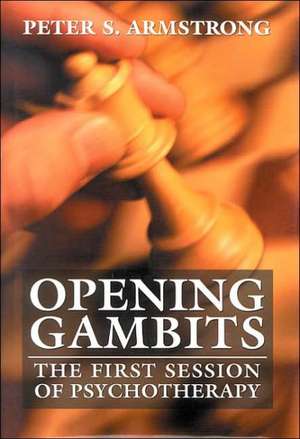
Opening Gambits: The First Session of Psychotherapy: Jason Aronson, Inc.
Autor Peter S. Armstrongen Limba Engleză Hardback – mar 2000
The therapist's stance and its implications for first session technique are discussed (e.g., first words, therapist anxiety, and subtle directives) as well as issues of scheduling, fees, and cancellations. Armstrong identifies eight essential tasks of the first session (including, for example, an atmosphere of safety, patient assessment, the contract, and transition), and demonstrates with rich clinical detail the steps he takes to accomplish them. Specific attention is given to patients with previous therapy, returning patients, compliant and meek patients, and those in need of medication or hospitalization. Well considered and thought-provoking, this book introduces beginning therapists to the complexity and range of first session concerns, and challenges experienced therapists to rethink the techniques and personal mannerisms that may have become automatic in meeting a patient for the first time.
Din seria Jason Aronson, Inc.
- 23%
 Preț: 730.25 lei
 - 42%
 Preț: 300.34 lei
 - 29%
 Preț: 863.40 lei
 - 29%
 Preț: 633.34 lei
 - 23%
 Preț: 727.46 lei
 - 29%
 Preț: 617.46 lei
 - 28%
 Preț: 673.79 lei
 - 31%
 Preț: 537.73 lei
 - 29%
 Preț: 650.25 lei
 - 33%
 Preț: 678.27 lei
 - 16%
 Preț: 139.07 lei
 - 31%
 Preț: 570.88 lei
 - 29%
 Preț: 524.52 lei
 - 32%
 Preț: 747.37 lei
 - 31%
 Preț: 537.73 lei
 - 32%
 Preț: 594.28 lei
 - 31%
 Preț: 571.49 lei
 - 31%
 Preț: 539.46 lei
 - 31%
 Preț: 570.88 lei
 - 16%
 Preț: 313.21 lei
 - 26%
 Preț: 883.01 lei
 - 31%
 Preț: 569.73 lei
 - 31%
 Preț: 598.23 lei
 - 24%
 Preț: 592.61 lei
 - 28%
 Preț: 497.29 lei
 - 30%
 Preț: 388.83 lei
 - 29%
 Preț: 617.29 lei
 - 29%
 Preț: 523.81 lei
 - 31%
 Preț: 572.72 lei
 - 32%
 Preț: 748.87 lei
 - 29%
 Preț: 522.98 lei
 - 31%
 Preț: 597.55 lei
 - 31%
 Preț: 570.17 lei
 - 30%
 Preț: 644.22 lei
 - 29%
 Preț: 615.96 lei
 - 32%
 Preț: 746.40 lei
 - 30%
 Preț: 550.84 lei
 - 18%
 Preț: 336.56 lei
 - 32%
 Preț: 697.72 lei
 - 30%
 Preț: 644.73 lei
 - 30%
 Preț: 643.16 lei
 - 31%
 Preț: 413.70 lei
 - 32%
 Preț: 681.48 lei
 - 24%
 Preț: 657.15 lei
 - 23%
 Preț: 276.97 lei
 - 28%
 Preț: 495.84 lei
 - 29%
 Preț: 521.69 lei
Preț: 571.79 lei
Preț vechi: 827.86 lei
-31%
Puncte Express: 858
Carte tipărită la comandă
Livrare economică 01-15 decembrie
Livrare prin curier în România Termenul estimat este afișat lângă disponibilitate.
Transport gratuit pentru acest produs Plată online sau ramburs, în funcție de opțiunile comenzii.
Retur gratuit în 14 zile Comandă securizată și suport în română.
Specificații
ISBN-13: 9780765702418
ISBN-10: 076570241X
Pagini: 235
Dimensiuni: 163 x 236 x 25 mm
Greutate: 0.56 kg
Ediția:New.
Editura: Bloomsbury Publishing
Colecția Jason Aronson Inc
Seria Jason Aronson, Inc.
Locul publicării:New York, United States
ISBN-10: 076570241X
Pagini: 235
Dimensiuni: 163 x 236 x 25 mm
Greutate: 0.56 kg
Ediția:New.
Editura: Bloomsbury Publishing
Colecția Jason Aronson Inc
Seria Jason Aronson, Inc.
Locul publicării:New York, United States
V-ar putea interesa
-
 Compassion Focused Therapy: Distinctive FeaturesPaul Gilbert-5%Preț: 181.85 lei191.42 lei
 -
 -5%Preț: 361.70 lei380.74 lei
 -
 What Made Freud Laugh: An Attachment Perspective on LaughterJudith Kay Nelson-15%Preț: 418.00 lei491.77 lei
 -
 Acupuncture in Pregnancy and ChildbirthZita West-26%Preț: 386.32 lei521.73 lei
 -
 MORE Creative Interventions for Troubled Children & YouthLiana Lowenstein-15%Preț: 157.11 lei184.44 lei
 -
 Irvin D. YalomRuthellen JosselsonPreț: 148.75 lei
 -
 Cognitive Behavior Therapy and Eating DisordersChristopher G. Fairburn-5%Preț: 436.97 lei459.97 lei
 -
 Cognitive Therapy of SchizophreniaDavid G. Kingdon-5%Preț: 278.13 lei292.77 lei
 -
 Preț: 333.09 lei
Recenzii
The first session of psychotherapy is crucial. It sets up expectations for the kind of treatment that is to follow, and if not well conducted, it may be the last session. Challenging experienced therapists to examine their own habits, Peter Armstrong also guides beginners through the opportunities and pitfalls of this surprisingly neglected subject. From the first words spoken by the therapist through fees, legal issues, the various kinds of assessment, to the offer of a second appointment, he discusses all of the practicalities from a psychodynamic perspective. He focuses on creating an atmosphere of safety that will facilitate exploration of the patient's experience and transference.
With rare teaching ability, Dr. Armstrong explicates how the psychotherapist approaches the first session, but this book is as much about the rationale for and substance of the psychoanalytic attitude. A must-read for beginning therapists or those interested in beginning psychotherapy themselves.
Despite the fact that every clinician has conducted many first sessions, until now there has been no definitive book on the subject. Dr. Armstrong has ably filled that vacuum. Buttressed with sound theoretical underpinnings and clear clinical illustrations, he covers everything from the therapist's first words to transference and countertransference phenomena, resistances and counterresistances, arrangement of the office, establishing fee schedules, and much more. All clinicians will welcome this very readable book. It is highly recommended, particularly for those who want to help their patients stay in treatment-and that is just about all of us.
With rare teaching ability, Dr. Armstrong explicates how the psychotherapist approaches the first session, but this book is as much about the rationale for and substance of the psychoanalytic attitude. A must-read for beginning therapists or those interested in beginning psychotherapy themselves.
Despite the fact that every clinician has conducted many first sessions, until now there has been no definitive book on the subject. Dr. Armstrong has ably filled that vacuum. Buttressed with sound theoretical underpinnings and clear clinical illustrations, he covers everything from the therapist's first words to transference and countertransference phenomena, resistances and counterresistances, arrangement of the office, establishing fee schedules, and much more. All clinicians will welcome this very readable book. It is highly recommended, particularly for those who want to help their patients stay in treatment-and that is just about all of us.