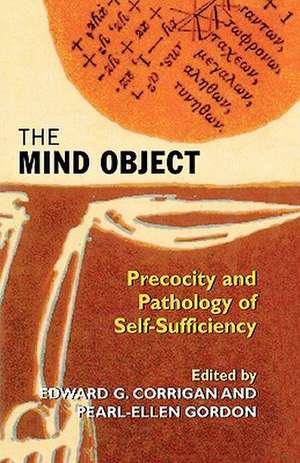
The Mind Object: Precocity and Pathology of Self-Sufficiency: Jason Aronson, Inc.
Editat de Edward G. Corrigan, Pearl-Ellen Gordonen Limba Engleză Hardback – noi 1995
Adresăm acest volum cu precădere psihoterapeuților, psihanaliștilor în formare și cercetătorilor din sfera psihologiei clinice, care vor descoperi aici o analiză riguroasă a modului în care intelectul poate deveni un refugiu patologic. The Mind Object investighează o situație clinică specifică: momentul în care un individ, ca răspuns la eșecul mediului timpuriu, se desprinde de realitatea corpului pentru a stabili funcționarea mentală ca entitate de sine stătătoare. Această ediție revizuită, publicată sub egida Jason Aronson Inc, aprofundează intuițiile lui D Winnicott despre „mind-psyche”, oferind un cadru teoretic pentru a înțelege cum mintea ajunge să fie investită cu o putere omnipotentă, devenind un „obiect” de atașament intens care substituie grija maternă.
Observăm în structura lucrării o preocupare pentru consecințele violente ale acestui clivaj: mintea transformată în obiect nu oferă doar consolare, ci poate deveni un agent persecutor care devalorizează nevoile fizice și emoționale ale sinelui. Editorii Edward G. Corrigan și Pearl-Ellen Gordon reușesc să integreze contribuții clinice care avertizează asupra „tentației intelectului”, un fenomen ce poate bloca progresul terapeutic atât la pacient, cât și la terapeut.
Din punct de vedere al curriculei analitice, volumul reprezintă o alternativă la Body-Mind Dissociation in Psychoanalysis de Riccardo Lombardi pentru cursurile de psihopatologie și teorii ale relațiilor de obiect. În timp ce Lombardi se concentrează pe axa senzorial-emoțională ca punte de legătură, The Mind Object are avantajul de a detalia geneza minții ca obiect de sine stătător, oferind o perspectivă mai nuanțată asupra schizoidiei și a mecanismelor de autosuficiență. Stilul este precis, academic, ancorat în prezentări de caz care ilustrează fragilitatea acestor soluții mentale precoce.
Din seria Jason Aronson, Inc.
- 23%
 Preț: 730.25 lei
 - 42%
 Preț: 300.34 lei
 - 29%
 Preț: 863.40 lei
 - 29%
 Preț: 633.34 lei
 - 23%
 Preț: 727.46 lei
 - 29%
 Preț: 617.46 lei
 - 28%
 Preț: 673.79 lei
 - 31%
 Preț: 537.73 lei
 - 29%
 Preț: 650.25 lei
 - 33%
 Preț: 678.27 lei
 - 16%
 Preț: 139.07 lei
 - 31%
 Preț: 570.88 lei
 - 29%
 Preț: 524.52 lei
 - 32%
 Preț: 747.37 lei
 - 31%
 Preț: 537.73 lei
 - 31%
 Preț: 571.49 lei
 - 31%
 Preț: 539.46 lei
 - 31%
 Preț: 570.88 lei
 - 16%
 Preț: 313.21 lei
 - 26%
 Preț: 883.01 lei
 - 31%
 Preț: 569.73 lei
 - 31%
 Preț: 598.23 lei
 - 24%
 Preț: 592.61 lei
 - 28%
 Preț: 497.29 lei
 - 30%
 Preț: 388.83 lei
 - 29%
 Preț: 617.29 lei
 - 31%
 Preț: 571.79 lei
 - 29%
 Preț: 523.81 lei
 - 31%
 Preț: 572.72 lei
 - 32%
 Preț: 748.87 lei
 - 29%
 Preț: 522.98 lei
 - 31%
 Preț: 597.55 lei
 - 31%
 Preț: 570.17 lei
 - 30%
 Preț: 644.22 lei
 - 29%
 Preț: 615.96 lei
 - 32%
 Preț: 746.40 lei
 - 30%
 Preț: 550.84 lei
 - 18%
 Preț: 336.56 lei
 - 32%
 Preț: 697.72 lei
 - 30%
 Preț: 644.73 lei
 - 30%
 Preț: 643.16 lei
 - 31%
 Preț: 413.70 lei
 - 32%
 Preț: 681.48 lei
 - 24%
 Preț: 657.15 lei
 - 23%
 Preț: 276.97 lei
 - 28%
 Preț: 495.84 lei
 - 29%
 Preț: 521.69 lei
Preț: 594.28 lei
Preț vechi: 868.32 lei
-32%
Carte tipărită la comandă
Livrare economică 04-18 decembrie
Specificații
ISBN-10: 1568214804
Pagini: 264
Dimensiuni: 166 x 214 x 21 mm
Greutate: 0.44 kg
Ediția:Revised edition
Editura: Bloomsbury Publishing
Colecția Jason Aronson Inc
Seria Jason Aronson, Inc.
Locul publicării:New York, United States
V-ar putea interesa
-
 -5%Preț: 330.01 lei347.39 lei
 -
 -18%Preț: 948.65 lei1156.89 lei
 -
 -18%Preț: 1059.11 lei1291.60 lei
 -
 -18%Preț: 917.42 lei1118.80 lei
 -
 -5%Preț: 1162.31 lei1223.49 lei
 -
 -18%Preț: 1003.26 lei1223.49 lei
 -
 -5%Preț: 1036.00 lei1090.52 lei
 -
 Preț: 412.95 lei
 -
 -5%Preț: 1035.79 lei1090.30 lei
 -
 -5%Preț: 1035.79 lei1090.30 lei
 -
 -5%Preț: 1098.32 lei1156.13 lei
 -
 -5%Preț: 342.42 lei360.45 lei
 -
 Jungian Music Psychotherapy: When Psyche SingsJoel KroekerPreț: 345.99 lei
 -
 Preț: 363.88 lei
 -
 Preț: 97.42 lei
 -
 UnshameCarolyn Spring-5%Preț: 103.93 lei109.40 lei
 -
 AutoritarismusOliver DeckerPreț: 212.91 lei
De ce să citești această carte
Pentru practicienii care se confruntă cu pacienți „intelectualizați”, această carte oferă instrumentele necesare pentru a identifica momentul în care mintea încetează să fie o funcție și devine un obiect defensiv. Veți câștiga o înțelegere profundă a disocierii minte-corp, învățând să navigați prin rezistențele unei minți care se auto-idolatrizează pentru a supraviețui, dar care, în final, izolează individul de viața creativă.
Descriere
Can a person relate to his or her own mind as an object, depend upon it to the exclusion of other objects, idealize it, fear it, hate it? Can a person live out a life striving to attain the elusive power of the mind's perfection, yielding to its promise while sacrificing the body's truth?
Winnicott was the first to describe how very early in life an individual can, in response to environmental failure, turn away from the body and its needs and establish "mental functioning as a thing in itself." Winnicott's elusive term, the mind-psyche, describes a subtle, yet fundamentally violent split in which the mind negates the role of the body, its feelings and functions, as the source of creative living. Later, Masud Khan elaborated on Winnicott's notions. This exciting book extends Winnicott's and Khan's ideas to introduce the concept of the mind object, a term that signifies the central dissociation of the mind separated from the body, as well as underscores its function.
When the mind takes on a life of its own, it becomes an object-separate, as it were, from the self. And because it is an object that originates as a substitute for maternal care, it becomes an object of intense attachment, turned to for security, solace, and gratification. Having achieved the status of an independent object, the mind also can turn on the self, attacking, demeaning, and persecuting the individual. Once this object relationship is established, it organizes the self, providing an aura of omnipotence. However, this precocious, schizoid solution is an illusion, vulnerable to breakdown and its associated anxieties.
Making a unique contribution, The Mind Object explores the dangers of knowing too much-the lure of the intellect-for the patient as well as for the therapist. The authors illuminate the complex pathological consequences that result from precocious solutions.
Recenzii
The Mind Object describes patients who have come to value their minds and often superior intellectual abilities above everything else in life. The concept is based on Winnicott's notion of what happens to the infant who substitutes the mind for maternal care. Edward Corrigan and Pearl-Ellen Gordon lay the theoretical groundwork for the case material to follow. Each author shows his or her own creative way of working with patients whose omnipotent narcissistic organization seriously interferes with their ability to relate. Clinicians who work with such patients will be illuminated by this inspiring new book.
This book brings together a distinguished international group of clinicians who have thought deeply and brilliantly about the challenges of treating the devastating consequences of premature and accelerated mental functioning. The authors examine, in thelives of children and adult patients, what happens when the human capacity to turn one's own mind into a powerful object must be distorted in the name of psychic survival. Drawing on earlier work of Ferenczi, Balint, Bion, and, in particular, Winnicott, the authors demonstrate how mental precociousness, a deforming growth spurt inthe intellectual domain, can be made in reaction to deficits in the holding environment. The mind becomes a potent yet finally terrifying container in the absence of a sooting and securing caretaking function. The adaptive brilliance can create a facade of hypercompetence and skill behind which lurks an impoverished feeling life, an absence of body sense, and an inner emptiness. What is so useful here is that these conceptual tools can be applied in such a wide range of clinical situations. Obsessional adults, overly adult children, children in a range of social circumstances with environmental deficits that can be starkly gross of subtly nuanced, body disorders, affective distur