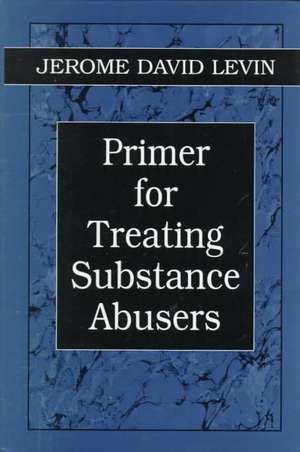
Primer for Treating Substance Abusers
Autor Jerome D Levinen Limba Engleză Hardback – iun 1999
He covers the full complexity of substance abuse diagnosis and treatment with a biopsychosocial approach and multimodal interventions, ranging from detoxification and rehabilitation programs to cognitive and behavioral treatments, self-help groups, and individual and family therapy. A clear, comprehensive book that presents an integrated picture of a complex phenomenon, this primer can be profitably read either straight through or as a reference text.
Preț: 649.41 lei
Preț vechi: 916.58 lei
-29%
Puncte Express: 974
Carte tipărită la comandă
Livrare economică 10-24 noiembrie
Livrare prin curier în România Termenul estimat este afișat lângă disponibilitate.
Transport gratuit pentru acest produs Plată online sau ramburs, în funcție de opțiunile comenzii.
Retur gratuit în 14 zile Comandă securizată și suport în română.
Specificații
ISBN-13: 9780765700780
ISBN-10: 0765700786
Pagini: 294
Dimensiuni: 157 x 235 x 23 mm
Greutate: 0.68 kg
Editura: Bloomsbury Publishing
Locul publicării:New York, United States
ISBN-10: 0765700786
Pagini: 294
Dimensiuni: 157 x 235 x 23 mm
Greutate: 0.68 kg
Editura: Bloomsbury Publishing
Locul publicării:New York, United States
V-ar putea interesa
-
 Cognition and AddictionMarcus Munafó-24%Preț: 565.02 lei745.96 lei
 -
 The Neurobiology of AddictionTrevor Robbins-31%Preț: 698.91 lei1010.30 lei
 -
 Cannabis Policy: Moving beyond stalemateRobin Room-18%Preț: 570.03 lei697.17 lei
 -
 Global Tobacco ControlP. Cairney-15%Preț: 648.34 lei762.75 lei
 -
 -26%Preț: 287.77 lei389.89 lei
 -
 Parents Who Misuse Drugs and aDonald ForresterPreț: 317.60 lei
 -
 Community Treatment of Drug MisuseNicholas Seivewright-5%Preț: 525.19 lei552.82 lei
 -
 Cannabis: A HistoryMartin Booth-18%Preț: 76.17 lei93.18 lei
 -
 Food Of The GodsTerence Mckenna-29%Preț: 84.88 lei120.06 lei
 -
 100 Q&AS ABOUT HOW TO QUIT SMOKINGCharles Herrick-5%Preț: 165.97 lei174.70 lei
 -
 Healing the Addicted BrainHarold UrschelPreț: 100.54 lei
 -
 Seeking Safety: A Treatment Manual for PTSD and Substance AbuseLisa M. Najavits-15%Preț: 453.92 lei534.03 lei
Recenzii
This is an original and valuable book for mental health or substance abuse trainees interested in learning how to treat addiction. Dr. Levin employs the ingenious technique of supplying basic questions and then answering them in a thoughtful way. In adopting this approach, he has created a well-organized and approachable text that is a pleasure to read.
Dr. Jerome Levin's Primer for Treating Substance Abusers is as basic as it gets. At the same time, it is erudite and comprehensive in reviewing each class of abused drug and the etiologies and treatments of substance use disorders. His scholarly focus on theory is eloquently complemented by compelling case examples. Through his review of theory and his cases, Dr. Levin reveals the complex nature of addictive vulnerability, its tragic consequences when unchecked, and the considerable hope for transformation and recovery when it is properly understood and treated. Beyond the practical and erudite aspects of his primer, Dr. Levin's clarify of writing, the many questions raised (and answered), and keen sense of humor make this book very engaging and readable.
This very readable book provides mental health professionals with a wonderfully comprehensive orientation toward addiction treatment. The author offers his extensive experience, rich case material, and summarizes and critiques the claims of leading thinkers and practitioners. He highlights fine points of clinical practice and describes broad strategies and tactics of treatment. He also explains diagnosis, etiology, theory, and research about addiction in historical and cultural contexts, and demonstrates how these contexts, if ignored, can thwart treatment efforts. In these ways this book is a detailed road map for mental health professionals who must guide addicts through obstacles, dead ends, and traps that mark the path to recovery.
Dr. Jerome Levin's Primer for Treating Substance Abusers is as basic as it gets. At the same time, it is erudite and comprehensive in reviewing each class of abused drug and the etiologies and treatments of substance use disorders. His scholarly focus on theory is eloquently complemented by compelling case examples. Through his review of theory and his cases, Dr. Levin reveals the complex nature of addictive vulnerability, its tragic consequences when unchecked, and the considerable hope for transformation and recovery when it is properly understood and treated. Beyond the practical and erudite aspects of his primer, Dr. Levin's clarify of writing, the many questions raised (and answered), and keen sense of humor make this book very engaging and readable.
This very readable book provides mental health professionals with a wonderfully comprehensive orientation toward addiction treatment. The author offers his extensive experience, rich case material, and summarizes and critiques the claims of leading thinkers and practitioners. He highlights fine points of clinical practice and describes broad strategies and tactics of treatment. He also explains diagnosis, etiology, theory, and research about addiction in historical and cultural contexts, and demonstrates how these contexts, if ignored, can thwart treatment efforts. In these ways this book is a detailed road map for mental health professionals who must guide addicts through obstacles, dead ends, and traps that mark the path to recovery.