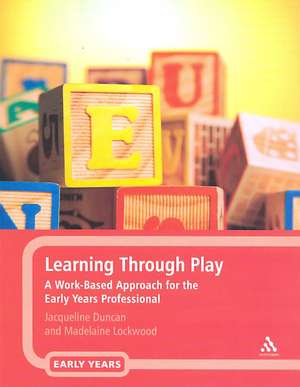
Learning Through Play: A Work-Based Approach for the Early Years Professional
Autor Jacqueline Duncan, Madelaine Lockwooden Limba Engleză Paperback – 15 mar 2008
Learning Through Play is an essential handbook for early-years practitioners on how to develop their understanding and practical applications in all early-years settings. It is an ideal training manual which speaks to both the early-years trainee and the experienced practitioner who is looking to improve their own practice and understanding, and that of colleagues.
Chapters support:
An understanding of play and its role in learning
An understanding of the role of the adult in the pre-school setting
The development of practitioner's skills in providing effective learning and development through quality play
The developing and planning of the curriculum and learning environment
The development of reflection and informed action in early-years settings
Managers, and those who hope to become managers, in developing good practice across their setting
Key features include Professional Development Activities. Some are for individual completion; others are for completion by your setting's team (but can be adapted for individual's use). Each chapter can be worked through as a discrete unit. This is a fully comprehensive and user-friendly guide for all who are keen to encourage the pre-school child's learning and development through play-based activities, giving the reader the tools with which to evaluate and develop their own practice and that of others.
Preț: 333.09 lei
Puncte Express: 500
Carte tipărită la comandă
Livrare economică 02-16 decembrie
Livrare prin curier în România Termenul estimat este afișat lângă disponibilitate.
Transport gratuit de la 400.00 lei Plată online sau ramburs, în funcție de opțiunile comenzii.
Retur gratuit în 14 zile Comandă securizată și suport în română.
Specificații
ISBN-13: 9781847061683
ISBN-10: 1847061680
Pagini: 264
Ilustrații: Illustrations
Dimensiuni: 186 x 250 x 18 mm
Greutate: 0.53 kg
Editura: Bloomsbury Publishing
Colecția Continuum
Locul publicării:London, United Kingdom
ISBN-10: 1847061680
Pagini: 264
Ilustrații: Illustrations
Dimensiuni: 186 x 250 x 18 mm
Greutate: 0.53 kg
Editura: Bloomsbury Publishing
Colecția Continuum
Locul publicării:London, United Kingdom
V-ar putea interesa
-
 Family TherapyRoger Lowe-5%Preț: 432.28 lei455.03 lei
 -
 Working with Emotions in PsychotherapyLeslie S. Greenberg-5%Preț: 352.23 lei370.76 lei
 -
 Attachment Processes in Couple and Family TherapySusan M. Johnson-5%Preț: 429.09 lei451.68 lei
 -
 Preț: 115.06 lei
 -
 -5%Preț: 385.54 lei405.83 lei
 -
 Focus on Psychodrama: The Therapeutic Aspects of PsychodramaPeter Felix Kellermann-29%Preț: 242.99 lei340.15 lei
 -
 -29%Preț: 207.43 lei292.84 lei
 -
 Art-Based ResearchShaun McNiffPreț: 246.94 lei
 -
 -21%Preț: 120.63 lei152.57 lei
 -
 Hidden Self-Harm: Narratives from PsychotherapyMaggie Turp-29%Preț: 195.04 lei273.94 lei
 -
 Challenging Behaviour: Principles and PracticesDave HewettPreț: 391.02 lei
Cuprins
Part 1: How Children Learn
1. The Role of the Adult: Making Observations and Understanding the Child
The role of the practitioner as observer in understanding children's play
What is observation?
Why observe children play?
A framework for effective observation
Ethics
2. The Child as a Thinker and Learner
The brain and learning
Children constructing their own understanding
The role of representation, language and interaction in learning
Learning starts from where the child is
Scaffolding
The spiral curriculum
Multiple intelligences
Learning dispositions and child involvement
Active learning schema
3. Aspects of Development: Influences on Learning
The influence of social and cultural contexts in which the child is developing
The influences on development: relationships, stimulation, health, gender, environment and play
How development affects learning and dispositions to learning
Play and its influences on learning
4. Key Ideas That Inform Us About Learning Through Play
Young children are competent and experienced learners Children's learning is influenced by significant others
Language is a central mechanism in learning
Children's own talk has a crucial function in their learning
Learning can be scaffolded
Observation can help us understand and support children's thinking
Learning and development in one area can affect learning in all others
Children learn best when actively involved in learning
Part 2: Play and its Role in Pre-School Education
5. Play and Learning
What do we mean by play?
Play in the educational context
How does good quality play support learning?
But what do we mean by good quality play?
Key aspects of play
Types of play and their importance
6. Developing the Context: Making Sense of Your Setting
Evaluation of key principles
The role of the practitioners in play
Personal development
Part 3: Key Principles for Developing and Supporting Play
7. The Role of the Practitioner: Monitoring and Assessment of Children's Learning Through Play
Defining monitoring and assessment
Reasons for monitoring and assessing
Key principles for monitoring and assessing children's learning through play
Approaches and procedures for monitoring and assessment
Exemplar for assessment and recording
8. The Learning Environment: Provision and Resources Why is the physical learning environment important? What makes a quality play environment?
Planning provision areas
9. The Role of the Adult in Supporting Sustained Meaningful Play: Intervention
What do we mean by intervention?
Why intervene?
What intervention strategies do settings adopt?
How can we intervene successfully?
What approaches might we adopt?
When might we choose not to intervene?
10. Planning: Developing a Framework for Children's Learning Through Play
Defining planning for play
Reasons for planning play
The planning for play continuum
Key principles for planning for play
The planning for play process
Part 4: Management, Evaluation and Development of Quality Pre-School Provision
11. The Role of the Adult: Leadership and Management
The role of the practitioner in leading and managing learning through play
Key principles and frameworks for the effective management and leadership of learning through play
The development of adult relationships
The importance of teamwork in providing high quality play
The characteristics involved in developing strong teamwork
Manage the observation, assessment, planning and intervention cycle
12. Developing Your Context: Where Do We Go from Here?
The improvement cycle: a framework for improving play in your setting
Envisioning the play provision for your context
Completing an audit
Writing a policy for play
Development planning
Action planning
Evaluation
Personal learning and development
1. The Role of the Adult: Making Observations and Understanding the Child
The role of the practitioner as observer in understanding children's play
What is observation?
Why observe children play?
A framework for effective observation
Ethics
2. The Child as a Thinker and Learner
The brain and learning
Children constructing their own understanding
The role of representation, language and interaction in learning
Learning starts from where the child is
Scaffolding
The spiral curriculum
Multiple intelligences
Learning dispositions and child involvement
Active learning schema
3. Aspects of Development: Influences on Learning
The influence of social and cultural contexts in which the child is developing
The influences on development: relationships, stimulation, health, gender, environment and play
How development affects learning and dispositions to learning
Play and its influences on learning
4. Key Ideas That Inform Us About Learning Through Play
Young children are competent and experienced learners Children's learning is influenced by significant others
Language is a central mechanism in learning
Children's own talk has a crucial function in their learning
Learning can be scaffolded
Observation can help us understand and support children's thinking
Learning and development in one area can affect learning in all others
Children learn best when actively involved in learning
Part 2: Play and its Role in Pre-School Education
5. Play and Learning
What do we mean by play?
Play in the educational context
How does good quality play support learning?
But what do we mean by good quality play?
Key aspects of play
Types of play and their importance
6. Developing the Context: Making Sense of Your Setting
Evaluation of key principles
The role of the practitioners in play
Personal development
Part 3: Key Principles for Developing and Supporting Play
7. The Role of the Practitioner: Monitoring and Assessment of Children's Learning Through Play
Defining monitoring and assessment
Reasons for monitoring and assessing
Key principles for monitoring and assessing children's learning through play
Approaches and procedures for monitoring and assessment
Exemplar for assessment and recording
8. The Learning Environment: Provision and Resources Why is the physical learning environment important? What makes a quality play environment?
Planning provision areas
9. The Role of the Adult in Supporting Sustained Meaningful Play: Intervention
What do we mean by intervention?
Why intervene?
What intervention strategies do settings adopt?
How can we intervene successfully?
What approaches might we adopt?
When might we choose not to intervene?
10. Planning: Developing a Framework for Children's Learning Through Play
Defining planning for play
Reasons for planning play
The planning for play continuum
Key principles for planning for play
The planning for play process
Part 4: Management, Evaluation and Development of Quality Pre-School Provision
11. The Role of the Adult: Leadership and Management
The role of the practitioner in leading and managing learning through play
Key principles and frameworks for the effective management and leadership of learning through play
The development of adult relationships
The importance of teamwork in providing high quality play
The characteristics involved in developing strong teamwork
Manage the observation, assessment, planning and intervention cycle
12. Developing Your Context: Where Do We Go from Here?
The improvement cycle: a framework for improving play in your setting
Envisioning the play provision for your context
Completing an audit
Writing a policy for play
Development planning
Action planning
Evaluation
Personal learning and development
Recenzii
Book description in Nursery World
"...guides readers on how to develop the early-childhood curriculum and pedagogy though play-based learning. It places emphasis on practical application and provides guidance on the management of play-based learning in early years setting." asiaone.com, December 2009
"...guides readers on how to develop the early-childhood curriculum and pedagogy though play-based learning. It places emphasis on practical application and provides guidance on the management of play-based learning in early years setting." asiaone.com, December 2009