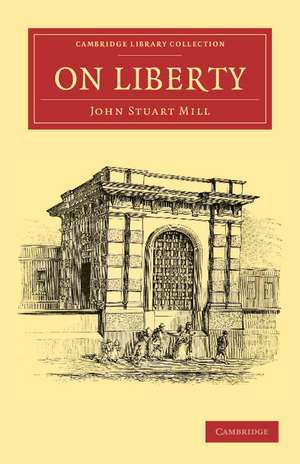
On Liberty: Cambridge Library Collection - Philosophy
Autor John Stuart Millen Limba Engleză Paperback – 21 dec 2011
Din seria Cambridge Library Collection - Philosophy
-
 Preț: 427.48 lei
 - 19%
 Preț: 433.94 lei
 -
 Preț: 428.22 lei
 -
 Preț: 340.96 lei
 -
 Preț: 289.38 lei
 - 19%
 Preț: 476.98 lei
 - 19%
 Preț: 441.48 lei
 -
 Preț: 272.70 lei
 -
 Preț: 374.18 lei
 - 19%
 Preț: 428.64 lei
 -
 Preț: 379.01 lei
 -
 Preț: 254.00 lei
 -
 Preț: 289.90 lei
 - 19%
 Preț: 436.07 lei
 -
 Preț: 252.85 lei
 -
 Preț: 346.62 lei
 -
 Preț: 346.78 lei
 - 19%
 Preț: 429.24 lei
 -
 Preț: 427.84 lei
 -
 Preț: 341.54 lei
 -
 Preț: 428.22 lei
 - 19%
 Preț: 435.61 lei
 -
 Preț: 436.82 lei
 -
 Preț: 288.22 lei
 -
 Preț: 339.28 lei
 - 19%
 Preț: 646.05 lei
 -
 Preț: 241.47 lei
 -
 Preț: 376.06 lei
 -
 Preț: 254.00 lei
 -
 Preț: 338.72 lei
 -
 Preț: 378.84 lei
 -
 Preț: 340.96 lei
 -
 Preț: 425.65 lei
 -
 Preț: 240.33 lei
Preț: 294.08 lei
Puncte Express: 441
Carte tipărită la comandă
Livrare economică 29 iunie-13 iulie
Specificații
ISBN-13: 9781108040839
ISBN-10: 1108040837
Pagini: 214
Dimensiuni: 140 x 216 x 12 mm
Greutate: 0.28 kg
Editura: Cambridge University Press
Colecția Cambridge University Press
Seria Cambridge Library Collection - Philosophy
Locul publicării:Cambridge, United Kingdom
ISBN-10: 1108040837
Pagini: 214
Dimensiuni: 140 x 216 x 12 mm
Greutate: 0.28 kg
Editura: Cambridge University Press
Colecția Cambridge University Press
Seria Cambridge Library Collection - Philosophy
Locul publicării:Cambridge, United Kingdom
V-ar putea interesa
-
 In Search of Lost Time, Vol 4Marcel Proust-17%Preț: 66.77 lei80.76 lei
 -
 Brave New WorldAldous HuxleyPreț: 56.55 lei
 -
 MythologiesRoland Barthes-39%Preț: 55.22 lei90.59 lei
 -
 Manufacturing ConsentEdward S. HermanPreț: 103.09 lei
 -
 Postwar: A History of Europe Since 1945Tony Judt-17%Preț: 103.63 lei125.09 lei
 -
 Preț: 87.87 lei
 -
 The Prime MinisterPeter Hennessy-19%Preț: 112.17 lei138.81 lei
 -
 The Revenge of GaiaJames Lovelock-20%Preț: 59.88 lei75.19 lei
 -
 HerzogSaul Bellow-19%Preț: 57.83 lei71.67 lei
 -
 The Call of the WildJack LondonPreț: 87.07 lei
 -
 On the Origin of SpeciesCharles Darwin-18%Preț: 53.37 lei65.31 lei
 -
 Preț: 205.26 lei
 -
 Things Fall ApartChinua AchebePreț: 141.44 lei
 -
 -18%Preț: 231.80 lei282.85 lei
 -
 A Brief History of TimeStephen HawkingPreț: 115.67 lei
 -
 The Book of Laughter and ForgettingMilan KunderaPreț: 71.46 lei
 -
 The Charterhouse of ParmaStendhalPreț: 127.29 lei
 -
 Men Without WomenErnest HemingwayPreț: 83.63 lei
 -
 The Story of ArtE. H. Gombrich-19%Preț: 243.72 lei301.78 lei
 -
 Preț: 372.88 lei
 -
 FlatlandEdwin A. AbbottPreț: 50.28 lei
 -
 The Count of Monte CristoAlexandre Dumas-27%Preț: 138.23 lei190.30 lei
 -
 -16%Preț: 92.88 lei111.23 lei
 -
 If On A Winter's Night A TravellerItalo Calvino-19%Preț: 87.38 lei107.90 lei
 -
 Sophie's WorldJostein GaarderPreț: 79.48 lei
Cuprins
1. Introductory; 2. Of the liberty of thought and discussion; 3. Of individuality, as one of the elements of well-being; 4. Of the limits to the authority of society over the individual; 5. Applications.
Descriere
Mill's 1859 essay defines liberty as an absolute individual right, and defends freedom of speech as a condition of progress.
Textul de pe ultima copertă
Discussed and debated from time immemorial, the concept of personal liberty went without codification until the 1859 publication of "On Liberty." John Stuart Mill's complete and resolute dedication to the cause of freedom inspired this treatise, an enduring work through which the concept remains well known and studied.
The British economist, philosopher, and ethical theorist's argument does not focus on "the so-called Liberty of the Will but Civil, or Social Liberty: the nature and limits of the power which can be legitimately exercised by society over the individual." Mill asks and answers provocative questions relating to the boundaries of social authority and individual sovereignty. In powerful and persuasive prose, he declares that there is "one very simple principle" regarding the use of coercion in society one may only coerce others either to defend oneself or to defend others from harm.
The new edition offers students of political science and philosophy, in an inexpensive volume, one of the most influential studies on the nature of individual liberty and its role in a democratic society."
The British economist, philosopher, and ethical theorist's argument does not focus on "the so-called Liberty of the Will but Civil, or Social Liberty: the nature and limits of the power which can be legitimately exercised by society over the individual." Mill asks and answers provocative questions relating to the boundaries of social authority and individual sovereignty. In powerful and persuasive prose, he declares that there is "one very simple principle" regarding the use of coercion in society one may only coerce others either to defend oneself or to defend others from harm.
The new edition offers students of political science and philosophy, in an inexpensive volume, one of the most influential studies on the nature of individual liberty and its role in a democratic society."
Notă biografică
John Stuart Mill (20 May 1806 - 8 May 1873), usually cited as J. S. Mill, was a British philosopher, political economist, and civil servant. One of the most influential thinkers in the history of classical liberalism, he contributed widely to social theory, political theory, and political economy. Dubbed "the most influential English-speaking philosopher of the nineteenth century",[8] Mill's conception of liberty justified the freedom of the individual in opposition to unlimited state and social control.[9]
Mill was a proponent of utilitarianism, an ethical theory developed by his predecessor Jeremy Bentham. He contributed to the investigation of scientific methodology, though his knowledge of the topic was based on the writings of others, notably William Whewell, John Herschel, and Auguste Comte, and research carried out for Mill by Alexander Bain. Mill engaged in written debate with Whewell.[10]
A member of the Liberal Party, he was also the second Member of Parliament to call for women's suffrage after Henry Hunt in 1832
John Stuart Mill was born at 13 Rodney Street in Pentonville, Middlesex, the eldest son of the Scottish philosopher, historian and economist James Mill, and Harriet Barrow. John Stuart was educated by his father, with the advice and assistance of Jeremy Benthamand Francis Place. He was given an extremely rigorous upbringing, and was deliberately shielded from association with children his own age other than his siblings. His father, a follower of Bentham and an adherent of associationism, had as his explicit aim to create a genius intellect that would carry on the cause of utilitarianism and its implementation after he and Bentham had died.
Mill was a notably precocious child. He describes his education in his autobiography. At the age of three he was taught Greek.[14] By the age of eight, he had read Aesop's Fables, Xenophon's Anabasis,[14] and the whole of Herodotus,[14] and was acquainted with Lucian, Diogenes Laërtius, Isocrates and six dialogues of Plato.[14] He had also read a great deal of history in English and had been taught arithmetic, physics and astronomy.
At the age of eight, Mill began studying Latin, the works of Euclid, and algebra, and was appointed schoolmaster to the younger children of the family. His main reading was still history, but he went through all the commonly taught Latin and Greek authors and by the age of ten could read Plato and Demosthenes with ease. His father also thought that it was important for Mill to study and compose poetry. One of Mill's earliest poetic compositions was a continuation of the Iliad. In his spare time he also enjoyed reading about natural sciences and popular novels, such as Don Quixote and Robinson Crusoe.