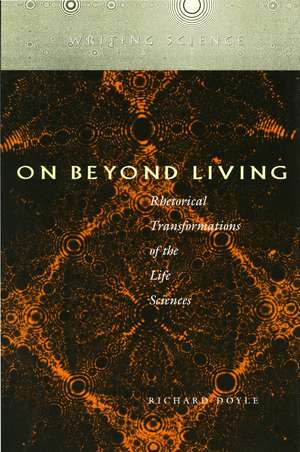
On Beyond Living: Rhetorical Transformations of the Life Sciences: Writing Science
Autor Richard Doyleen Limba Engleză Hardback – iul 1997
Bazându-ne pe arhivele seriei Writing Science de la Stanford University Press, suntem de părere că lucrarea On Beyond Living reprezintă o analiză critică esențială pentru înțelegerea modului în care limbajul modelează cercetarea științifică. Richard Doyle nu investighează doar biologia, ci „software-ul” retoric care a permis mutarea atenției de la organismul viu la secvențele de molecule. Autorul susține că metafore precum „codul genetic” nu au fost simple figuri de stil, ci instrumente care au reconfigurat ontologia vieții în termeni de procesare a informației.
Prin lecturi atente ale textelor semnate de pionieri precum Erwin Schrödinger sau Jacques Monod, cartea cartografiază triumful unei biologii „postvitale” care estompează granița dintre organisme și mașini. Putem afirma că acest volum completează perspectiva oferită de Who Wrote the Book of Life? de Lily Kay, adăugând o dimensiune teoretică poststructuralistă asupra modului în care retorica a precedat și a facilitat descoperirile tehnice. Spre deosebire de alte lucrări ale autorului, precum The King of the Golden River sau Jack The Giant Killer, care explorează ilustrația și folclorul victorian (atribuite adesea artistului omonim), acest volum își stabilește autoritatea în câmpul studiilor culturale și al istoriei științei.
Structura este riguroasă, îmbinând teoria contemporană cu discursul științific arid, oferind o genealogie a modului în care ființa umană a ajuns să fie echivalată cu datele. Este un text dens, cu un ton precis, care provoacă cititorul să vadă genomul nu ca pe o descoperire neutră, ci ca pe o construcție lingvistică și tehnologică complexă.
Din seria Writing Science
-
 Preț: 225.83 lei
 - 19%
 Preț: 727.83 lei
 -
 Preț: 304.99 lei
 -
 Preț: 239.38 lei
 - 19%
 Preț: 629.30 lei
 -
 Preț: 191.35 lei
 -
 Preț: 281.94 lei
 -
 Preț: 312.75 lei
 -
 Preț: 237.77 lei
 -
 Preț: 172.98 lei
 -
 Preț: 193.88 lei
 - 19%
 Preț: 482.49 lei
 -
 Preț: 309.63 lei
 -
 Preț: 296.56 lei
 -
 Preț: 238.23 lei
 -
 Preț: 238.94 lei
 -
 Preț: 519.81 lei
 - 20%
 Preț: 171.14 lei
 -
 Preț: 347.61 lei
 -
 Preț: 321.93 lei
 -
 Preț: 253.18 lei
 -
 Preț: 534.48 lei
 -
 Preț: 199.76 lei
 - 19%
 Preț: 555.39 lei
 -
 Preț: 120.04 lei
 -
 Preț: 189.39 lei
 -
 Preț: 275.20 lei
 -
 Preț: 263.27 lei
 - 19%
 Preț: 480.46 lei
 - 20%
 Preț: 251.77 lei
 -
 Preț: 175.72 lei
 -
 Preț: 228.73 lei
 -
 Preț: 192.19 lei
Preț: 703.96 lei
Preț vechi: 869.09 lei
-19%
Carte tipărită la comandă
Livrare economică 30 noiembrie-14 decembrie
Specificații
ISBN-10: 0804727643
Pagini: 188
Dimensiuni: 152 x 229 x 18 mm
Greutate: 0.45 kg
Ediția:1
Editura: Stanford University Press
Colecția Stanford University Press
Seria Writing Science
V-ar putea interesa
-
 Signal Transductionljsbrand M. Kramer-24%Preț: 577.28 lei761.25 lei
 -
 Moonwalking with EinsteinJoshua Foer-31%Preț: 64.81 lei93.26 lei
 -
 The Future of the MindMichio KakuPreț: 80.05 lei
 -
 Consciousness and the BrainStanislas DehaenePreț: 106.92 lei
 -
 Preț: 282.00 lei
 -
 Atlas of Human Brain ConnectionsMarco Catani-30%Preț: 823.41 lei1180.80 lei
 -
 -19%Preț: 364.93 lei448.61 lei
 -
 Brain and MusicStefan KoelschPreț: 369.66 lei
 -
 -23%Preț: 833.25 lei1082.15 lei
 -
 -19%Preț: 554.73 lei684.86 lei
 -
 Between Pacific Tides: Fifth EditionEdward RickettsPreț: 286.42 lei
 -
 Preț: 251.42 lei
 -
 Self-Generation: Biology, Philosophy, and Literature Around 1800Helmut Müller-SieversPreț: 534.48 lei
 -
 The Great Herbal of Leonhart FuchsFrederick G Meyer-23%Preț: 2167.45 lei2814.87 lei
 -
 The Princess NobodyAndrew LangPreț: 56.93 lei
 -
 The Power of HabitCharles DuhiggPreț: 86.85 lei
De ce să citești această carte
Recomandăm această carte cercetătorilor din domeniul filozofiei științei și studiilor culturale. Cititorul va câștiga o înțelegere profundă a modului în care metaforele informaționale au devenit fundamentul biologiei moderne. Este un instrument critic necesar pentru a decoda limbajul din spatele proiectelor genomice actuale, oferind un argument solid împotriva reducerii vieții la simple date digitale.
Despre autor
Richard Doyle este profesor asociat de retorică și studii științifice în cadrul Departamentului de Engleză de la Penn State University. Expertiza sa se situează la intersecția dintre științele vieții, tehnologie și teoria literară. Deși numele său este legat de tradiția artistică a familiei Doyle în alte contexte editoriale, în cadrul seriei Writing Science, el se distinge ca o voce critică în analiza discursului științific. Activitatea sa academică se concentrează pe modul în care limbajul și media transformă înțelegerea noastră despre natura umană și biologie.
Descriere scurtă
With careful readings of key texts from the history of molecular biology—such as those of Erwin Schrödinger, George Gamow, Jacques Monod, and François Jacob—the author maps out the complex relations between the practices of rhetoric and the technoscientific triumphs they accompanied, triumphs that bolstered a "postvital" biology that increasingly elides and questions the boundary between organisms and machines.
There have been many popular books, and a few academic ones, on the Human Genome Initiatives. On Beyond Living is a genealogy of these initiatives, a map of how we have come to equate human beings with "information." Melding contemporary theory with scientific discourse, it is certain to provoke discussion (and controversy) in the fields of cultural studies, theory, and science with its penetrating inquiries into the relations between rhetoric and technoscience.