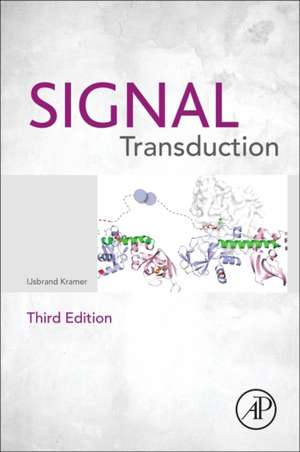
Signal Transduction
Autor ljsbrand M. Krameren Limba Engleză Hardback – 31 dec 2015
Evoluția biologiei celulare în ultimele decenii a transformat modul în care înțelegem comunicarea intercelulară, trecând de la simple observații ale răspunsurilor la stimuli la cartografierea unor rețele moleculare extrem de complexe. Putem afirma că ediția a treia a lucrării Signal Transduction, semnată de ljsbrand M. Kramer, reflectă fidel această maturizare a domeniului prin integrarea datelor istorice cu cele mai recente descoperiri în biochimie și farmacologie. Ne-a atras atenția în mod deosebit rigoarea cu care autorul tratează procesul de fosforilare, urmărind mecanismele de la bacterii până la om.
Structura volumului este una progresivă și enciclopedică, pornind de la o perspectivă istorică necesară pentru a înțelege cum a apărut conceptul de cuplaj stimul-răspuns. Cititorii familiarizați cu Introduction to Cellular Signal Transduction de Ari Sitaramayya vor aprecia aici profunzimea detaliilor anatomice și patologice care însoțesc descrierea cascadelor de semnalizare. Spre deosebire de manualele care se limitează la prezentarea căilor biochimice izolate, lucrarea publicată de ELSEVIER SCIENCE ancorează aceste procese în realități clinice, precum transformarea oncogenică, imunitatea înnăscută sau reglarea apetitului.
Organizarea pe capitole facilitează o navigare logică: după introducerea tehnică în mecanismele receptorilor, textul explorează semnalizarea specifică în contracția musculară, procesarea senzorială și metabolismul insulinei. Utilizarea nomenclaturii standardizate permite cercetătorilor să coreleze rapid informația din text cu bazele de date genetice online. Vizual, experiența de studiu este susținută de ilustrații conceptuale color, esențiale pentru înțelegerea modului în care structura moleculară determină funcția proteinelor și localizarea lor subcelulară.
Preț: 577.28 lei
Preț vechi: 761.25 lei
-24%
Carte tipărită la comandă
Livrare economică 23 noiembrie-07 decembrie
Specificații
ISBN-10: 0123948037
Pagini: 1104
Dimensiuni: 152 x 229 x 74 mm
Greutate: 1.38 kg
Ediția:3. Auflage.
Editura: ELSEVIER SCIENCE
V-ar putea interesa
-
 Resident Stem Cells and Regenerative TherapyRegina Coeli dos Santos Goldenberg-27%Preț: 843.41 lei1161.38 lei
 -
 Preț: 107.17 lei
 -
 -28%Preț: 433.06 lei605.28 lei
 -
 The Age of GenomesSteven Monroe LipkinPreț: 102.35 lei
 -
 -25%Preț: 820.58 lei1100.61 lei
 -
 Preț: 113.11 lei
 -
 -19%Preț: 76.47 lei93.87 lei
Public țintă
Established researchers as well as advanced undergraduate and graduate researchers, and scientists working in cell biology, pharmacology, immunology, and related fields.De ce să citești această carte
Această ediție este o resursă fundamentală pentru cercetătorii avansați și studenții la medicină sau biochimie. Oferă o sinteză rară între biologia moleculară și patologia clinică, ajutând cititorul să înțeleagă nu doar cum funcționează semnalizarea celulară, ci și cum defectele acestor mecanisme conduc la boli. Este un instrument de referință pentru cei care vizează dezvoltarea de noi intervenții terapeutice.
Descriere scurtă
Signal transduction third edition further elaborates on diverse signaling cascades within particular contexts such as muscle contraction, innate and adaptive immunity, glucose metabolism, regulation of appetite, oncogenic transformation and cell fate decision during development or in stem cell niches. The subjects have been enriched with descriptions of the relevant anatomical, histological, physiological or pathological condition.
- In-depth insight into a subject central to cell biology and fundamental to biomedicine, including the search for novel therapeutic interventions
- Essential signaling events embedded in rich physiological and pathological contexts
- Extensive conceptual colour artwork to assist with comprehension of key topics
- Special emphasis on how molecular structure determines protein function and subcellular localization
- Employment of unambiguous protein names (symbols) in agreement with leading protein- and gene databases, allowing the learner to extend his/her exploration on the web
Cuprins
Descriere
Notă biografică
Ijsbrand Kramer is a professor at the University of Bordeaux, working in the European Institute of Chemistry and Biology (IECB). He holds a Bachelors and Masters degree in BioMedicine from the University of Utrecht, The Netherlands, with a one year research-excursion in the Department of Cell Biology at the University of Liverpool, UK. He did his Ph.D. at the University of Amsterdam, in the Central Laboratory of Blood transfusion services (Stichting Sanquin) and worked as a post-doctoral fellow at the Hubrecht Laboratory in Utrecht and at the University of Washington in Seattle. He then took a lecturer position at the Department of Pharmacology at University College London, where he taught Signal Transduction (with Bastien Gomperts and Pether Tatham) and Pharmacology. Both teaching activities have been documented in textbooks: Signal Transduction (3 editions) and Receptor Pharmacology (CRC Press/Taylor Francis Group, 3 editions). Most of his research centers on the theme of inflammation, starting with neutrophils and the NADPH oxidase, synovial fibroblasts and destruction of the joint and more recently podosomes formation and extracellular matrix destruction in vascular endothelium. He moved to the University of Bordeaux for family reasons and switched from Pharmacology to Cell Biology, with a strong contribution to an introductory course for 1st year university students. Given the important teaching load and the general low level of student engagement in higher education he started to investigate the reasons for student failure (finding out about their expectations and attitudes) and the role of images and animations in comprehension. Scientific publications, web-based multimedia resources and dramatically enhanced retention rates (from 33 to 85%) are the fruits of these activities. At the same time he organized with University College London and Universitat Pompeu Fabra, Barcelona, summer schools on Receptor and Signalling Mechanism. He has been co-director of two European Programmes (Interbio and Transbio) that aimed at enhancing industrial innovation in the biomedical sector in the South West European Region (SUDOE).
For book/publicity purposes, image of the author by Maarten Kramer