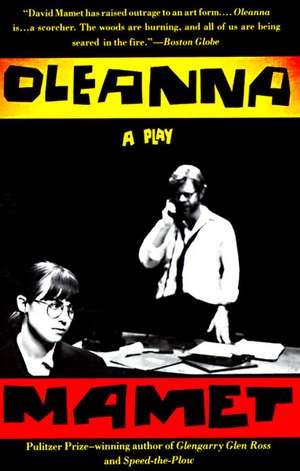
Oleanna: A Play
Autor David Mameten Limba Engleză Paperback – 30 apr 1993
Preț: 81.83 lei
Puncte Express: 123
Carte disponibilă
Livrare economică 17-31 iulie
Livrare prin curier în România Termenul estimat este afișat lângă disponibilitate.
Transport gratuit de la 400.00 lei Plată online sau ramburs, în funcție de opțiunile comenzii.
Retur gratuit în 14 zile Comandă securizată și suport în română.
Specificații
ISBN-13: 9780679745365
ISBN-10: 067974536X
Pagini: 96
Dimensiuni: 132 x 206 x 5 mm
Greutate: 0.1 kg
Ediția:Vintage Books.
Editura: Vintage Publishing
ISBN-10: 067974536X
Pagini: 96
Dimensiuni: 132 x 206 x 5 mm
Greutate: 0.1 kg
Ediția:Vintage Books.
Editura: Vintage Publishing
V-ar putea interesa
-
 Collected Papers on Greek TragedyT. C. W. Stinton-31%Preț: 1427.66 lei2071.05 lei
 -
 The Agon in EuripidesMichael Lloyd-27%Preț: 508.11 lei700.40 lei
 -
 -30%Preț: 656.74 lei934.91 lei
 -
 The Plays of Robert BrowningThomas J. Collins-18%Preț: 1201.50 lei1465.24 lei
 -
 The Story of Meriadoc, King of CambriaMildred Leake Day-18%Preț: 857.42 lei1045.63 lei
 -
 Mercurius Rusticans: A Critical EditionAnn J. Cotton-18%Preț: 771.04 lei940.29 lei
 -
 Modern Arabic Drama in EgyptMuhammad Mustafa BadawiPreț: 300.58 lei
 -
 Theatre, Court and City, 1595 1610Janette DillonPreț: 369.12 lei
 -
 Constructing Christopher MarloweJ. A. DowniePreț: 373.70 lei
 -
 A Critical Introduction to Twentieth-Century American DramaC. W. E. BigsbyPreț: 448.56 lei
 -
 Theatre and HumanismKent Cartwright-14%Preț: 702.40 lei816.74 lei
 -
 The Water Engine & Mr. HappinessDavid MametPreț: 91.38 lei
 -
 The Three SistersAnton Pavlovich ChekhovPreț: 106.26 lei
 -
 SchoolDavid MametPreț: 78.27 lei
 -
 The AnarchistDavid MametPreț: 88.51 lei
 -
 China DollDavid MametPreț: 88.18 lei
 -
 The Old NeighborhoodDavid MametPreț: 66.98 lei
 -
 Life in the TheatreDavid MametPreț: 83.41 lei
 -
 Medieval and Renaissance Drama in England, Volume 31S. P. CerasanoPreț: 505.88 lei
 -
 Modern Verse DramaArnold P. HinchliffePreț: 322.37 lei
 -
 Staging Beckett in Ireland and Northern IrelandDr David Tucker-24%Preț: 239.47 lei316.51 lei
 -
 The Dramaturgy of the SpectatorTatiana Korneeva-19%Preț: 528.28 lei652.20 lei
 -
 The Importance of Being EarnestOscar WildePreț: 31.83 lei
Notă biografică
David Mamet is a dramatist, director, novelist, poet, and essayist. He has written the screenplays for more than twenty films, including Heist, Spartan, House of Games, The Spanish Prisoner, The Winslow Boy, Wag the Dog, and The Verdict. His more than twenty plays include Oleanna, The Cryptogram, Speed-the-Plow, American Buffalo, Sexual Perversity in Chicago, and the Pulitzer Prize-winning Glengarry Glen Ross. Born in chicago in 1947, Mamet has taught at the Yale School of Drama, New York University, and Goddard College, and he lectures at the Atlantic Theater Company, of which he is a founding member.
Recenzii
"David Mamet has raised outrage to an art form. . . . Oleanna is…a scorcher. The woods are burning, and all of us are being seared in the fire.”—Boston Globe
“Mamet’s clenched fist to the gut—and intellect…a vicious and timely riff on sexual harassment and political correctness. Pinter, Albee, Miller. They’re all looking over Mamet’s shoulder.”—New York
“Wholly absorbing…a virtuoso performance…As if ripped right from the typewriter, it could not be more direct in its technique or incendiary in its ambition. . . . Oleanna is likely to provoke more arguments than any other play this year.”—The New York Times
“Our foremost master of the language of moral epilepsy.”—Newsweek
Textul de pe ultima copertă
In David Mamet's latest play, a male college instructor and his female student sit down to discuss her grades and in a terrifyingly short time become the participants in a modern reprise of the Inquisition. Innocuous remarks suddenly turn damning. Socratic dialogue gives way to heated assault. And the relationship between a somewhat fatuous teacher and his seemingly hapless pupil turns into a fiendishly accurate X ray of the meechanisms of power, censorship, and abuse.
Descriere
Descriere de la o altă ediție sau format:
Mamet's ground-breaking and controversial play on the male-female
power struggle, annotated with an introduction, notes and commentary.
"An ear for reproducing everyday language has long been David
Mamet's hallmark and he has now employed it to skewer the dogmatic,
puritannical streak which has become commonplace on and off the campus.
With Oleanna he continues an exploration of male-female conflicts begun
with Sexual Perversity in Chicago in 1974. Oleanna cogently
demonstrates that when free thought and dialogue are imperilled, nobody
wins." (Michael Wise, Independent)
In Oleanna "John and Carol go to it with hand-to hand combat
that amounts to a primal struggle for power. As usual with Mamet, the
vehicle for that combat is crackling, highly distilled dialogue
unencumbered by literary frills or phony theatrical ones." (Frank Rich,
International Herald Tribune)
Mamet's ground-breaking and controversial play on the male-female
power struggle, annotated with an introduction, notes and commentary.
"An ear for reproducing everyday language has long been David
Mamet's hallmark and he has now employed it to skewer the dogmatic,
puritannical streak which has become commonplace on and off the campus.
With Oleanna he continues an exploration of male-female conflicts begun
with Sexual Perversity in Chicago in 1974. Oleanna cogently
demonstrates that when free thought and dialogue are imperilled, nobody
wins." (Michael Wise, Independent)
In Oleanna "John and Carol go to it with hand-to hand combat
that amounts to a primal struggle for power. As usual with Mamet, the
vehicle for that combat is crackling, highly distilled dialogue
unencumbered by literary frills or phony theatrical ones." (Frank Rich,
International Herald Tribune)