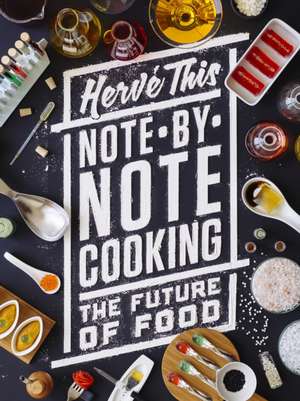
Note-By-Note Cooking
Autor Hervé This Traducere de Malcolm Debevoiseen Limba Engleză Hardback – 21 oct 2014
Diferența majoră între Note-By-Note Cooking și manualele de chimie industrială sau documentația oficială de laborator constă în viziunea sa radicală: autorul nu se limitează la a analiza alimentele existente, ci propune reconstrucția lor totală din compuși puri. Observăm o trecere de la analiza post-factum la sinteza creativă, unde ingredientele tradiționale sunt înlocuite cu molecule specifice, precum sotolonul pentru arome de curry sau tyrosina pentru profunzime gustativă. Abordarea diferă de Food Flavors de Henryk Jelen prin pragmatismul direcției — în timp ce Jelen se concentrează pe proprietățile senzoriale care influențează acceptarea produselor, Hervé This oferă un cadru de lucru pentru a genera structuri noi. Cartea este organizată riguros pe piloni tehnici: Formă, Consistență, Gust și Miros. Apreciem în mod deosebit capitolul dedicat consistenței, unde autorul corelează structura fizică a matricii alimentare cu eliberarea aromelor, demontând mitul conform căruia chimia în bucătărie este artificială sau dăunătoare. Spre deosebire de Understanding Natural Flavors, care explorează limitele a ceea ce constituie un ingredient „natural”, această lucrare publicată de Columbia University Press îmbrățișează compușii sintetizați în laborator ca fiind soluția sustenabilă pentru viitorul populației globale. Textul este unul tehnic, dar accesibil, culminând cu o anexă de rețete care demonstrează că această „bucătărie notă-cu-notă” nu este doar o teorie abstractă, ci o metodă de lucru cu rezultate vizibile și reproductibile.
Preț: 175.27 lei
Carte disponibilă
Livrare economică 09-23 noiembrie
Livrare express 23-29 octombrie pentru 31.73 lei
Specificații
ISBN-10: 0231164866
Pagini: 272
Ilustrații: 55
Dimensiuni: 159 x 211 x 30 mm
Greutate: 0.47 kg
Editura: Columbia University Press
V-ar putea interesa
-
 Preț: 276.33 lei
 -
 The Homoerotics of OrientalismJoseph BoonePreț: 368.01 lei
 -
 Preț: 258.97 lei
 -
 Archival Resources of Republican China in North AmericaChengzhi Wang-23%Preț: 603.01 lei783.13 lei
 -
 Theatre and Evolution from Ibsen to BeckettKirsten Shepherd–barrPreț: 515.43 lei
 -
 Adult Sibling RelationshipsGeoffrey GreifPreț: 265.70 lei
 -
 With Dogs at the Edge of LifeColin Dayan-23%Preț: 561.53 lei729.26 lei
 -
 Roberto Bolaño′s Fiction – An Expanding UniverseChris AndrewsPreț: 263.87 lei
 -
 Preț: 453.07 lei
 -
 Pulitzer′s Gold – A Century of Public Service Journalism 2eRoy Harris, Jr.Preț: 350.45 lei
 -
 Ethical Loneliness – The Injustice of Not Being HeardJill Stauffer-23%Preț: 645.85 lei838.77 lei
 -
 Must We Divide History Into Periods?Jacques Le GoffPreț: 168.60 lei
 -
 The Silent Qur`an and the Speaking Qur`an – Scriptural Sources of Islam Between History and FervorMohammad Ali Amir–moezzi-23%Preț: 430.75 lei559.41 lei
 -
 Birth of a TheoremCédric VillaniPreț: 140.86 lei
 -
 Negri on Negri: in conversation with Anne DufourmentelleAntonio NegriPreț: 467.01 lei
 -
 NormandyOlivier WieviorkaPreț: 237.77 lei
 -
 Living with RobotsPaul DumouchelPreț: 286.52 lei
 -
 Good GovernmentPierre RosanvallonPreț: 325.88 lei
 -
 Preț: 128.57 lei
 -
 Dodge RoseJack CoxPreț: 89.49 lei
 -
 Finnley WrenPhilip WyliePreț: 107.54 lei
 -
 Catching the Big FishDavid LynchPreț: 132.77 lei
De ce să citești această carte
Recomandăm această carte profesioniștilor din industria alimentară și bucătarilor avangardiști care doresc să înțeleagă arhitectura moleculară a gustului. Cititorul câștigă o perspectivă tehnică asupra modului în care pot fi create arome noi folosind compuși puri, optimizând în același timp valoarea nutrițională și sustenabilitatea preparatelor. Este un ghid practic despre viitorul gastronomiei, dincolo de limitele ingredientelor organice tradiționale.
Cuprins
Tables, Figures, and Color Plates
Introduction: Why the Need for Note-by-Note Cooking Should Be Obvious
1. Shape
Polyhedrons
Nonpolyhedral Solids
The Fable of the Man with the Golden Brain
2. Consistency
A Woeful Misunderstanding
The Relation Between Consistency and Flavor
Not Everything Has to Be Soft
Thinking in Physical Terms
Additives
Contrasting Consistencies
3. Taste
Misdirection and Misperception
The Impossible Description of Unknown Tastes
Sapid Compounds
Mineral Salts
Organic and Mineral Acids
Amino Acids and Their Derivatives
Sugars
Alcohols and Polyols
Intense Sweeteners
Flavoring Agents
Bitterants
Matrix Effects
A New Basic Taste
4. Odor
Manipulating Odorant Compounds
Methods of Extraction and Processing
Natural, Same as Natural, Artificial
Volatility, Threshold Perception, Toxic Risk
A Lexicon of Basic Culinary Odors
Odorant Compounds
On the Properties of Odorigenic Extracts and Compositions
Trigeminal Sensations
5. Color
The Eye Precedes the Palate
Legally Approved Coloring Agents
Natural Versus Artificial Redux
6. Artistic Choice and Culinary Nomenclature
Substance and Form
The Construction of Flavors
Naming Dishes
The First Generation of Note-by-Note Menus
7. Nutrition, Toxicology, Market Dynamics, Public Interest
The Mixed Blessings of Abundance
A World of Plenty, Filled with Danger
Selection and Supply of Compounds
Political Considerations
Appendix: A Few Recipes
Index