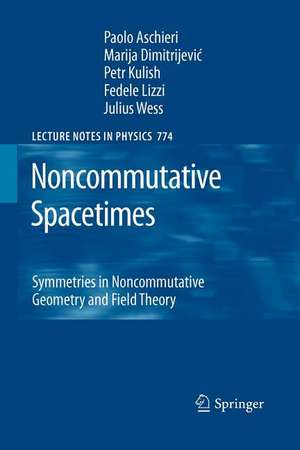
Noncommutative Spacetimes
Autor Paolo Aschieri, Marija Dimitrijevic, Petr Kulish, Fedele Lizzi, Julius Wessen Limba Engleză Paperback – 29 noi 2011
Preț: 485.88 lei
Puncte Express: 729
Carte tipărită la comandă
Livrare economică 09-23 decembrie
Livrare prin curier în România Termenul estimat este afișat lângă disponibilitate.
Transport gratuit pentru acest produs Plată online sau ramburs, în funcție de opțiunile comenzii.
Retur gratuit în 14 zile Comandă securizată și suport în română.
Specificații
ISBN-13: 9783642242496
ISBN-10: 3642242499
Pagini: 216
Ilustrații: XIV, 199 p. 10 illus.
Dimensiuni: 155 x 235 x 12 mm
Greutate: 0.34 kg
Ediția:2009
Editura: Springer
Locul publicării:Berlin, Heidelberg, Germany
ISBN-10: 3642242499
Pagini: 216
Ilustrații: XIV, 199 p. 10 illus.
Dimensiuni: 155 x 235 x 12 mm
Greutate: 0.34 kg
Ediția:2009
Editura: Springer
Locul publicării:Berlin, Heidelberg, Germany
V-ar putea interesa
-
 Mathematical Methods for Physicists: A Comprehensive GuideGeorge B. Arfken-30%Preț: 675.06 lei969.76 lei
 -
 Information, Physics, and ComputationMarc Mézard-30%Preț: 676.71 lei970.50 lei
 -
 Essentials of Econophysics ModellingFrantisek Slanina-11%Preț: 485.80 lei545.84 lei
 -
 Probabilities in PhysicsClaus Beisbart-30%Preț: 805.46 lei1146.73 lei
 -
 Preț: 252.86 lei
 -
 -8%Preț: 512.94 lei557.54 lei
 -
 Quantum GravityCarlo Rovelli-11%Preț: 689.32 lei774.51 lei
 -
 Introduction to Strings and BranesPeter West-8%Preț: 548.71 lei596.41 lei
 -
 Self-Organised CriticalityGunnar Pruessner-11%Preț: 706.28 lei793.57 lei
 -
 Star Maps for BeginnersTheodore LevittPreț: 89.02 lei
 -
 The Little Book of String TheorySteven S. GubserPreț: 127.76 lei
 -
 Introduction to Mathematica® for PhysicistsAndrey GrozinPreț: 473.71 lei
 -
 Mathematical PhysicsSadri Hassani-17%Preț: 580.99 lei699.98 lei
 -
 Towards the Mathematics of Quantum Field TheoryFrédéric Paugam-18%Preț: 1165.29 lei1421.09 lei
 -
 -15%Preț: 442.16 lei520.18 lei
Public țintă
ResearchCuprins
Deformed Field Theory: Physical Aspects.- Differential Calculus and Gauge Transformations on a Deformed Space.- Deformed Gauge Theories.- Einstein Gravity on Deformed Spaces.- Deformed Gauge Theory: Twist Versus Seiberg#x2013;Witten Approach.- Another Example of Noncommutative Spaces: #x03BA;-Deformed Space.- Noncommutative Geometries: Foundations and Applications.- Noncommutative Spaces.- Quantum Groups, Quantum Lie Algebras, and Twists.- Noncommutative Symmetries and Gravity.- Twist Deformations of Quantum Integrable Spin Chains.- The Noncommutative Geometry of Julius Wess.
Textul de pe ultima copertă
There are many approaches to noncommutative geometry and to its use in physics. This volume addresses the subject by combining the deformation quantization approach, based on the notion of star-product, and the deformed quantum symmetries methods, based on the theory of quantum groups.
The aim of this work is to give an introduction to this topic and to prepare the reader to enter the research field quickly. The order of the chapters is "physics first": the mathematics follows from the physical motivations (e.g. gauge field theories) in order to strengthen the physical intuition. The new mathematical tools, in turn, are used to explore further physical insights. A last chapter has been added to briefly trace Julius Wess' (1934-2007) seminal work in the field.
The aim of this work is to give an introduction to this topic and to prepare the reader to enter the research field quickly. The order of the chapters is "physics first": the mathematics follows from the physical motivations (e.g. gauge field theories) in order to strengthen the physical intuition. The new mathematical tools, in turn, are used to explore further physical insights. A last chapter has been added to briefly trace Julius Wess' (1934-2007) seminal work in the field.