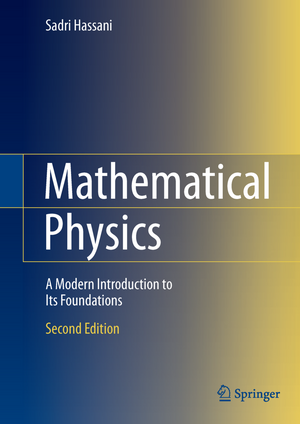
Mathematical Physics
Autor Sadri Hassanien Limba Engleză Hardback – 19 aug 2013
Observăm în această a doua ediție a Mathematical Physics o rafinare necesară a echilibrului dintre rigoarea formală și intuiția fizică. Autorul, Sadri Hassani, deschide volumul cu o explorare a spațiilor vectoriale, elemente fundamentale care dictează progresia întregului curs. Structura celor peste 1200 de pagini reflectă o tranziție logică de la metodele analitice clasice — analiza Fourier și complexă, ecuații diferențiale și funcții Green — către conceptele avansate de geometrie diferențială și topologie, esențiale în teoriile contemporane ale câmpurilor. Suntem de părere că această ediție aduce un plus de valoare semnificativ prin rescrierea integrală a unor capitole și introducerea de tematici noi, precum fibratele (fibre bundles) și reprezentările algebrelor Clifford. Această abordare permite o trecere fluidă de la mecanica cuantică la teoriile de etalon (gauge theories), oferind cititorului un aparat matematic complet. Comparativ cu Mathematics of Classical and Quantum Physics de Frederick W Byron, care oferă un tratament unificat dar mai sintetic, lucrarea lui Hassani este mult mai detaliată și extinsă în ceea ce privește structurile algebrice și varietățile, fiind orientată către o înțelegere de profunzime a fundamentelor. În contextul operei sale, Mathematical Physics reprezintă vârful de lance al cursurilor de metode matematice scrise de Sadri Hassani. Dacă în Mathematical Methods autorul se concentra pe nevoile studenților din anii terminali de licență, acest volum extinde orizontul către cercetarea avansată, păstrând totodată acele note istorice și exemple rezolvate care fac abstractizarea mai accesibilă. Tonul este precis, academic, dar ancorat permanent în utilitatea practică a formalismului matematic pentru fizician.
Preț: 577.72 lei
Preț vechi: 696.05 lei
-17%
Carte disponibilă
Livrare economică 09-23 noiembrie
Livrare express 24-30 octombrie pentru 104.20 lei
Specificații
ISBN-10: 3319011944
Pagini: 1205
Ilustrații: 160 illus.
Dimensiuni: 184 x 258 x 54 mm
Greutate: 2.45 kg
Ediția:2nd ed. 2013. Ausgabe von 2013
Editura: Springer Verlag GmbH
Locul publicării:Cham, Switzerland
V-ar putea interesa
-
 Preț: 374.71 lei
 -
 -8%Preț: 505.94 lei549.93 lei
 -
 Mathematical MethodsSadri Hassani-15%Preț: 627.95 lei738.76 lei
 -
 Nonequilibrium Physics at Short Time ScalesKlaus Morawetz-18%Preț: 991.63 lei1209.30 lei
 -
 -15%Preț: 625.57 lei735.96 lei
 -
 Lost Causes in and beyond PhysicsR.F. StreaterPreț: 371.73 lei
 -
 New Directions in Statistical PhysicsLuc T. Wille-18%Preț: 986.99 lei1203.64 lei
 -
 MATHEMATICAL FEYNMAN PATH INTEGRALS &...Mazzucchi SoniaPreț: 305.88 lei
 -
 DYNAMICAL SYMMETRYWulfman Carl E-18%Preț: 971.42 lei1184.66 lei
 -
 GEOMETRI FORMULA OF CLASSIC & QUAT MECHAAl Giovanni Giachetta Et-18%Preț: 850.07 lei1036.67 lei
 -
 MATRIX CALCUL KRONECKER (2ND ED)Steeb Willi-Hans-15%Preț: 549.04 lei645.93 lei
 -
 PROB & SOL IN QUAN COMPUT & QUAN 3EDSteeb Willi-Hans-15%Preț: 589.42 lei693.44 lei
 -
 -18%Preț: 788.01 lei960.98 lei
 -
 NOISY OSCILLATOR, THEGitterman MoshePreț: 341.49 lei
 -
 DIFFERENTIAL MANIFOLDSBaillon Paul-15%Preț: 527.64 lei620.75 lei
 -
 PHYSICS OF REALITY, THEAmoroso Richard L-18%Preț: 1187.54 lei1448.23 lei
 -
 SPACE, TIME AND MATTERSen Dipak KPreț: 442.61 lei
 -
 CPT AND LORENTZ SYMMETRYKostelecky V Alan-18%Preț: 725.83 lei885.16 lei
 -
 -18%Preț: 714.03 lei870.76 lei
 -
 -18%Preț: 1236.03 lei1507.36 lei
 -
 -15%Preț: 567.89 lei668.10 lei
 -
 VISUAL AND COMPUTATIONAL PLASMA PHYSICSHsu James J Y-15%Preț: 612.66 lei720.78 lei
Public țintă
GraduateDe ce să citești această carte
Această carte este recomandată studenților la masterat și doctorat care doresc să stăpânească limbajul matematic al fizicii moderne. Dincolo de metodele standard de calcul, volumul oferă acces la concepte de geometrie diferențială și teoria grupurilor, fundamentale pentru înțelegerea relativității generale și a fizicii particulelor. Câștigați o perspectivă riguroasă, susținută de exemple clare, asupra modului în care structurile matematice definesc realitatea fizică.
Despre autor
Sadri Hassani este profesor emerit de fizică la Illinois State University, fiind recunoscut pentru abilitatea sa de a preda concepte matematice complexe într-o manieră structurată și pedagogică. Opera sa este diversă, cuprinzând atât manuale tehnice de referință precum Mathematical Methods, cât și lucrări care analizează relația dintre știință și societate, așa cum este Quanta in Distress sau From Atoms to Galaxies. Prin volumele sale, Hassani promovează o alfabetizare științifică riguroasă, demontând adesea interpretările eronate ale fizicii cuantice în cultura populară.
Cuprins
Recenzii
“Mathematical Physics: A Modern Introduction to Its Foundations is intended for adoption in a course or a sequence of ‘methods of mathematical physics’ at the advanced undergraduate or beginning graduate level. … this is a textbook that every library must have (with a large number of copies in reserve), and it will be a valuable aid for committed students, researchers, and instructors of science and applied mathematics.” (Eleftherios Kirkinis, SIAM Review, Vol. 56 (3), September, 2014)
“Hassani uses the concept of a vector space to build all of the discussions for the basic ideas about the subject. … Hassani writes well and does a very good job of connecting the various topics presented. Each of the 30 chapters contains clear, worked-out examples and problems at the end. Summing Up: Recommended. Upper-division undergraduates and graduate students.” (E. Kincanon, Choice, Vol. 51 (11), July, 2014)
Some praise for the previous edition:
PAGEOPH [Pure and Applied Geophysics]
Review by Daniel Wojcik, University of Maryland
"This volume should be a welcome addition to any collection. The book is well written and explanations are usually clear. Lives of famous mathematicians and physicists are scattered within the book. They are quite extended, often amusing, making nice interludes. Numerous exercises help the student practice the methods introduced. … I have recently been using this book for an extended time and acquired a liking for it. Among all the available books treating mathematical methods of physics this one certainly stands out and assuredly it would suit the needs of many physics readers."
ZENTRALBLATT MATH
Review by G.Roepstorff, University of Aachen, Germany
"… Unlike most existing texts with the same emphasis and audience, which are merely collections of facts and formulas, the present book is more systematic, self-contained, with a level of presentation that tends to be more formal and abstract. This entails proving a large number of theorems, lemmas, and corollaries, deferring most of the applications that physics students might be interested in to the example sections in small print. Indeed, there are 350 worked-out examples and about 850 problems. … A very nice feature is the way the author intertwines the formalism with the life stories and anecdotes of some mathematicians and physicists, leading at their times. As is often the case, the historical view point helps to understand and appreciate the ideas presented in the text. … For the physics student in the middle of his training, it will certainly prove to be extremely useful."
THE PHYSICIST
Review by Paul Davies, Orion Productions, Adelaide, Australia
"I am pleased to have so many topics collected in a single volume. All the tricks are there of course, but supported by sufficient rigour and substantiation to make the dedicated mathematical physicist sigh with delight."
EMS [EUROPEAN MATHEMATICAL SOCIETY] NEWSLETTER
"This book is a condensed exposition of the mathematics that is met in most parts of physics. The presentation attains a very good balance between the formal introduction of concepts, theorems and proofs on one hand, and the applied approach on the other, with many examples, fully or partially solved problems, and historical remarks. An impressive amount of mathematics is covered. … This book can be warmly recommended as a basic source for the study of mathematics for advanced undergraduates or beginning graduate students in physics and applied mathematics, and also as a reference book for all working mathematicians and physicists."
Notă biografică
Textul de pe ultima copertă
This second edition is a substantial revision of the first one with a complete rewriting of many chapters and the addition of new ones, including chapters on algebras, representation of Clifford algebras and spinors, fiber bundles, and gauge theories. The spirit of the first edition, namely the balance between rigor and physical application, has been maintained, as is the abundance of historical notes and worked out examples that demonstrate the "unreasonable effectiveness of mathematics" in modern physics.
Einstein has famously said, "The most incomprehensible thing about nature is that it is comprehensible." What he had in mind was reiterated in another one of his famous quotes concerning the question of how " ... mathematics, being after all a product of human thought, is so admirably appropriate to the objects of reality." It is a question that comes to everyone's mind when encountering the highly abstract mathematics required for a deep understanding of modern physics. It is the experience that Eugene Wigner so profoundly described as "the unreasonable effectiveness of mathematics in the natural sciences."