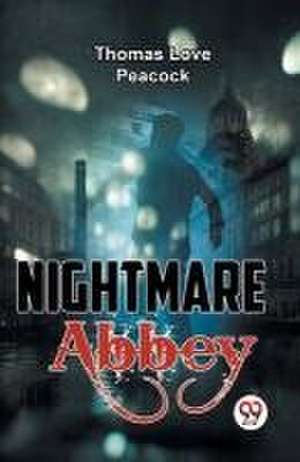
Nightmare Abbey
Autor Thomas Love Peacocken Limba Engleză Paperback – 7 ian 2023
| Toate formatele și edițiile | Preț | Express |
|---|---|---|
| Paperback (27) | 37.71 lei 3-5 săpt. | +4.99 lei 7-13 zile |
| DOUBLE 9 BOOKSLLP – 7 ian 2023 | 60.34 lei 3-5 săpt. | +4.99 lei 7-13 zile |
| BROADVIEW PR – 9 apr 2007 | 183.42 lei 3-5 săpt. | |
| CREATESPACE – | 37.71 lei 3-5 săpt. | |
| CreateSpace Independent Publishing Platform – | 40.46 lei 3-5 săpt. | |
| CREATESPACE – | 43.00 lei 3-5 săpt. | |
| CreateSpace Independent Publishing Platform – | 43.40 lei 3-5 săpt. | |
| CreateSpace Independent Publishing Platform – 28 noi 2015 | 51.28 lei 3-5 săpt. | |
| CREATESPACE – | 54.48 lei 3-5 săpt. | |
| Echo Library – 19 mar 2006 | 55.86 lei 3-5 săpt. | |
| – | 56.31 lei 3-5 săpt. | |
| Renard Press Ltd – 28 iul 2021 | 58.75 lei 3-5 săpt. | +7.26 lei 7-13 zile |
| CREATESPACE – | 58.90 lei 3-5 săpt. | |
| Bibliotech Press – 30 iun 2012 | 62.23 lei 3-5 săpt. | |
| – | 63.91 lei 3-5 săpt. | |
| – | 64.04 lei 3-5 săpt. | |
| – | 64.27 lei 3-5 săpt. | |
| Echo Library – 30 iun 2003 | 65.13 lei 3-5 săpt. | |
| – | 70.17 lei 3-5 săpt. | |
| CREATESPACE – | 78.94 lei 3-5 săpt. | |
| – | 81.40 lei 3-5 săpt. | |
| HardPress Publishing – 27 ian 2013 | 85.88 lei 38-44 zile | |
| W. W. Norton & Company – 27 mar 2024 | 87.56 lei 3-5 săpt. | |
| CREATESPACE – | 89.42 lei 3-5 săpt. | |
| Echo Library – 30 apr 2006 | 118.27 lei 3-5 săpt. | |
| Sovereign – 25 aug 2018 | 118.69 lei 6-8 săpt. | |
| LIGHTNING SOURCE INC – 16 mai 2018 | 119.55 lei 17-23 zile | |
| TREDITION CLASSICS – 30 noi 2011 | 126.13 lei 6-8 săpt. | |
| Hardback (1) | 712.18 lei 27-39 zile | |
| Cambridge University Press – 22 dec 2016 | 712.18 lei 27-39 zile |
Preț: 60.34 lei
Puncte Express: 91
Preț estimativ în valută:
10.67€ • 12.33$ • 9.23£
10.67€ • 12.33$ • 9.23£
Carte disponibilă
Livrare economică 18 aprilie-02 mai
Livrare express 04-10 aprilie pentru 14.98 lei
Specificații
ISBN-13: 9789358593129
ISBN-10: 9358593121
Pagini: 84
Dimensiuni: 215 x 138 x 6 mm
Greutate: 0.11 kg
Editura: DOUBLE 9 BOOKSLLP
ISBN-10: 9358593121
Pagini: 84
Dimensiuni: 215 x 138 x 6 mm
Greutate: 0.11 kg
Editura: DOUBLE 9 BOOKSLLP
V-ar putea interesa
-
 Sense and SensibilityJane AustenPreț: 24.60 lei
 -
 Northanger AbbeyJane AustenPreț: 24.60 lei
 -
 Three Gothic NovelsHorace Walpole-19%Preț: 72.98 lei90.20 lei
 -
 EmmaJane Austen-26%Preț: 47.36 lei63.58 lei
 -
 Preț: 95.90 leiNou
 -
 Castle RackrentMaria Edgeworth-20%Preț: 32.94 lei41.17 lei
 -
 The Picture of Dorian GrayOscar WildePreț: 33.29 lei
 -
 Pride and PrejudiceJane Austen-18%Preț: 34.83 lei42.31 lei
 -
 A Modest Proposal and Other Satirical WorksJonathan SwiftPreț: 23.75 lei
 -
 CandideVoltairePreț: 30.08 lei
 -
 Vanity Fair: Official ITV tie-in editionWilliam Makepeace Thackeray-21%Preț: 46.03 lei58.62 lei
 -
 Rape of the LockAlexander PopePreț: 24.70 lei
 -
 -26%Preț: 52.08 lei69.99 lei
 -
 -20%Preț: 156.21 lei195.27 leiRecomandat
 -
 Preț: 49.97 lei
 -
 Oliver TwistCharles DickensPreț: 36.19 lei
 -
 The Importance of Being EarnestOscar WildePreț: 31.83 lei
 -
 Preț: 31.77 lei
 -
 The Thomas Love Peacock CollectionThomas Love Peacock-26%Preț: 70.93 lei96.03 lei
Recenzii
This 1818 novel is set in a former abbey whose owner, Christopher Glowry, is host to visitors who enjoy his hospitality and engage in endless debate. Among these guests are figures recognizable to Peacock’s contemporaries, including characters based on Lord Byron and Samuel Taylor Coleridge. Mr. Glowry’s son Scythrop (also modeled on a famous Romantic, Peacock’s friend Percy Bysshe Shelley) locks himself up in a tower where he reads German tragedies and transcendental philosophy and develops a “passion for reforming the world.” Disappointed in love, a sorrowful Scythrop decides the only thing to do is to commit suicide, but circumstances persuade him to instead follow his father in a love of misanthropy and Madeira. In addition to satire and comic romance, Nightmare Abbey presents a biting critique of the texts we view as central to British romanticism.
This Broadview edition includes a critical introduction and a range of illuminating contemporary documents on the novel’s reception and its German and British literary contexts. A selection of Peacock’s critical and autobiographical writings is also included.
“Though considered a light—even a slight—novel, Nightmare Abbey requires of its ideal reader extensive knowledge of the age that produced it: the literature, the politics, and, not least, the personalities associated with English Romanticism. Lisa Vargo succeeds admirably in bringing this rich background—masterfully synthesized in a critical introduction and amply documented in notes and appendices—to bear on the work for which its author is best known and which, as much as any other work of the period, engages English Romantic culture in all its numerous contradictory forms. Vargo has brought together the resources of recent Peacock scholarship and an invaluable archive of excerpted contemporary texts to produce an edition of Peacock’s most characteristic—and arguably his best—novel for a new generation of readers.” — James Mulvihill, University of Alberta
“Published in the same year as Mary Shelley’s Frankenstein, Thomas Love Peacock’s Nightmare Abbey is not just a burlesque of the Gothic novel, but a sustained critique of what he regarded as ‘the darkness and misanthropy of modern literature.’ His witty satire on ‘the spirit of the age’ can best be understood through an awareness of its complex intertextual relations with other works of Romantic literature. To help promote such awareness, Lisa Vargo’s new Broadview edition provides a thoughtful introduction, detailed explanatory notes, and an exceptionally rich array of contextual material drawn from contemporary reviews of the novel, translations of earlier German literature, relevant works by Godwin, Coleridge, Shelley, Byron, and Hazlitt, and, perhaps equally important, Peacock’s own critical and autobiographical writings.” — Nicholas A. Joukovsky, Pennsylvania State University
This Broadview edition includes a critical introduction and a range of illuminating contemporary documents on the novel’s reception and its German and British literary contexts. A selection of Peacock’s critical and autobiographical writings is also included.
“Though considered a light—even a slight—novel, Nightmare Abbey requires of its ideal reader extensive knowledge of the age that produced it: the literature, the politics, and, not least, the personalities associated with English Romanticism. Lisa Vargo succeeds admirably in bringing this rich background—masterfully synthesized in a critical introduction and amply documented in notes and appendices—to bear on the work for which its author is best known and which, as much as any other work of the period, engages English Romantic culture in all its numerous contradictory forms. Vargo has brought together the resources of recent Peacock scholarship and an invaluable archive of excerpted contemporary texts to produce an edition of Peacock’s most characteristic—and arguably his best—novel for a new generation of readers.” — James Mulvihill, University of Alberta
“Published in the same year as Mary Shelley’s Frankenstein, Thomas Love Peacock’s Nightmare Abbey is not just a burlesque of the Gothic novel, but a sustained critique of what he regarded as ‘the darkness and misanthropy of modern literature.’ His witty satire on ‘the spirit of the age’ can best be understood through an awareness of its complex intertextual relations with other works of Romantic literature. To help promote such awareness, Lisa Vargo’s new Broadview edition provides a thoughtful introduction, detailed explanatory notes, and an exceptionally rich array of contextual material drawn from contemporary reviews of the novel, translations of earlier German literature, relevant works by Godwin, Coleridge, Shelley, Byron, and Hazlitt, and, perhaps equally important, Peacock’s own critical and autobiographical writings.” — Nicholas A. Joukovsky, Pennsylvania State University
Descriere
Descriere de la o altă ediție sau format:
This 1818 novel is set in a former abbey whose owner, Christopher Glowry, is host to visitors who enjoy his hospitality and engage in endless debate. Among these guests are figures recognizable to Peacock’s contemporaries, including characters based on Lord Byron and Samuel Taylor Coleridge. Mr. Glowry’s son Scythrop (also modeled on a famous Romantic, Peacock’s friend Percy Bysshe Shelley) locks himself up in a tower where he reads German tragedies and transcendental philosophy and develops a “passion for reforming the world.” Disappointed in love, a sorrowful Scythrop decides the only thing to do is to commit suicide, but circumstances persuade him to instead follow his father in a love of misanthropy and Madeira. In addition to satire and comic romance, Nightmare Abbey presents a biting critique of the texts we view as central to British romanticism.
This Broadview edition includes a critical introduction and a range of illuminating contemporary documents on the novel’s reception and its German and British literary contexts. A selection of Peacock’s critical and autobiographical writings is also included.
This 1818 novel is set in a former abbey whose owner, Christopher Glowry, is host to visitors who enjoy his hospitality and engage in endless debate. Among these guests are figures recognizable to Peacock’s contemporaries, including characters based on Lord Byron and Samuel Taylor Coleridge. Mr. Glowry’s son Scythrop (also modeled on a famous Romantic, Peacock’s friend Percy Bysshe Shelley) locks himself up in a tower where he reads German tragedies and transcendental philosophy and develops a “passion for reforming the world.” Disappointed in love, a sorrowful Scythrop decides the only thing to do is to commit suicide, but circumstances persuade him to instead follow his father in a love of misanthropy and Madeira. In addition to satire and comic romance, Nightmare Abbey presents a biting critique of the texts we view as central to British romanticism.
This Broadview edition includes a critical introduction and a range of illuminating contemporary documents on the novel’s reception and its German and British literary contexts. A selection of Peacock’s critical and autobiographical writings is also included.
Cuprins
Acknowledgements
Introduction
A Note on the Text
Thomas Love Peacock: A Brief Chronology
Nightmare Abbey
Appendix A: The Reception of Nightmare Abbey
Introduction
A Note on the Text
Thomas Love Peacock: A Brief Chronology
Nightmare Abbey
Appendix A: The Reception of Nightmare Abbey
- The Monthly Review 90 (November 1819)
- The Literary Gazette 99 (12 December 1818)
- The Tickler 1.1 (1 December 1818)
- The European Magazine, and London Review 75 (March1819)
- From James Spedding, Edinburgh Review 68 (January1839)
- The Examiner (28 May 1837)
- From Karl Grosse, “The Marquis of Grosse” (1796)
- From Johann Wolfgang von Goethe, Stella: A Play for Lovers (1774)
- From Johann Wolfgang von Goethe, The Sorrows of Young Werther (1774)
- From Thomas Jefferson Hogg, Memoirs of Prince Alexy Haimatoff (1813)
- From William Godwin, An Enquiry Concerning Political Justice (1793)
- From William Godwin, Mandeville: A Tale of the Seventeenth Century in England (1817)
- From Samuel Taylor Coleridge, The Statesman’s Manual (1816)
- From Samuel Taylor Coleridge, Biographia Literaria (1817)
- Percy Bysshe Shelley, “Hymn to Intellectual Beauty” (1817)
- From Percy Bysshe Shelley, Author’s Preface to The Revolt of Islam (1818)
- From George Gordon, Lord Byron, The Corsair, A Tale (1814)
- From George Gordon, Lord Byron, Childe Harold’s Pilgrimage, Canto the Fourth (1818)
- George Gordon, Lord Byron, Dedication to Don Juan (1833)
- From William Hazlitt, The Spirit of the Age (1825)
- From “An Essay on Fashionable Literature” (1818)
- From “The Four Ages of Poetry” (1820)
- From “French Comic Romances” (1835)
- Preface to Volume 57 of Bentley’s Standard Novels (1837)
- “Recollections of Childhood: The Abbey House” (1837)
- From “Memoirs of Percy Bysshe Shelley” (1860)
Notă biografică
Thomas Love Peacock (1785-1866) was a poet and author. He was a prolific writer, mainly of satirical works, and many critics believe that he and Percy Bysshe Shelley influenced one another's works, since they were close friends. Peacock's father died in reduced circumstances, so the young Thomas was largely self-educated, and spent much time in the Reading Room at the British Library studying the best classical texts he could find. Whilst much of his poetry and essays were very well-thought of, Peacock is best known today for his novels Nightmare Abbey and Melincourt.